Clear Pricing
Zero Lock-Ins. Absolute Integrity. Here are our rates — all of them.
Pay only for the concrete work you receive.
That last? It is the reason we are usually your least expensive option — because expert work directed at the source of the problem often takes only a few hours, and only those hours are what you pay for.
One of seven pages on money, time and choosing help. Browse all 69.
Related links
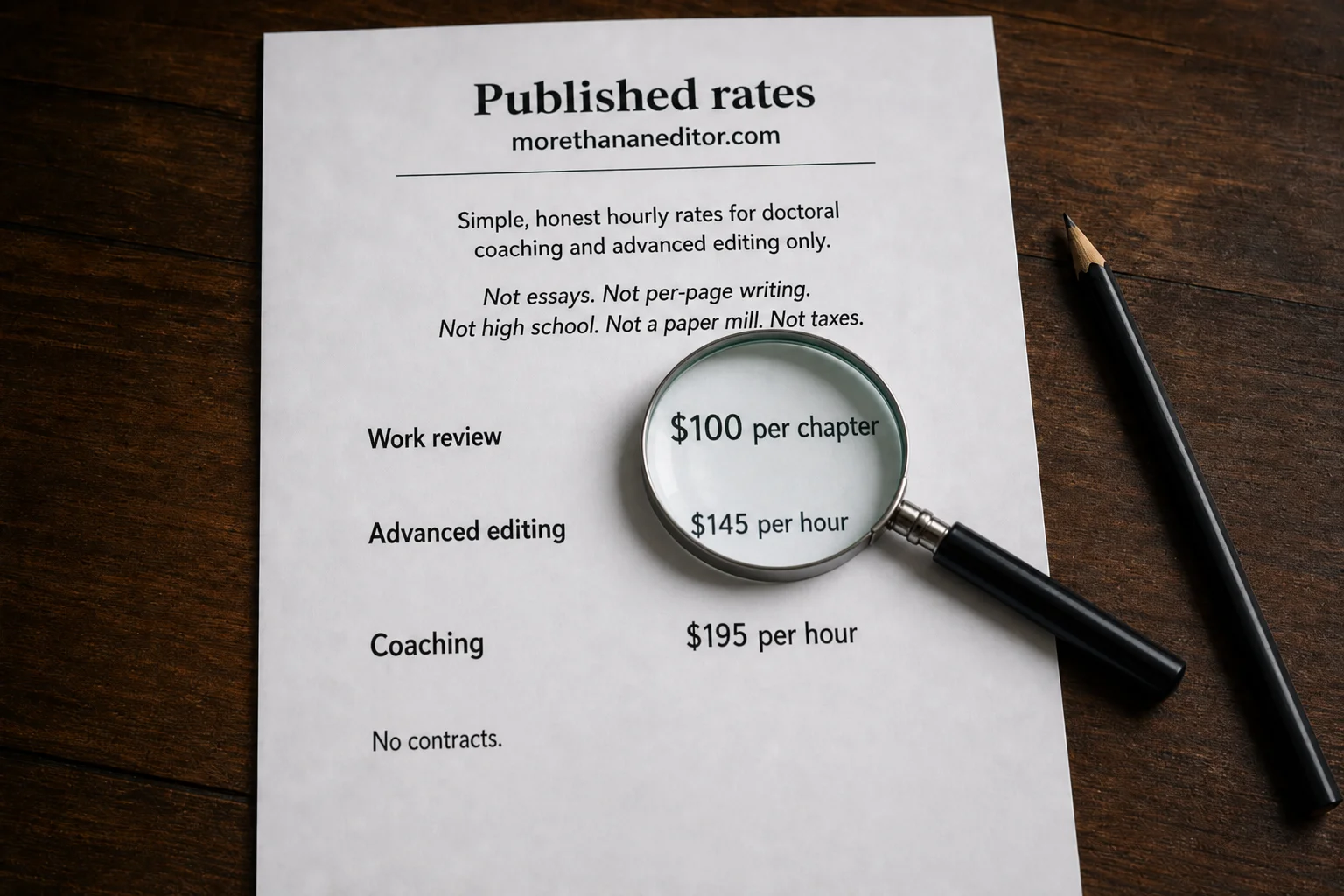
All our prices are published and up front. We also tell you what we will not charge you for. No game playing. Thus? No asking for a quote to find out a rate, no consultation-before-numbers, no minimum engagement.
If you are comparing us with anybody else, the useful question is not what they charge — it is whether they will tell you before you contact them.
On this page
Start here
Why our rates look high
The rates
Common questions
Elsewhere on the site
At a glance
All figures in US dollars, and firm to 31 December 2026. Each row links to the full rate table in that section.
| Service | Rate | Link |
|---|---|---|
| Work review, per chapter or part chapter | $100 | What will mine cost? |
| Work review, full thesis | $450 flat | What will mine cost? |
| Work review follow-up call | No further charge. Included in review price. | What will mine cost? |
| Advanced editing — graduate, team | $145 / hr | Advanced editing |
| Advanced editing — graduate, principal | $245 / hr | Advanced editing |
| Advanced editing — post-doctoral / publication, team | $155 / hr | Advanced editing |
| Advanced editing — post-doctoral / publication, principal | $265 / hr | Advanced editing |
| Coaching and analysis, team | $195 / hr | Coaching & sherpa |
| Coaching and analysis, principal | $330 / hr | Coaching & sherpa |
| Sherpa time — coordination and review | $145 / hr | Coaching & sherpa |
| Content creation, post-doctoral, team | $225 / hr | Coaching & sherpa |
| Content creation, post-doctoral, principal | $380 / hr | Coaching & sherpa |
| Remediation — initial diagnostic review | $450 flat | Remediation |
| Remediation, team | $250 / hr | Remediation |
| Remediation, principal | $425 / hr | Remediation |
| Data cleaning | $155 / hr | Data services |
| Data coding and themes | $155 / hr | Data services |
| Formula and macro writing | $195 / hr | Data services |
| Statistical analysis | On inquiry | Data services |
| Consulting and corporate | See commercial rates | Consulting & corporate |
| Book work | See commercial rates | Book work |
| Administrative time, including overhead | $95 / hr | Administrative |
Discounts. 5% for military service; prepaid blocks from $1,000 at 5%, 6% at $2,500; they stack. Credits for referrals, testimonials, and acting as a reference. Details
What does dissertation help actually cost?
A work review — where we read your material and tell you what is wrong with it — is $100 per chapter or $450 for a full thesis. Most reviews are partial, so $100 to $300 is what most people actually pay.
Beyond that we bill hourly, and the hours depend entirely on what your dissertation needs. A diagnosis and a plan is a few hours. A dissertation with alignment problems in every chapter is more. We do not know until we have looked, and neither do you.
For comparison: university writing centers publish editor rates from about two cents a word to twenty. A fifty-thousand-word dissertation at six cents is three thousand dollars — about fifteen hours at our rate.
Our hourly rate is much higher than other published rates. So much higher one asks: "Why?"
Why we publish an hourly rate that looks high
First, because we always tell the truth, and that is what top-quality people — people who can really think — cost per hour. Quality counts — and it counts a huge amount at the doctoral and post-doc level. Like our competitors, we could quote per word and appear, at first glance, to look cheaper. We do not, because it would hide what you are actually buying. Quality thinking.
The mills sell words. What we sell is thinking about a specific reader, and text built to deliver what that reader needs.
An hourly rate is uncomfortable to publish. It invites exactly the comparison you are making now. But it is the honest number for the value of what you are buying.
It is also a signal, and we mean it as one. A rate like ours pays for the best: people who think accurately, logically, and holistically. Which in turn means people who can find problems and diagnose them rapidly and accurately. We have not been editors in any conventional sense for years. We are not looking to pad our bills with work a competent AI can do — indeed, if you need editing, we tell you which AI models currently do it best, and we give you the most effective prompts, at no charge. We sell the real work: the hard work of diagnosis, true comprehension, the plan that follows, and its execution. We are with you every step of the way. And in the real world, we are still less expensive.
That capability is rare. Most people who can edit cannot diagnose. Most who can diagnose have never worked at doctoral level. Most who have both are inside universities, think tanks, or advanced institutes — and not available to you.
Nor is your Chair necessarily one of them. Chairing is a demanding skill set in its own right, but it is not the skill set of a diagnostician. It can be the launch pad for developing one. It is not the same thing.
Which raises a hard question. What is an hour of your own time worth right now? Or, better, with a doctorate in hand? Now reflect on the tuition still running, the career on hold, and the same chapter coming back for the fourth time. Then ask what an hour is worth from someone who can end that.
Cheaper billable hours — often bolstered by cents-per-word rates — are actually more expensive. If you are billed four times the hours, it is far from cheaper. It also takes longer.
We bill few hours, and that is deliberate
Between highly competent people and the best available tools, the work takes less time than it used to. We are not troubled by that.
We would rather have a client who finishes and tells somebody than squeeze an extra hour out of somebody who is already stretched. Our work, primarily, comes from referrals — from candidates, and from their Chairs. That only happens if the arithmetic worked out in your favor.
An editing practice that needs to bill you more hours is a practice with a pipeline problem. You should not be paying for it. Conversely, we actually need to bill less, to create the value that gets us that referral.
One thing to watch when comparing
A low hourly rate quoted alongside a separate per-word charge is two bills, not one. Together they are frequently more than a higher hourly rate on its own — and you will not see it until the invoice.
Ask anyone you are considering: what is the total, and what is it for?
We are not the most expensive option. Do the arithmetic.
University writing centers publish editor rates. They run from about two cents a word to twenty.
A fifty-thousand-word dissertation at six cents a word is three thousand dollars. At fifteen cents it is seven and a half thousand.
A hundred thousand words? Double. Every one of those numbers doubles, because per-word pricing scales with length and nothing else.
Diagnosis does not. A longer dissertation does not have twice the structural problems — it usually has the same ones, spread over more pages. The framework either holds or it does not. The research questions either match the instrument or they do not. Finding that out takes the same time whether your draft is fifty thousand words or a hundred and fifty.
We charge for the diagnosis and the plan that follows it, not for the page count.
At our rate, three thousand dollars is about fifteen hours of coaching. Seven and a half thousand is nearly forty.
Which matters because of what those hours buy.
A per-word editor reads every word and charges for every word — and you hope they do so with comprehension. That is what per-word pricing means. We do not, because we are usually not doing that work. When we do, we know what we are looking for. Why? Because we have already analyzed your central thesis, research questions and theoretical framework. That understanding allows us to read in a highly targeted manner.
Most stalled dissertations need a diagnosis and a plan, not a full pass. Finding out why a chapter is not landing takes a few hours.
If the dissertation does need a full rewrite? It likely means it has alignment issues throughout — and fixing the alignment in every chapter needs some hard, penetrating thinking, not a rewrite by machine or human.
If the dissertation is truly in crisis throughout? We will analyze the — often interactive — causes, work with you to disentangle the reasoning and alignment issues and help you get your dissertation back on track. If you then need basic editing of the new text you write? You can use the prompts we supply for a good AI editing pass, followed by our final — yes, human — review.
You are not paying us to read your dissertation. You are paying us to know what to look for.
What will mine cost?
We cannot tell you until we have looked at it. Nor can you.
If you could diagnose the problem accurately yourself, you would not need us. That is not a criticism — you are immersed in the material, you have been for years, and the whole difficulty is that it looks fine from where you stand.
So we look first, and then we tell you.
| Work review, per chapter or part chapter | $100 |
| Work review, full thesis | $450 |
| Follow-up call | No further charge. Included in review price. |
We review your existing material and produce a written report identifying the issues we see and what we would propose doing about them. It is independent — we are not affiliated with your institution, and the report reflects our own assessment.
Clients frequently tell us this review is more detailed than feedback they have had elsewhere. If you are not comfortable with what it says — and that is often the case — we strongly recommend discussing that discomfort with us during the post-review conversation, and before going any further.
An honest review of unfinished work is rarely pleasant reading. Far better to have that conversation now than after you have committed time and money.
Then a scheduled call, normally up to an hour, to go through the findings.
The purpose of the whole process is alignment
The best coach or editor in the world is the wrong one for you if they do not share your vision, do not grasp what you are trying to accomplish, or simply do not think the way you think. That is not a failing on either side, and it is far better discovered now than three chapters in.
By the end you should know whether we are right for you — and we should have a clear enough picture of your project to estimate scope, budget and timeline.
Some highly specialized services do not require this process. We will tell you if yours is one of them.
We do not simply take clients on. Here is how the process actually works.
Why we do not use contracts
Zero lock-ins. Absolute integrity. Pay only for the concrete work you receive.
We believe contracts in the academic coaching and editing space are fundamentally unethical.
The university system — even more so online — is already a machine that often feels like it is designed to bleed you white through continuous enrollment fees and endless review delays. Governments setting time limits on how long they will fund a degree before cutting it off only make it worse. Whatever the reasons, and whatever the stakes, we refuse to participate in that or any other kind of financial hostage-taking.
We do not use contracts. We never have and we never will.
We do not even ask for a deposit to get started. We will do up to four hours of work on nothing but your word. If what comes back is not what you wanted, those four hours are the full extent of your commitment.
If you do not like a specific milestone, or decide our further input is not what your project needs? Bully for you. You are never locked in. You can take your files and move on to another editor immediately, and you will go with our full blessing.
Academic coaching requires a real collaborative partnership. Fit counts. If the fit is not good, forcing an unhappy candidate to keep using us because they signed something is bad practice and bad ethics. We stand entirely behind the quality of our work — if we are not delivering undeniable value, you should not be paying us.
You will sign one thing when we take you on: a confirmation that you have read our Terms & Conditions, which goes to every new client as part of onboarding. That is an acknowledgment, not a commitment. It does not oblige you to buy anything, and it does not oblige us to take your project.
What will you tell me that other editors will not?
Most operators in this market assert that they can help you. Very few tell you what they can actually do — and we have yet to find one that tells you what it cannot.
"Full academic support." "Comprehensive packages." "Tailored to your specific needs." "We are here as long as you need us." None of it answers the question you actually need answered before you hand over your research: what can this person or this team genuinely do, and where do they stop?
We answer that in the only way that means anything. We give the advice away and let you judge it.
Documentation beats conversation. There is no paywall on this site, no freewall, no irritating captcha puzzle, no subscription, and no download to unlock. Nearly 70 pages of specific, experience-based advice — free, and staying that way.
No paywall, no freewall. Free in the way human beings mean free — no irritating captcha puzzle, no download to unlock, no course, no trial, and no follow-up sequence if you click something.
Read Scholarly Style, or Navigating AI Detection Paranoia, or Purging Citation Contamination. A few minutes reading the pages on this site will tell you whether we know what we are talking about. If we do not, you have lost a few minutes and nothing else.
That is a test no assertion can pass and no scam mill can fake. You can also read our own published work, which is the same test applied to whether we can write.
And some of what is here is critical information and advice thrown off by our work and provided freely. It also stands in for the quality of our thinking — and the care we take.
The Ghost in the Machine is a dated log of what AI models did to real text in our own work. Twelve failures, with the passages before and after. We have not found anybody else keeping one. On our site we discuss how to work around these problems as well.
Predatory journal detector. Is this journal real? is a checking tool we built because our own clients needed it. Free, printable, and it recommends no product we sell.
A Deal with the Devil: Writing in the Age of AI — an experience-based guide to the highs and the many lows of writing with AI.
AI and institutional policy, written for people drafting policy — most of whom will never be clients.
And what to hand somebody who asks about AI, written for librarians, who are being asked constantly and given very little to work with.
None of that is marketing. It is what our work throws off — as writers as well as coaches — and we publish it freely because we think there is a need. Especially so in the case of AI and writing.
So, in public:
- What we do well, and what we would take on without hesitation.
- What we do not do at all. We will not write work you submit for academic credit — not a chapter, not a section, no matter the deadline. See Academic Honesty.
- What we bring specialists in for, rather than pretending to expertise we do not have.
- When we would tell you to go elsewhere, including when the honest answer is that you do not need to hire anyone.
The text factories and scam mills lie about who is writing your material — stock photography, automated spinners, promises of the world for very little. The legitimate practices say little about scope, less about limits, and nothing about what they subcontract.
We would rather treat you as a colleague than as an enrollment number, and colleagues get told the truth about what you can and cannot do for them.
...how much is this actually going to cost me?
The honest answer is that it depends on what your work needs, and we cannot know that until we have read some of it. Anyone quoting a firm number before reading your writing is guessing, has priced in a margin large enough to cover being wrong, or — worse — will simply ghost you when the work turns out to be harder than the price they quoted.
We bill by the hour, and we think that is the fairer way round.
A flat fee has to be set high enough to cover the worst project the seller expects to see. That means straightforward work subsidizes difficult work, and if your project is in reasonable shape you pay for somebody else's disaster. Hourly billing means you pay for the hours your own work actually takes.
The trade is that you cannot know the total in advance. We handle that in three ways:
- The work review comes first, so we both know what we are dealing with before you commit to anything.
- We give you our estimate in writing, with what we propose doing, and you approve it before we start.
- We will not carry more than four unpaid hours for anyone. You will never discover a bill you did not see coming.
...where do I start, and what does that cost?
A conversation, which is free. Tell us what is going on. We are not going to sell you anything on that call — we often spend it telling people what they do not need.
Then a work review, which is paid.
Rates: $100 per chapter or part chapter · $450 whole thesis We read what you have and write you a report: what we think is blocking you, what we would propose doing, and roughly what that would take.
A follow-up call to go through it is included in the price. The report is where we set out what we found. The call is where we go over those findings, clarify anything that is not clear, and address whatever other questions arise.
| Work review, per chapter or part chapter | $100 |
| Work review, whole thesis | $450 |
Most reviews are partial — two or three chapters is common — so $100 to $300 is the figure most people actually pay.
It is also independent. We are not part of your institution, we have no stake in your committee's decisions, and the report carries what we actually think.
A warning about that report. Clients regularly tell us it is more detailed than any feedback they have had elsewhere, and that it makes uncomfortable reading. That is often the case. If it is, say so, and we will talk it through before you decide anything.
...but you are more expensive than the alternatives
You will find hourly rates lower than ours. Here is the part that matters more than the rate.
The hours are fewer, and that is the whole point.
Five years ago a chapter arriving for editing needed a full mechanical pass — grammar, punctuation, consistency, formatting — before anyone could look at whether the argument held. That was most of the bill, and it was the least valuable part of it.
We do not sell that any more. AI does it, we will tell you which model and give you the prompts, and it costs you nothing — or at most? A few dollars in AI model tokens. What we bill for is what is left: whether your argument holds, whether your methodology fits your questions, whether Chapter 5 claims more than Chapter 4 delivered.
Higher rate. Far fewer hours. Lower total.
A service quoting you $80 an hour for twelve hours of work costs more than we do at $145 for four — and one of those two spent eight hours on something a machine now does in ten minutes.
Compare totals, not rates. Ask anyone quoting you what they will actually spend the time on.
...what are your actual rates?
Two rates are shown for most services. Team is the work of your sherpa and our specialists. Principal is the founder working directly on your project. The next section explains why you almost certainly want the first.
There is no basic editing tier, and that is deliberate. Grammar, punctuation, and mechanical consistency are now done well by AI, and we will tell you which model to use and give you the prompts, at no charge. What we sell is the human work that follows.
Advanced editing
Structural assessment, argument coherence, citation verification, and the judgment calls no automated pass can make.
Rates: Graduate $145 / $245 · Post-doctoral $155 / $265 per hour
| Team | Principal | |
|---|---|---|
| Graduate | $145 | $245 |
| Post-doctoral / publication | $155 | $265 |
Coaching and sherpa time
Rates: Coaching $195 / $330 · Sherpa $145 · Content creation $225 / $380 per hour
| Team | Principal | |
|---|---|---|
| Coaching and analysis | $195 | $330 |
| Sherpa time — coordination and review | $145 | — |
| Content creation, post-doctoral | $225 | $380 |
Remediation — rejected and bounced work
For dissertations returned by a Chair, a committee, or School Review.
Rates: Diagnostic review $450 flat · Remediation $250 / $425 per hour
| Team | Principal | |
|---|---|---|
| Initial diagnostic review (required, flat fee) | $450 | — |
| Remediation, single combined rate | $250 | $425 |
This is the hardest work we do, and it is priced accordingly. Editing and coaching cannot be meaningfully separated when a dissertation has failed, so one rate covers both. See our rejected and bounced dissertations page.
Data services
Rates: Cleaning & coding $155 / hr · Macros $195 / hr · Statistical analysis on inquiry
| Team | Principal | |
|---|---|---|
| Data cleaning | $155 | — |
| Data coding and themes | $155 | — |
| Formula and macro writing | $195 | — |
| Statistical analysis | — | On inquiry |
Statistical work is quoted per project because scope varies enormously. It includes advice on experimental design. Availability is limited at times.
Consulting and corporate rates, book work, rush charges, and credits and discounts are published on Commercial rates, rush & credits.
Administrative
Rates: $95 / hr administrative · Calls bill at the rate of the service they concern
| Administrative time, including overhead | $95 |
Calls bill at the rate of whatever service they concern, in fifteen-minute increments, with preparation included. Billing and scheduling calls bill at the administrative rate.
...why is there a higher rate for the founder, and do I need it?
Almost certainly not, and we would rather say so here than after you have paid for it.
Your sherpa works for you. The founder works for us.
Your sherpa holds your project, coordinates whatever specialists you need, reviews their work against what your argument actually requires, and coaches you through the parts that need thinking rather than fixing. That is your project being worked on, and it is billed.
The founder is quality control on us, and you are never charged for it. He spot-checks work routinely before it goes out, he is the final review whenever a sherpa is uncertain, and he reads a dissertation thoroughly when it has truly serious problems — or when either your sherpa or you have flagged something.
That last part is worth knowing: you can trigger it. Raise a concern and it gets the founder's full attention, at no additional charge.
He also takes ordinary team-level work from time to time, deliberately, to stay current with what institutions and committees are actually doing. When he does that work it bills at the team rate, because that is what the work is.
The principal rate covers genuinely principal-level work, and it is on this page so you know the option exists. If something goes badly wrong, if your methodology is genuinely unusual, or if a dissertation is in serious trouble, the person ultimately responsible for MTAE can be put on your project directly.
Below post-doctoral level that is unnecessary in well over nine cases in ten. If yours is one of the exceptions we will tell you, and tell you why.
What we will not do is bill you at the principal rate for work the team should be doing. If the result would be the same, you would only be paying more for it.
...how do I know what I will actually be billed?
Every invoice comes with a work summary: what was done, how long it took, who did it, and whether any of it was at rush rates. Rush charges appear as separate lines. Where more than one person worked on your project, hours are listed separately by person.
Small pieces of work are added together. A real week might look like this:
- 12 minutes of sherpa time drafting explanatory emails
- 2 hours 25 minutes of advanced editing
- a 40-minute coaching call, including preparation
That invoices at 3 hours 17 minutes, each line at its own rate. Not three and a half, not four.
If you are ever unsure whether something is billable, ask. We would rather answer the question than have you wondering.
...what if I cannot afford this?
Then read on, because some of what follows may be more use to you than hiring us.
Everything on this site is free and always will be. The material on Scholarly Style, Navigating AI Detection Paranoia, Purging Citation Contamination and the rest is not a teaser. A candidate who is capable and short of money can work through those pages, apply what is there, and fix a great deal without spending anything with us. We would rather that happened than have you go without help.
But be honest with yourself about time.
What is on these pages is many years of experience set down as plainly as we can manage. It is genuinely free and it genuinely works. What it cannot do is give you back the time it will take you to absorb and apply it — weeks, months, and in some cases longer.
Napoleon famously — if perhaps apocryphally — told his marshals they could ask him for anything but time. A candidate three weeks from a deadline is in the same position. If you have months, use the site and keep your money. If you have days, what you are short of is not knowledge — it is hours. Hours are what we can actually sell you.
Buy the review and stop there. A $100 chapter review sets out what is wrong. Nothing obliges you to hire us to fix it, and some people take the report and do the work themselves. That is a legitimate use of us and we are not offended by it.
Buy hours in small amounts. No minimum, no retainer. If you can afford two hours, buy two hours.
Prepaid blocks start at $1,000. Work continues without pausing for an invoice to clear, you hold priority in the work queue, and at busy periods you get calendar priority and longer bookings. Blocks also carry a 5% discount on all billings — 6% at $2,500 or more. Useful if you have substantial work ahead; not required.
And we will tell you if you do not need us. If your work is in better shape than you think, or the problem is one you can solve without paying anyone, the review will tell you so. We have talked people out of hiring us more often than you might expect.
And if the money is the only thing standing between you and finishing — say so. In cases of real need, a conversation with our founder has been fruitful for some candidates in the past.
We make no promises. But we would rather you have the conversation than stop for want of one.
One of seven pages on money, time and choosing help. Browse all 69.

