A Practical, Day-to-Day Reference for Chairs
...and Committee Members and Mentors
"Ask me for anything but time."
— Napoleon, famously if perhaps apocryphally, to his marshals
Years of experience inform us that beyond all the many burdens Chairs carry? The biggest one? Time.
The corollary? Ignored by all too many? A Chair's time is a Chair's scarcest resource.
If you arrived with one specific question rather than the whole reference, it may already be answered on Questions Supervisors Ask.
Back to What Help Do You Need?
One of three pages on supervising a doctorate. Browse all 69.
Related links
- Questions Supervisors Ask
- What Your Chair's Comments Actually Mean
- AI Questions for Supervisors
- Navigating AI Detection Paranoia
- Purging Citation Contamination
- The Literature Review
- Real or Scam?
- Editor, Advanced Editor, or Coach?
- Human-in-the-Loop Structural Refinement
- Academic Honesty
- About Us
- Working With Your Chair and Committee
- Doctoral Triage & Defense Directory
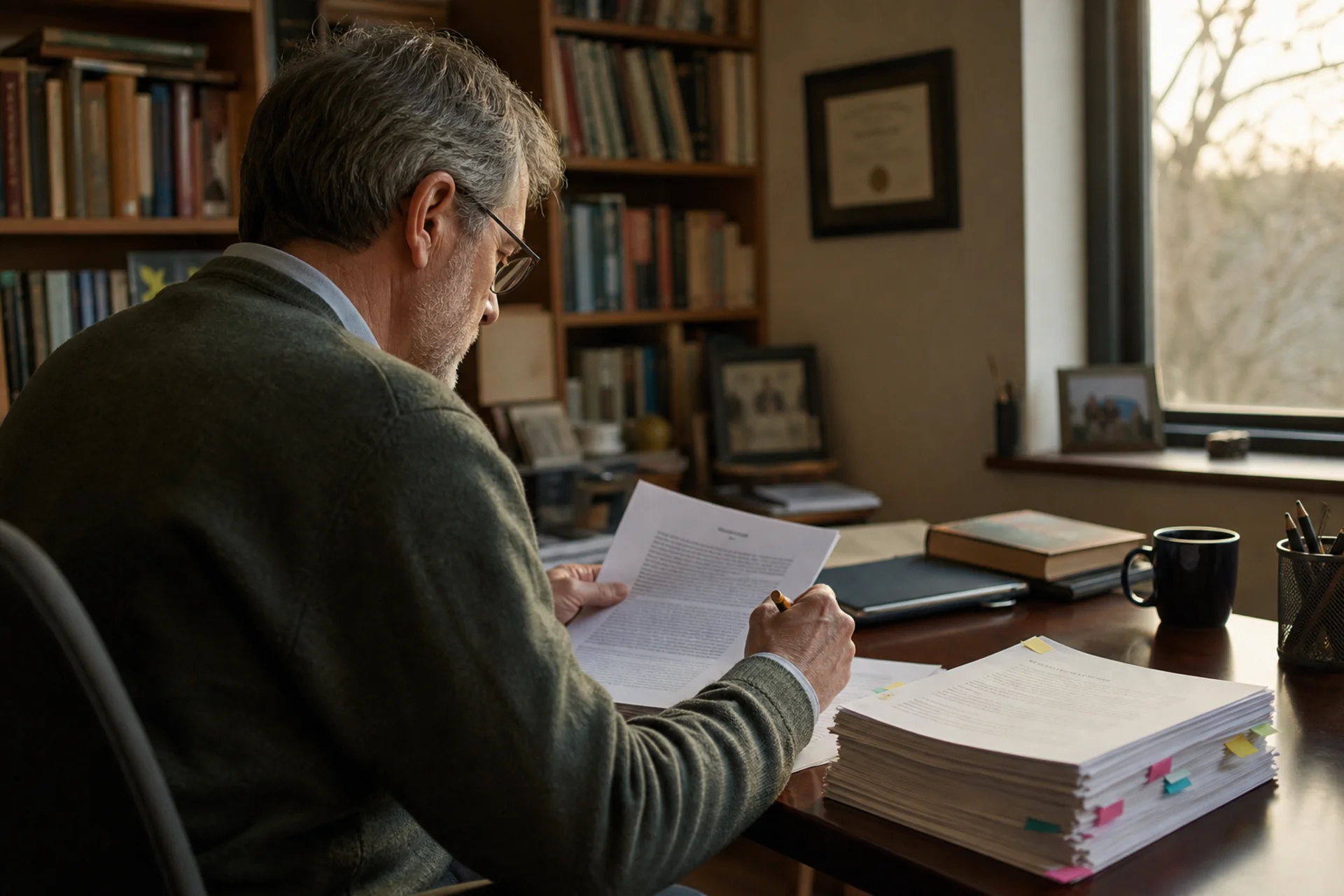
Every bit of material below? Built on that critical recognition.
Everything is designed for instant use, and for the 'to the point' credibility you need when answering the tediously repetitive questions Chairs field. And for the ongoing, and very real, challenge of providing answers that are sufficiently simple, clear, and effective in conveying complex material.
We have one request, and it is only a request. If you forward any material from this page? We would be grateful if the attribution line came with it.
Sharing personally is free whether you attribute or not. Publishing in print is different — free to publish, no payment required, but attribution is required, as is standard practice.
Use what is useful to you — today, tomorrow, and next year...
Snippets of Chair Wisdom — concise, on-point material you can forward to a candidate as it stands. No preamble needed, organized by where they are stuck.
Cutting Candidate Fog — a set of handy tools for you: ways to handle the situations that have no good script yet.
Answers to repetitive issues — translations of the feedback phrases candidates most often misunderstand.
AI, Use, Abuse, and how to handle it — what a detector score actually means, what it does not mean, and how to raise a concern without making an accusation.
What AI models actually do to text — the long and ugly list
Every item below is documented, with a date, a named model, and the text before and after. None is hypothetical.
- DELETION: It deletes true material and calls the deletion a correction. A real term, a real source, a real distinction — reported as invented, and removed.
- CONFLATION: It reads precision as redundancy. Two sentences specifying different things get merged into one. The prose improves. The meaning goes.
- VAGUIFICATION: It replaces a specific claim with a vague one. Fewer than forty becomes around forty. Nobody queries it, because nobody can.
- SILENT OMISSION: It drops insertions silently. Text you added does not come back, and nothing reports it. Replacements announce their own failure; insertions do not.
- AMNESIA: It forgets what it told you — and gives no signal of having forgotten. It reports a finding instead.
- MISREPORTING: It misreports what just happened, from a record still in front of it.
- MEANING DRIFT: It shifts the meaning while keeping the shape. Ask it to adapt a passage for a different reader and you get something that reads like the same argument and makes a different claim. Nothing looks wrong. It is simply about something else now.
- DEGRADED COPY: It reproduces its own work from memory, and the copy is worse. Ask for the same passage on a second page and you get a paraphrase — shorter, reworded, items missing — presented as the thing itself. This is the most frequent failure on this list by a wide margin.
- SYCOPHANCY: It agrees with you. Ask whether your argument holds and it will say yes. This one needs no case log — it is built into how these systems are trained, and you can reproduce it in seconds with your own work.
- LOST EMPHASIS: It keeps your words and drops your emphasis. Mark a single word italic and the word comes back unmarked. Nothing is deleted, nothing is reworded, and a word-for-word comparison passes — but a reason to look, never the finding is a distinction, and the same sentence unmarked is a slogan.
- FALSE EMPHASIS: It adds emphasis you did not ask for, in the wrong place. Bold arrives on the source rather than the finding, on six sentences in a row rather than one. When most of a passage is emphasized, none of it is — and the reader's eye lands where the machine chose, not where you did.
- REVERSION: It undoes the edits you just furnished to it. Send back a corrected document and the corrections it happened to notice survive; the rest silently reverts to the version before yours. Your file was open in front of it. It treated your work as suggestions and rebuilt from its own draft anyway.
What every item has in common: the output reads perfectly well.
There is no error message, no flag, no gap on the page. The prose closes over the loss.
And none of this is a matter of using a better model. Every case we found involved current, paid, frontier-tier systems.
Take a look at a selection from the nearly 70 pages onsite, if you would like to look before you forward anything
| Link | Why |
|---|---|
| The Literature Review | First, deliberately. The workhorse page — relevance documents, the seventy-five-source floor we treat as rock-bottom, verification, predatory journals. It is about doing the work, not avoiding a danger. Opening with a crisis page would frame the whole site as being about emergencies |
| What lives in your laptop bag | Forward as-is. Power, adapters, conference travel — the checklist a candidate actually needs. |
| Navigating AI Detection Paranoia | The situation with no established script. Most likely to be immediately useful to a Chair |
| Purging Citation Contamination | Specific, technical, and reads as a colleague's method rather than a pitch |
| Real or Scam? | The one warning page worth including. It tells a Chair what to steer candidates away from — a Chair-shaped concern — and it is where we criticize our own market, which is the strongest available evidence we are not simply another operator |
Snippets of Chair Wisdom — ready to forward to candidates
Self-contained, written to the candidate, attribution attached.
Select, copy, send — no editing needed.
Every snippet below ends with this line, and you are free to delete it when necessary:
— morethananeditor.com · 100% free resources for doctoral candidates
Choosing a topic
The adjacency trap
Candidates gravitate toward the big, important questions in a field and then find that almost none of the literature they have gathered supports the narrow study they are actually doing.
Supporting research is research your study builds directly on — it measures the same things, in a comparable population, using a comparable design. It is the work you will cite when you explain what your findings mean. A paper is adjacent if you could not cite it in your findings discussion without stretching.
If most of your reading is adjacent, you have a literature review with nothing to review.
— morethananeditor.com · 100% free resources for doctoral candidates
Two checks before committing to a topic
One. Find several recent studies foundational to your specific question — work your study would build directly on, not work that merely shares your field. Read their concluding sections, where authors state what future research is needed. That tests whether your gap is real, and it is one of the best sources of topics in existence.
Two. Identify the survey instrument you would use and confirm your institution permits it. Many programs require a validated instrument you did not build.
The two checks, together, cost a few hours. They can save you a term.
— morethananeditor.com · 100% free resources for doctoral candidates
Proposal and methodology
The three things that have to fit — and you
Your research questions, your theoretical framework, and your survey instrument have to align precisely — one link in the dissertation alignment chain. Break one and the other two stop working.
And there is a fourth element: you. All three have to be doable in your circumstances — cognitively, financially, and in the time you actually have. A design that works in principle and takes eighteen months you do not have is not a workable design.
You cannot appraise a framework without knowing your questions, and you cannot finalize your questions without knowing what a framework would let you ask. The three are settled together, iteratively, or they are not settled at all.
— morethananeditor.com · 100% free resources for doctoral candidates
Ask, in writing
Ask your Chair, in writing, whether they are content with your theoretical framework and methodology now that your research questions have taken their final shape.
Their written answer protects you. And if the fit has drifted, month nine is a far better time to find out than at your defense.
— morethananeditor.com · 100% free resources for doctoral candidates
Chapter 1
The proposal alignment check
Proposal against Chapter 1 — one link in the alignment chain.
List every commitment your proposal makes — problem, purpose, each research question, framework, methodology, population, sample, analysis. One line each.
List every commitment your Chapter 1 makes, in the same form.
Put the two lists side by side and compare them line for line. Any difference is either an improvement you must tell your Chair about, or an error you must fix. There is no third category.
— morethananeditor.com · 100% free resources for doctoral candidates
The agreement test
Read your title, your abstract, your problem statement, and your purpose statement one after another, with nothing else around them.
They should describe the same study, with the same emphasis, in the same scope. Five minutes, and it catches a problem that otherwise surfaces at review — where it reads as confusion rather than as four sentences needing alignment.
— morethananeditor.com · 100% free resources for doctoral candidates
Chapter 2 — the literature review
Verify every source, one section at a time
Ask your AI to output your bibliography as a plain list — title, authors, direct link, nothing else, in the order they appear in your chapter. Then work down it: click, confirm the title matches, confirm the authors match, tick it off.
Do one chapter section per sitting. Verification fatigue is real, and the errors that slip through are disproportionately the ones checked last, when you have stopped reading and started rubber-stamping.
— morethananeditor.com · 100% free resources for doctoral candidates
Nothing enters your notes unopened
Before anything goes into your relevance document, confirm you have opened the actual source and that its title, authors, and claims match what you are recording.
If you did not open it, it does not go in. This costs minutes now and may save your candidacy later.
— morethananeditor.com · 100% free resources for doctoral candidates
Chapter 3 — methodology
Check against your program's required elements
Get your program's required list of methodology chapter elements — handbook, template, if they do not exist? Ask your Chair and get the answer in writing.
Put it beside your draft and go down it, marking each element present, thin, or missing.
Under an hour, and it finds what a reviewer would have found for you, later, less pleasantly.
— morethananeditor.com · 100% free resources for doctoral candidates
Terminology drift
Put your introduction and your methodology chapter side by side and check they use the same words for the same things.
- Same variable names.
- Same population description.
- Same framework terminology.
Drift between chapters is one of the most common things Chairs, committees, and School Review note, and it is invisible while you are writing because you know what you meant. They do not and they do not read minds.
— morethananeditor.com · 100% free resources for doctoral candidates
Chapter 4 — results
Cross-check in both directions
List every table and figure in your chapter. Then list every one your text refers to. The two lists must match exactly.
A table nobody mentions, and a mention of a table that is not there, are both easy to miss after your fiftieth read — and both certain to come back to you.
— morethananeditor.com · 100% free resources for doctoral candidates
The reproducibility test
Every number in your chapter must be reproducible from your own data, in your own software, with nothing else in the room. If you could not sit down and produce it again on request, it does not go in.
That test catches far more than AI misuse. It catches the analysis you ran once months ago and no longer remember, and the figure copied from an earlier draft that no longer matches your data.
— morethananeditor.com · 100% free resources for doctoral candidates
Chapter 5 — conclusions
Claims against findings
List every claim your Chapter 5 makes. One line each. List every finding your Chapter 4 actually reports, the same way.
Put them side by side and draw a line from each claim back to the finding that supports it. Any claim without a line is an overreach. Cut it, or soften it until it matches what you actually found.
— morethananeditor.com · 100% free resources for doctoral candidates
Reverse-outline Chapter 5 against Chapter 4
Paragraph by paragraph, write one sentence stating what that paragraph actually claims — not what you meant it to claim. Do the same for Chapter 4's findings.
Read the two lists together with both chapters closed. The claims that do not trace to a finding are exactly what your committee will ask about, and it is considerably better to find them yourself first.
— morethananeditor.com · 100% free resources for doctoral candidates
Any chapter — writing and revision
The First Paragraph Test
Copy the first paragraph of every chapter into one document, in order, and read them together with nothing else around them.
Coherent scholarship reads as one writer across all of them. Where Chapter 3 sounds like a different person from Chapter 1, a reader will feel it — usually as "uneven" or "doesn't hang together," without being able to say why.
— morethananeditor.com · 100% free resources for doctoral candidates
The Point Test
Read a section. Close it. Then ask: does it make a point worth remembering?
Not was it about something — did it make a point. One you could repeat tomorrow. One somebody could disagree with.
If nothing comes back, neither will it for your reader. That is usually why feedback keeps returning vague.
— morethananeditor.com · 100% free resources for doctoral candidates
Argue with your AI
These tools are built to agree with you. Ask whether your work is good and you will be told it is.
So invert the question. Never "is this right?" Always: what are the strongest objections a hostile reviewer would raise? Argue the opposite case. What is the weakest part of this, and why?
Same tool, completely different answer — because you have asked it to disagree.
— morethananeditor.com · 100% free resources for doctoral candidates
When something has gone wrong
Version history, now
Turn on version history and keep dated drafts, starting today. If your work is ever questioned by a detector or a reviewer, that record is what shows how it was built — and it cannot be assembled afterwards.
— morethananeditor.com · 100% free resources for doctoral candidates
When the feedback is vague
One reader being vague tells you little. So find out. Give the same material, unchanged and unexplained, to two or three people who have not seen it. Ask one question: what is this arguing?
Do not prompt them. The moment you explain it, you have destroyed the test.
If they cannot tell you — or each tells you something different — that is evidence about the writing, and it is fixable.
— morethananeditor.com · 100% free resources for doctoral candidates
Writing-centre directors, graduate advisors, and student advocates auditing a departmental dispute can use the Doctoral Triage & Defense Directory. It is the same public pages, listed by the situation rather than by topic.
Cutting Candidate Fog — Handy tools for you
This is the part that builds credibility, because it addresses your own position, as Chair, rather than the student's.
Framing line for the section opener:
Every supervisor works outside their own specialty sometimes — a candidate's sub-topic, a method you have not used in years, a literature that has moved since you last read it. What follows works regardless of the subject matter. It is about how a document behaves, whether a candidate understands their own work, and what a review process is going to catch.
Editor, coach, or something else?
A brief, honest guide to what a struggling candidate actually needs — including when the answer is neither.
- Basic editing fixes work that is sound but does not read well — grammar, punctuation, formatting, sentence-level clarity. A good AI model now does most of this, and what remains is a final review by experienced eyes. It does not touch whether the argument holds.
- Advanced editing is the tier most candidates do not know to ask for by name, and it is where most of the real editing work now sits. It looks at the whole document at once rather than the paragraph in front of it: does the methodology described in Chapter 3 match what Chapter 4 reports actually doing? Does terminology introduced in Chapter 1 survive to Chapter 5? Does the abstract still describe what the finished dissertation argues? Is the voice scholarly and consistent from first page to last? This requires holding an entire document in mind, which is precisely why it catches what basic editing structurally cannot — and why AI still struggles with it.
- Coaching goes deeper again: does the topic hold up, does the methodology fit the research questions, does Chapter 4 actually support what Chapter 5 concludes. Diagnostic and sequential, requiring doctoral-level reasoning and genuine understanding of the specific research — not a checklist run once.
- None of the three is the answer when the candidate is in crisis rather than in difficulty. Someone paralyzed by panic does not need a better outline. They need to be able to think again first.
The most common misdiagnosis is sending a candidate for editing when the problem is structural. It costs them money and time and does not fix anything.
A useful self-test you can pass on. Open Chapter 3 and Chapter 4 side by side and read only the methodology described in each. If they do not match exactly, that is the kind of problem advanced editing exists to catch — and it is far better that the candidate found it than that School Review did.
→ Related: Editor, Advanced Editor, or Coach? and Panic
What School Review catches that a committee does not
A dissertation can clear its committee and then come back from School Review. It is dispiriting for the candidate, it costs a term, and it reflects on the Chair who approved it.
They are not looking for the same things your committee looked for.
Your committee assessed whether the scholarship is sound. Review is checking whether the document meets institutional requirements. It is not a second opinion on the scholarship. It is a different test.
Review checks:
- Internal consistency across chapters. Research questions in chapter 1 that do not match the ones actually answered in chapter 4. Purpose statements that drifted between drafts. A Chair or committee often reads chapters as they arrive, months apart; review reads them together, in one sitting.
- Alignment. Whether the problem, the questions, the framework, the method, and the findings actually form a chain. Each link can look sound in isolation while the chain does not hold.
- Whether the conclusions actually follow from the findings. A chapter 5 problem, not a chapter 4 problem.
- Claims outrunning evidence. Conclusions the data does not support, usually in the discussion or conclusion, often written last and too often fastest.
- Methodology properly evidenced.
- Citation integrity. References that do not exist, do not say what they are cited for, or appear in the text but not the list.
- Template and format compliance. Tedious, mechanical, and a common cause of rejection on its own.
The First Paragraph Test and a single read of chapters 1 and 4 side by side will catch most alignment problems in under an hour — before review does, and before it costs anyone a term.
→ Related: Editor, Advanced Editor, or Coach? · How the Doctoral Process Actually Works
Your own first impression is doing more work than you think
Worth knowing: they are dreading it too. Candidates describe the same feeling about the same meeting, in almost the same words — and each side reads the other's discomfort as a verdict. Most of the dread on both sides is uncertainty rather than conflict, and uncertainty is the part that can be fixed. A stated agenda, a specific question, and a written note afterwards remove more of it than any amount of goodwill.
Uncomfortable, and worth knowing.
Asch demonstrated in 1946 that identical information presented in reverse order produces opposite impressions — early information does not merely get remembered better, it changes how everything after it is interpreted. His work concerned impressions of people rather than documents, so the extension is ours — but the two findings that follow are directly about assessment, and they carry the point on their own.
Applied to reading a dissertation: if the opening pages read as competent, a later muddle looks like a lapse. If the opening read as confused, the identical muddle looks like confirmation.
This is not a failing. It is how anyone reads two hundred pages, and no amount of good intention switches it off.
Two practical consequences:
- Where a candidate's opening is weak but the work underneath may be sound, it is worth reading a middle chapter first, cold, before forming a view. It takes twenty minutes and it occasionally changes an assessment entirely.
- Telling a candidate their opening is weak is high-value feedback, because it is not costly to fix and disproportionately affects how every subsequent reader — including School Review, which reads with no context at all — receives the whole document.
If you teach a course? Two further findings, both verified, both about assessment specifically:
Graders are measurably biased by information that has nothing to do with the work.
A review of 20 studies covering 1,935 graders found a consistent effect — small but real, and large enough to change a borderline grade — from characteristics that had nothing to do with performance. It found no meaningful difference between primary-school and university-level grading. (Malouff & Thorsteinsson, 2016, Australian Journal of Education, 60(3). Overall effect size g = 0.36.)
A student's grade is affected by whose work was marked immediately before theirs. An analysis of over twenty thousand examination results found that the order of marking affected the marks, with the effect strongest for papers evaluated late in a sequence and where the grades were closely bunched. (Goldbach, Sickmann & Pitz, 2022, Applied Economics, 54(32), 3727–3739.)
Neither is a reason to feel bad. However, both are reasons to build in small counterweights: read a middle chapter cold where an opening is weak, take breaks in long marking sequences, and treat "this feels off" as a prompt to check rather than a conclusion.
And there is a third finding that operates on you without your knowledge.
Researchers at the University of Michigan analyzed 30 million Canvas grading records and found a consistent effect from the order of marking alone:
- Assignments graded 50th to 60th in a sitting received lower scores than those graded 1st to 10th — by about a fifth of a standard deviation, which on a hundred-point scale is enough to move a borderline paper down a grade band.
- Comments on later work were measurably more negative and less polite.
- Later-graded work drew more regrade requests — which the authors read as evidence that grading quality declines, not merely generosity.
The effect was larger than almost every student characteristic they controlled for — larger than ethnicity, larger than gender, second only to the student's current GPA.
And then the part that should give every one of us pause.
Canvas SpeedGrader sorts submissions by surname initial by default. So students late in the alphabet are systematically graded late — average position 40 for "Z" against 8 for "A." Those students consistently received lower scores, harsher comments, and filed more regrade requests, across every subject area, accumulating into lower final course grades.
In a subsample where graders happened to work backward from Z to A, the disparity reversed. That is as close to a controlled test as real-world data gets — the same effect, reversed by reversing the order — and it is the strongest evidence in the paper.
Blackboard, Moodle, D2L Brightspace and Coursera all default to surname order too — over 90% of the North American market.
Two things follow, improve your output, and cost you nothing.
Randomize your grading order, or at least vary it. If your system will not randomize, sort by submission time or work backward occasionally.
Take breaks in long sequences. The effect is fatigue, and it is not a character flaw. It is what happens to anyone assessing sixty things in a row.
Pei, Wang & Li, University of Michigan — 30 million Canvas grading records.
To reiterate, all on this page is free to use
Free to use, and free to pass on. Forward a snippet to a candidate, send them the whole page, send it to as many colleagues as you like. No permission needed and none to ask for. We would be grateful if the attribution line traveled with it, and it is free whether it does or not.
And it stays free. There is nothing to buy anywhere on this site, no gate, no email capture, no course, and no follow-up if you click something. If that still seems unlikely, check. It takes one click.
Publishing it is different, and here attribution is not a request.
If you want to reproduce any of this in a handbook, a course pack, a departmental guide, an institutional website, or anything else that carries your institution's name, you are welcome to — but attribution is required.
That is the same arrangement most open-source licenses use, and for the same reason. This material is our copyrighted intellectual property. We are giving it away, freely and without charge, and the one condition is that it remains identifiable as ours wherever it is published.
Attribution for published use means naming the source visibly — morethananeditor.com — in a place a reader will actually see it. A footer, a source note, a credits line. Not buried in an appendix.
And do tell us. Not as a gate, and not for permission — we would simply like to know where it has ended up. Email me directly.
If a candidate needs more than a tip, we are More Than An Editor — doctoral coaching and advanced editing, direct about what we will and will not do. No contract, no retainer, no minimum.
And if you think it would be useful to talk through a difficult case? Don't hesitate to contact Petrus directly.
It is genuinely useful to me, and indirectly to our whole team, to see things from a Chair's perspective from time to time. So any such call will most certainly be at no charge — and it creates no obligation of any sort.
One of three pages on supervising a doctorate. Browse all 69.

