The Thesis Proposal
— the ground under your foundation.
Your proposal is foundational to your research. Too often it is shifting sand instead — and a source of confusion rather than a footing. To secure approval, you must demonstrate a rigorous grasp of your project's intellectual underpinnings from the start. We focus on the three critical areas where early research plans most frequently break down.
Back to Thesis writing process
One of seven pages on planning your dissertation. Browse all 69.
Related links
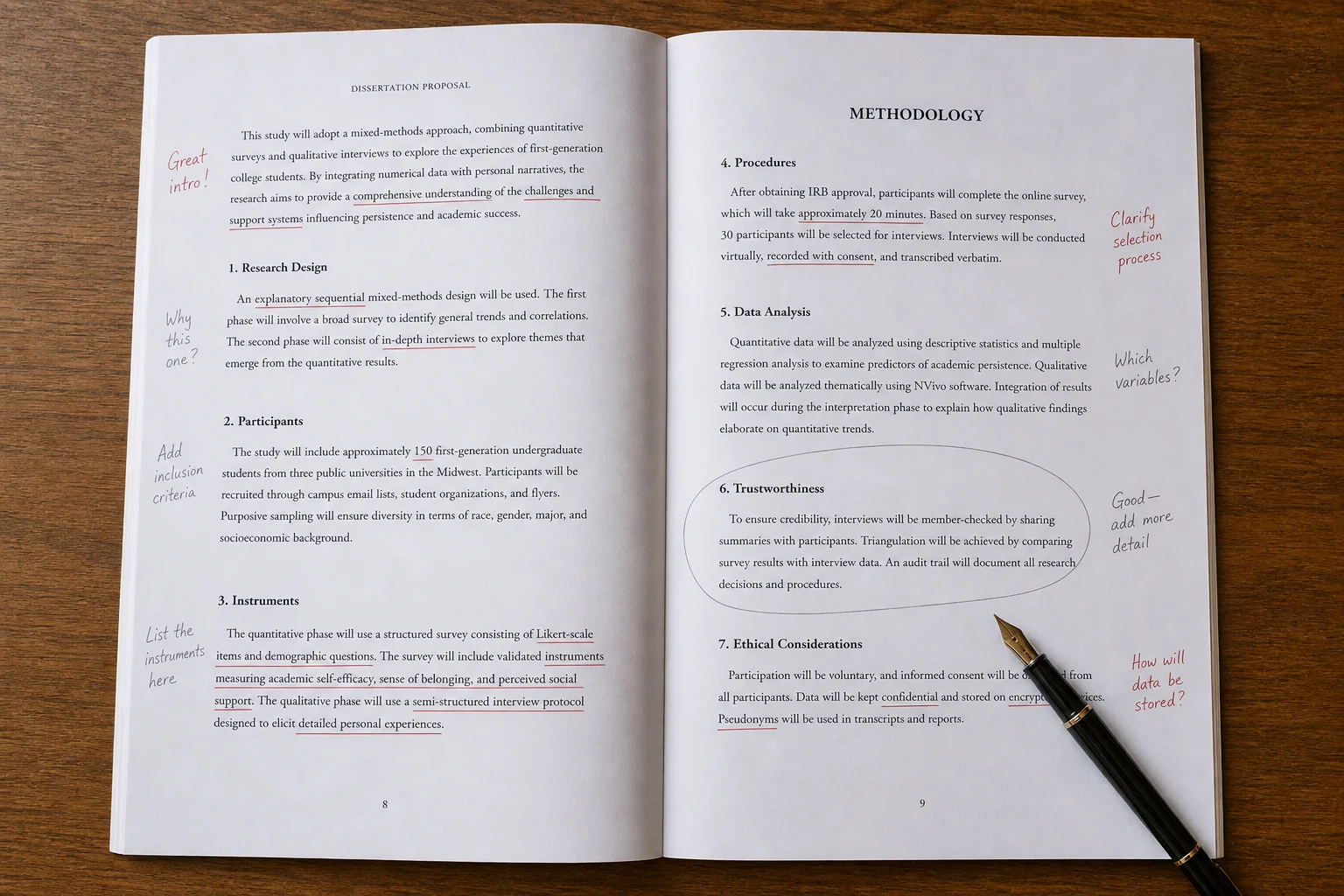
The proposal initiates your entire research process. It often consumes an entire academic term — and significantly more if your objectives remain ill-defined. Securing approval from your Chair typically stalls at three distinct structural fracture points: topic selection, the theoretical framework, and methodological alignment. Addressing these three dimensions upfront ensures your proposal passes initial review and protects your future dissertation chapters from systemic structural errors.
Skills Required
- Topic Identification
- Literature Synthesis
- Methodological Alignment
- Instrument Sourcing
- Structured Outlining
- Statistical/Analytical Skills
- Scholarly Writing
Where does a proposal actually begin?
You have finished your courses and passed your comprehensive exam. Now the real effort begins. First, ensure you are set up to write efficiently. Do you have the resources you need to work effectively? We discuss these on our writing environment page. Even if you feel completely ready, we suggest reviewing that page — or at least its checklist — to save you considerable grief later. Next, gather all thesis documentation your university provides and review it carefully. Pass these same materials along to your editor or writing coach for review as well.
How do you choose a topic?
Choosing a topic can range from easy to nightmarishly difficult. Your topic must advance the art by extending your field with new research. Critically, however, its scope must stay narrow enough to conduct effective research within your time and financial budgets, yielding clear answers that fit within your required thesis length. Because this choice is so challenging, we outline a clear framework in our topic selection guide.
How much prior research do you need?
There is another crucial issue in topic selection: the prior art. In our experience, you will need at the very minimum seventy-five solid, academically acceptable sources — and most reviews need more. Cutting edge research is great — for established researchers. It does not help you if the field is so bleeding edge there are only 10 academic sources available. Avoid that at all costs! And? No, grey sources such as vendor sites and the like — they are only allowed in specific circumstances.
Most universities take a rather formulaic approach to the thesis process. If you cannot meet their minimum standards for the number of sources, save yourself a world of grief and find another topic. If the topic is truly important to you, return to it as a post-doc!
One thing worth checking before you submit. If your review rests almost entirely on one source — or your thesis engages almost entirely with one source — examine that closely now. A topic with thin directly supporting literature is survivable at proposal stage and very expensive at chapter five.
What theoretical framework or frameworks?
Having found a goldilocks research topic — one that is neither too broad nor too narrow, and genuinely advances the field — it is, alas, not yet time to start on your proposal. It is time to think about your methodology. If you pick the wrong one, it can make performing your research difficult or even impossible.
First, what will be the theoretical underpinnings of your research? What theory or theories do you intend to use?
What theoretical framework(s)? Is your theoretical framework capable of providing the answers you need? Drafting your specific survey or interview questions comes later. But think ahead now to what you are likely to be asking. Any misalignment with your theoretical framework causes trouble — ranging from harder data analysis to outright catastrophe, with data that do not 'fit' the framework(s).
Does your framework fit your questions?
A good 'fit' saves a very great deal of time and grief! For a qualitative thesis, avoid the most difficult analytic approaches where you can — phenomenology-based approaches in particular — in favor of easier ones. And think carefully about the 'fit' between what you propose to research and your approach.
For quantitative research, it is absolutely critical to choose the correct statistical approach and methodology. Do not put off clear thinking about your statistical methods.
Why this is hard to change later
Why? Once a proposal is approved, it is hard to change. Worse, you can get several chapters into your thesis drafting — and even perform all of your research — only to find that the statistical approach you got approved does not 'fit' your data.
This can make statistical analysis tortuous or, in some cases, mean starting over and trying to get a completely different statistical methodology approved — if you even can. In any case, it will cost a great deal of time and stress, and usually a large amount of tuition money. Guessing at your statistical approach or analytical methodology during the proposal phase is strongly contraindicated!
Writing the Proposal
You have a goldilocks topic, new but neither too broad nor narrow in scope. You have verified that there is enough prior research available to provide abundant sources for your literature review and to provide analytic grounding and context for your own questions. That makes your conclusions much easier to write. You have all the basic resources needed to write your thesis in one place. You have verified that the theoretical framework and theories you propose to use are the approaches used in your chosen field. Critically, if you are proposing quantitative research, you have consulted a statistician. And you have confirmed that your research questions, your theoretical framework and your statistical methodology form an aligned triangle — so your tools match the type of research questions you will be posing.
Check your own skills
Now, yet again, review your university's guides and guidelines for thesis writing. And review your own skills once more, arranging to make up any deficiencies. As a reminder these skills include but are not limited to:
- Critical Thinking Skills/Analytic skills
- Research skills/Topic Identification
- Holistic grasp of prior research
- A clear understanding of how prior research relates to your topic
- Outlining skills
- Statistical skills (if quantitative research)
- Scholarly Writing skills
- Responsible AI Research & Organizational skills
If you have deficiencies in any of these areas, it is time to address them as soon as possible. We can provide help in all of these areas, but they are the critical ones at the proposal stage. Most are critical throughout the entire research and thesis writing process. If you are mostly confident and getting help where you need it — or wholly confident! — it is time to ask your Chair for any tips or advice they have and start to write.
Outline before you write
If your university provides a template for the proposal, it is time to outline each section they require. If there is no template, find one elsewhere or take careful notes on what your Chair advises. If your Chair is uncertain, we strongly recommend using a template from a good university and adapting it, if necessary, to your circumstances.
Now, you can start writing each section based on the outline you have created. This outline ensures that you miss nothing and include nothing that is extraneous or irrelevant. It is also something that can easily be shown to a mentor or Chair, allowing them to quickly grasp if you are on track or not.
Using AI at this stage
If you are looking to accelerate this stage, responsibly utilizing AI can be a massive asset for notes organization and research support. AI should never write your text. But it is an exceptional tool for sorting large volumes of research notes into clear thematic groups, or for stress-testing your outline for logical gaps before your Chair sees it.
Before you rely on any of this, find out what your program actually permits — and do it now, at the proposal stage, rather than discovering the answer after a chapter has been flagged. The rules are rarely in one place: check your graduate handbook, your academic integrity policy, any program-specific guidance, and your Chair's own stated expectations, because those four frequently disagree. If you cannot find a clear answer, ask your Chair in writing about the specific use you intend, not about AI in general. Our Navigating AI Detection Paranoia page sets out how to locate these policies, how to phrase the question so the answer is usable, and what to do when your institution has said nothing at all.
The outline step is truly critical. Doing all of your thinking upfront and ensuring everything you need is there in point form will reduce stress, save a great deal of time writing, and save even more time on rewriting or having your proposal approval delayed. Do not skimp on this and do not think you will solve problems "at the screen" while doing the actual writing. You will not. That is the road to procrastination — you hit writing roadblocks caused by missing logical steps, which in turn rest on missing material, facts, or knowledge. Ensuring everything you need is locked into your outline prior to writing also saves a lot of stress.
When to stop polishing
Polishing past the point of improvement is usually fear of the verdict, not care for the document. The proposal is the first time anybody formally judges your work, and the anticipation of that is measurably harder to bear than the judgment itself. More here.
A bonus of a well-written, clearly thought-out, and linear proposal is that much of the material can be recycled — with due care — into your thesis. Do not cut and paste, however. You must paraphrase, extend the material, and critically, shift your writing from the future tense of a proposal ("This study will...") to the past tense of a completed thesis ("This study analyzed..."). Ideally, your proposal is the granite on which the foundation of your thesis will be built in Chapter 1, while contributing to later chapters and serving as a solid guide. If it is skimped on and not well thought through, linear, or well-written, it can be shifting sand under the foundations of your thesis and cause endless grief.
One thing is worth outlining before anything else: your methodology chapter, before you write the methodology section of the proposal.
Many doctoral candidates discover — often to their horror — that the methodologies they actually need are not the ones they got approved at proposal stage and echoed in their introductory chapter. They put off the hard thinking about how to perform the research, meaning to do it later, and are caught with the wrong statistical approach approved and quite frequently the wrong theories or theoretical framework.
If the research and analysis are mysterious to you, do not guess and do not blindly parrot what you found in some other study. Get help immediately. An hour of a statistician's time can save endless grief on a quantitative paper.
Getting these things right can save huge stress, a great deal of time and money, and possibly the thesis itself.
Summary
The proposal is a critical step. Inadequate preparation at this juncture can cause endless grief and, in extreme cases, a lost doctorate. Know — do not guess — that the chosen theoretical framework and its matching statistical methods (where applicable) are correct. Be certain you can locate a suitable survey instrument, get permission to both use and publish it, and ensure it matches the theoretical framework and analytical methodologies you intend to use. Finally, ensure there are abundant, high-quality sources available in the literature that can directly support your topic and research questions. If any of these things are lacking and you do not know how to remedy them, get help immediately. Failures in any of these areas can cost a great deal, tuition, and stress — or lead to total failure.
One of seven pages on planning your dissertation. Browse all 69.

