Outlining
Outlining is an act of confrontation. That is why it gets avoided.
Indeed, one can say with academic humor that it is the literal skeleton in most candidates' closets. Many candidates avoid outlining like the plague.
However, it forces form on the void — you put all your required sections, supporting materials and ideas on the page in one place. And? You avoid doing this at your own peril.
Outlining is the actual act that creates clarity in writing. It does so by forcing you to confront all you do not know. To think wholesale and retail — the whole, and each individual task. Most vitally? The logical order they must come in.
Back to Thesis Writing Process
One of seven pages on planning your dissertation. Browse all 69.
Related links
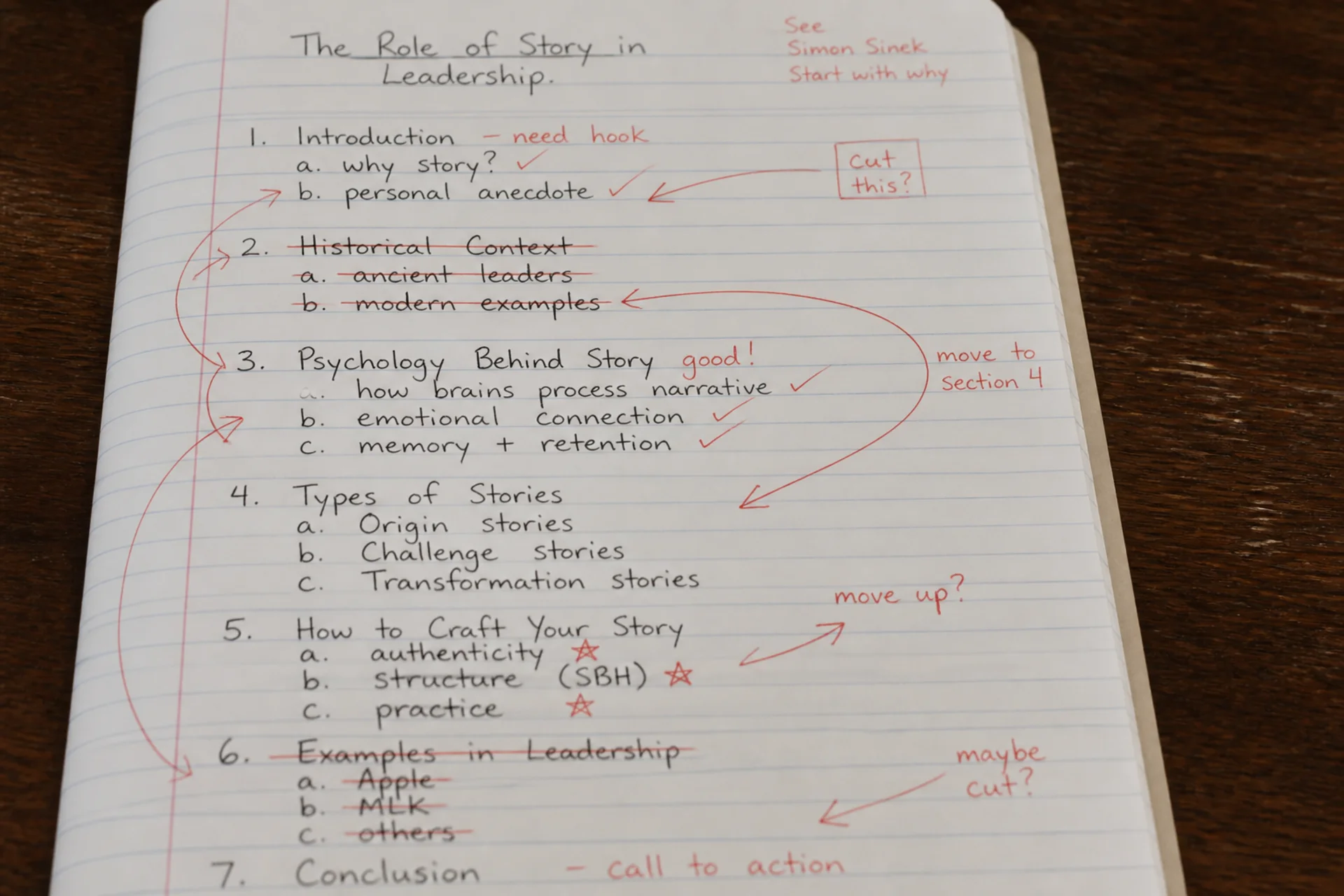
It relentlessly identifies each and every gap, and all that is needed before the first glowing electron forms the first letter of the first word of your written dissertation.
There is no substitute for outlining in scholarly writing. Period. The cost of avoiding the confrontation is measured in lost time, stress — and all too often money.
On this page
- Have it now
- Word Processors' Hidden Writing Superpower
- The outline is the skeleton. Your text is the flesh
- How to build one
- Outlining is the cure for the blank page
- The other thing an outline prevents: off-topic text
- The result of a skeleton with every bone in place? A truly complete outline.
- "It will come to me while I am writing"
- What it actually costs
- Where else to look
Word Processors' Hidden Writing Superpower
We use Word and LibreOffice as examples, but all word processors have built-in outlining tools.
This is a superpower for doctoral candidates, and it is skipped over far too often.
The principle is the same everywhere. You write your outline using heading styles — Heading 1, Heading 2, Heading 3 — rather than by typing numbers and indenting manually. The software then knows the structure, which is what lets you move whole sections in one action and see the shape of the document at a glance.
Microsoft Word
- Outline view: View → Outline. Shows only your headings, collapsible by level
- Navigation pane: View → Navigation Pane. A live map of the document down the left side. Drag a heading and the whole section moves with it
- Promote and demote: `Tab` and `Shift+Tab` in Outline view
LibreOffice Writer
- Navigator: `F5`, or View → Navigator
- Promote and demote: `Tab` and `Shift+Tab` at the start of a heading line
- Move a section: in Navigator, select a heading and use the move buttons. The content moves with it
Why heading styles rather than manual numbering
Type "1.2.3 Sample selection" as ordinary text and it is just words. Apply Heading 3 and it becomes a moveable object — one you can collapse, drag, renumber automatically, and turn into a table of contents in one click.
Have it now
Have it now, alone, in front of your screen. Do not put it off.
Yes, it is painful when you start. Inevitably you will find many, many gaps — missing sources, research you have not done, holes in what you know that will need filling, very likely questions about your theoretical framework, which instrument can support it and whether that instrument is even available to you, and the methodology intimately bound up with both. Quite likely questions about statistics. A great many niggly gaps, large and small, and all of them ones you absolutely need to fill.
And no, it cannot be done in an afternoon. Filling gaps takes time and effort. But it is impossible to outline in full without doing it.
Some of that time is fragments — bits and pieces of work, and waiting for answers that have to come from elsewhere. Some of it is hard thought, sliding the puzzle pieces of your assertions and arguments around until they sit in an order that holds.
Some of the outline, in early drafts, will be little more than headings taken from your institution's guide to what belongs in the later chapters. That is fine. Even a complete outline at the point where you start your research is still scaffolding for the chapters you have not written. It is, by definition, an evolving document.
But without it you cannot see what is going on in your dissertation. And the inability to see is where going off topic starts — along with worse.
The outline is the beating heart of a dissertation. A flatworm gets by without one, because it is flat enough that everything is already close to everything else. Your dissertation is not flat. Chapter 1 is a long way from Chapter 5, and something has to carry the argument between them.
And here is the part nobody tells you: doing it this way saves an enormous amount of time.
Every gap you find at the outline stage is a gap that costs you almost nothing to find. It sits on the page where you can see it, next to every other gap, and you can work out what order to fill them in. Found later — mid-chapter, or worse, in a returned draft — the same gap costs you the work built on top of it as well.
Getting all the hard parts into one place, where you can look at them together, is painful. It is also solid gold.
The pain is not incidental. It is what a doctorate actually consists of. Nobody awards one for the writing.
Avoid the confrontation now, and you will still have to do it later: in writing, in front of the people assessing you. That version costs a term. Sometimes longer.
And? The pain will be greater. Much greater.
The outline is the skeleton. Your text is the flesh
A finished outline is a complete document from which you write your text. Getting to 'finished' is the magic part.
Our advice is to keep two copies of your outline open on your screen — larger screens help, and two monitors are better still. Note that both are strongly correlated with increased writing productivity in general. More on screens and working setup on our writing environment page.
Copy #1 stays pristine. That is your reference.
Copy #2 is the copy where your actual text will end up. You will overwrite the outline with the real text, one point in the outline at a time.
Two consequences follow, and they are the point of the whole exercise:
- You never go off topic. You never waste a second writing something unneeded
- If the outline is properly done, it is a complete series of logical steps — no gaps, nothing left out. It starts at A and ends at Z. When the last point in the outline has been overwritten, the text is complete — and better still, you have no doubts about it.
One qualification. Overwriting the last point means you have said everything you planned to say. It does not mean you have written the length your institution requires.
If you come up short, the outline was short — not the writing. Going back to pad finished prose produces exactly the padding a committee notices. What you need is the section you did not know you needed, and that is an outline problem.
Which is the other reason for setting page ranges before you start. Write to them and you land in the required window without thinking about it.
How to build one
When you start, the outline will be very short.
Probably only the key headings your institution requires for a given section or chapter. If you have those, they are an excellent starting point.
At this stage the outline is about highlighting to you what you do not know and about identifying critical arguments for the text. It is the gap between what you know now, what you need to find out, and reality. This is uncomfortable unless you are accustomed to working with outlines, because it comes before you have to confront real thinking about your topic and real thinking about the logical arguments. It is also uncomfortable as you feel you are confronting all you do not know at once.
Then the real work: what is missing?
Once you have the rough outline — the required headings and any arguments you can think of — the actual work begins, and it fits in one question.
What is missing?
What is missing is every element standing between you and a relentlessly linear sequence of headings, subheadings and sub-subheadings that captures every key point you need to make, and their subpoints in turn – and as many as you need.
The final outline should flow with no logical gaps from beginning to end. On a practical basis, that discomfort means you now have to go and find what is missing — research, citations, arguments.
There is a fast way to see whether your outline is an argument or a list. An outline whose headings all carry roughly the same amount of material is a list of topics. One that argues is uneven — some sections carry a great deal because they are doing the work, and others exist to get you there. The tip beside this explains how to check it in five minutes.
And put a page range beside every heading.
Not a guess at what you will write. A decision about what the section is worth. Introduction: one page. Literature search strategy: one to three. Conceptual framework: three to six. The review itself: thirty to fifty.
This does three things at once.
It forces you to decide what matters before you have written a word — and a section you cannot justify three pages for may not be a section.
It shows you the shape of the chapter. A literature review where every subsection is allocated two pages is the same fault the line count catches, visible before you write rather than after.
And it tells you when to stop. Doctoral writing runs long by default. A section with a ceiling gets finished; a section without one gets expanded.
Then there is the part nobody mentions, and it matters more than the other three.
Because you write over the outline, the ranges become a progress bar.
Suppose your institution wants chapter two at forty to fifty pages, and your own outline allocates twenty-five of those to the review itself. The day you pass twenty-five you have hit a target, and you know it — even though you are still writing, even though the section is not finished.
That is a real win at a moment when there are very few of them. Doctoral work is long, and most of it offers no signal that you are getting anywhere. Page ranges manufacture one, section by section, and they do it honestly — you have genuinely written what that section was supposed to be worth.
Ask your Chair for the ranges if your program publishes them. Many do, and candidates rarely ask.
Reminder: never assert a fact without a covering citation. In a first draft of the outline, if you do not put in actual cites? Remember to put `[cite]` everywhere you will need one. Be consistent, so you can search on it later if the document is long.
A really good outline, for somebody new to them, goes down to the paragraph level in point form. Reminder: a paragraph expresses one thought or idea.
Some gaps you think you cannot fill yourself. A gap you cannot fill usually means one of four things:
- A difficult source hunt. The work exists and you have not found it yet
- A conversation with your Chair. Something needs deciding that you cannot decide alone
- A scope decision. The question you are asking may be larger than the study you can actually do
- A visit to an expert — or just an email. Yes, you can approach professors at other universities. Got a geography question? Go visit a geographer. Here AI can help — Human-in-the-Loop Structural Refinement — it can often identify experts as near as possible to you. That is not a promise!
All four cost less done at outline stage than later. All four are hugely less trouble now than discovering the same gap in Chapter 4.
On approaching an expert — it is easier than you think
Professors exist to disseminate information. That is the job.
Too shy to write to one at a private institution? Write to one at a state university, funded by taxpayer dollars.
And remember that everybody loves having their opinion solicited. It validates them. A little flattery goes a long way:
Dear Professor X,
I understand you are our state's leading expert on left-handed teacups...
Then ask one specific question. "I am looking at X and I cannot establish whether anybody has measured Y" gets a reply. A vague request for help does not.
And say that you will attribute them. "If your answer helps, I will cite you in the text." That is not flattery — it is the currency of the profession, and it turns a favor into something with a return.
Then have somebody read it
That is the confrontation, and it is doing its job. An outline shows you what you do not know, all at once, and that is genuinely unpleasant. Writing prose makes you feel better as you are 'doing something' – but doing without that essential outline merely conceals and papers over gaps. It does not remove them — it hides them. Note however, an outline well done allows you to see the individual gaps and apply a divide-and-conquer strategy to them.
When your outline is done and you think it includes every step of every argument and every step of material that supports assertions, have a competent outside person read it.
Every question they have is likely a missing point or subpoint.
And ask them one more thing: what is this study about, from the headings alone?
If they cannot tell you, the outline is not an argument yet. It is a list of topics that happen to be related — which is the same fault the line-count check catches, seen from the reader's side.
Later, when there is prose, you will ask a different question. Not what is missing but tell me what I meant. Both work at both stages. That is the order they matter in.
The reverse outline: what you extract afterwards
An outline is what you write before a chapter. A reverse outline is what you extract after — and it is the quickest way to find out whether what you wrote matches what you meant to write.
How to do it.
- Take a chapter you have already drafted. Work paragraph by paragraph.
- For each paragraph, write one short sentence stating what that paragraph actually argues — not what you intended it to argue, and not a summary of its contents. Just the claim.
- Read your list of sentences on its own, with the chapter closed.
What you are looking for:
- Paragraphs that turn out to make no claim at all. Filler.
- Two paragraphs making the same claim. Redundancy.
- A claim that appears from nowhere with nothing before it. A missing step in your logic.
- A sequence that jumps rather than flows. A linearity break.
Any paragraph you cannot summarize in one sentence is a paragraph doing more than one job. Split it.
This is also a legitimate and genuinely strong use of AI. Hand it a drafted chapter and ask for exactly that paragraph-by-paragraph claim list, then read the list yourself. Diagnosis is a task AI does well. Deciding what to do about what it finds is yours.
Outlining is the cure for the blank page
This is what makes the whole thing bearable, and almost nobody says it.
Writing paralysis is not laziness and it is not a character flaw. It is what happens when you sit down in front of something too large and too undefined to start.
A dissertation — or even one difficult chapter — creates an enormous unknown. You sit down to write Chapter 2 and there is no obvious place to put your hands — forty pages of something you have not worked out, all of it arriving at once. That is a wall, and walls are paralyzing.
An outline does not only expose the unknown. It divides it.
Not one unknown but forty small ones. I need two more sources for this point. I cannot state the connection between these two sections. This subheading needs a definition I have not settled. There is no evidence here for what I am about to claim.
Every one of those is small enough to act on, and every one has an obvious next step. They stop being things you do not know and become things you are going to find out — one at a time, in an order you chose.
Which is why the confrontation is survivable.
You are not facing I do not know how to write this chapter. You are facing forty specific gaps, many of which will close with some concentrated research. The balance will likely relate to your own study or methodology — which is to say they are known unknowns. Things you are going to find out.
Same material. Different arrangement. Entirely different feeling.
The other thing an outline prevents: off-topic text
Gaps are one failure. Off-topic writing is the other, and it is at least as expensive.
Writing without an outline is an open invitation to produce text that does not belong — and often a great deal of it.
We have not infrequently seen literature reviews that were nearly all off topic. The lack of an outline allowed adjacent and otherwise interesting material to get into the chapter, when it had nothing to do with the research question. It created textual fog obscuring what needed to be there.
That is only one example. Every chapter needs an outline.
And your Chair will notice both. Gaps and off-topic text are among the first things we look for in dissertations that come through our hands, and a Chair reading yours will find them too.
You will start to think your Chair's favorite word is unclear...or 'off topic' or 'nonlinear' or 'rewrite.' And it is not fun to fix.
The result of a skeleton with every bone in place? A truly complete outline.
All on-point text. No fluff — you found it while outlining. No time wasted on material that does not belong. Text that flows easily from beginning to end.
But I could be writing my dissertation in this time...
Yes, you could. And it can feel as though it takes forever when you could be writing and doing. That is a deception and a snare. The outline guarantees quality writing and drastically shortens the time spent writing. Doing before thinking? That equates to a lack of clarity and, alas, to a lack of success.
"It will come to me while I am writing"
No. It will not.
The act of writing does not fill critical gaps. It conceals them — from you, the author, first of all.
Your Chair does not know what was supposed to be there. Nor does your Chair much care for reams of off-point text. It makes Chairs grumpy. Your committee members the same. They see the gap(s), they read the off-topic text – and they call it unclear.
What it actually costs
The confrontation was always coming. That is the point of a doctoral dissertation, or any thesis.
So? Your choice...
You can have it on your own terms, flags flying. Engage with the material and become genuinely prepared to write good text before you write it.
Or you can have it later — painfully — fighting your way through the fog of unclear and off-point text, with a Chair flagging your work at every turn.
Fighting the good fight and getting it done right takes less time than you fear. Much of that time — looking up sources, and so on — would have to be spent in any case.
Some chapters will take an hour. Some will send you off to find things and take days. But in every case it will cost drastically less in time, effort, and often misery and money than not doing it.
Where else to look
Most of what a search returns on outlining is written by essay mills. These three are not, and they are free.
Purdue OWL — Why and How to Create a Useful Outline. The general reference every writing center points at. Not doctoral-specific, and none the worse for it.
MIT Communication Lab — Creating an Outline for Your Master's Thesis. Written for a thesis rather than an essay, which makes it the closest of the three to what you are doing.
Uniformat — Complete Examples by Discipline. Five detailed outlines — education, management, biology, psychology, humanities — with real titles, real theoretical frameworks and named instruments. The best examples we found anywhere. Uniformat sells thesis formatting software for Canadian universities; we have no connection to them and the examples stand on their own.
What none of them shows is the process. Every one gives you a finished outline. None shows one being built — what it looked like before, what changed when the research questions sharpened, why a section that seemed like one heading turned out to be three.
That is the part we are working on.
One of seven pages on planning your dissertation. Browse all 69.

