Thesis Approval Trouble
If your work has stalled, the reason is probably not the one you have been telling yourself. It is rarely ability and rarely discipline. It is almost always something structural that nobody has named out loud yet — and that kind of problem can be found.
We have maintained a 100% graduation success rate for candidates coached through to School Review since 2010. If your progress has stalled due to Chair, committee, or School Review roadblocks, we can help.
One of eight pages on when things go wrong. Browse all 69.
Related links
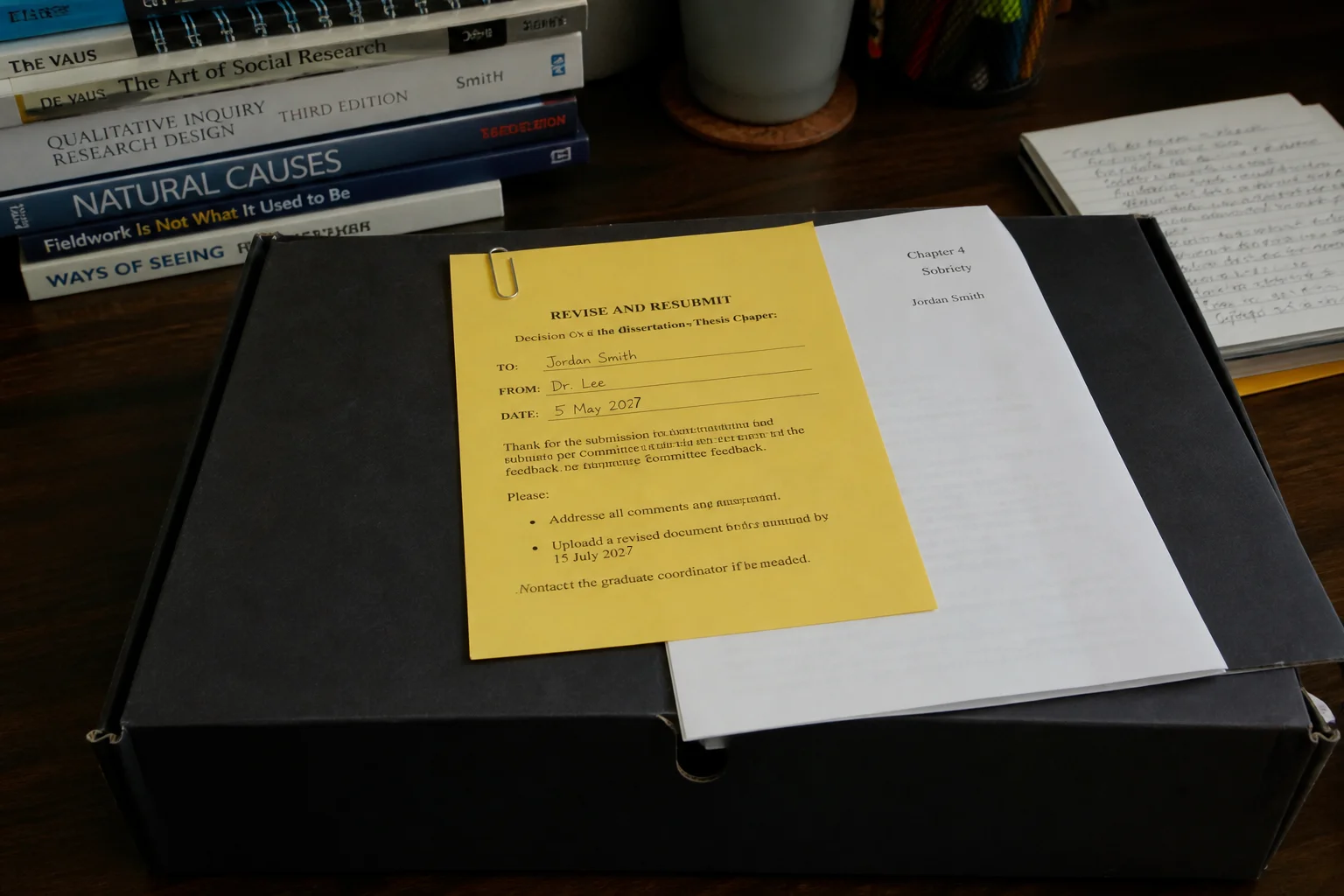
Stalled work is its own particular misery. The causes are varied, the result is the same. Here is where clear thinking — preferably from someone who can read your materials with care, comprehend it completely, and bring both experience and fresh eyes — can in nearly all cases unblock matters effectively and quickly. The tiny number of cases that remain, generally, are related to the need to address root causes and restructure a dissertation more thoroughly. Still doable — but not as quickly.
The page you are currently on assumes you have enough time to work the problem — and if you do not, it is time for immediate action.
If your dissertation has actually been returned by your Chair, your committee, or School Review, that is a different problem with a different fix. Start on our rejected and bounced dissertations page instead.
If your deadline is days away and you cannot think straight, stop reading and go to our Panic page. Someone will pick up, at any hour. You will not get an answering service or a chatbot.
Writing groups and boot camps are almost always recommended; what the evidence actually shows is a different question.
Common approval trouble signs:
- A dissertation bounced by your committee, Chair, or school
- A stalled proposal or chapter awaiting approval
- Feedback pointing to conceptual or structural misalignment
- Institutional requirements you cannot map to a remediation plan
- Pressure to graduate on a fixed timeline after a setback
- Need for holistic review—not line editing alone
A hard truth based on 20 years' experience: few PhD candidates know the real questions to ask when starting the doctoral process. The ugly bit? They ask for help far too late.
If your work has stalled, the last thing you need is a fancier editor.
You need somebody who can look at what you have written and work out what is actually wrong with it — someone accustomed to thinking not only relentlessly logically but also holistically. That is a different and much rarer skill set.
When the feedback is vague, read the vagueness
Some of the hardest feedback to act on is the feedback that does not feel like it points at specific causes for a hold up.
This needs more depth. · I am not sure what you are arguing. · It does not read like doctoral work yet. · Something is missing.
You cannot fix paragraphs your Chair's eye slid past with no comment — but which left internal discomfort. Candidates in this position usually rewrite broadly, hand it back, and receive yet more vague feedback — sometimes for terms at a time.
Part of the reason is that you cannot see it yourself, and it is not for lack of trying. It is the 'forest and the trees' problem. You are so immersed in your own material you cannot see the 'trees' (your issues) for the 'forest' (your whole text). You have worked with this material so long that you read past its deficiencies. You know what you meant, so your mind interpolates what is missing — which is the same mechanism we describe on our clarity page.
Vague feedback is information. It just is not the information it appears to be.
There are two kinds, and they call for opposite responses.
Sometimes the reader is the problem.
An overloaded Chair skimming at midnight. A committee member outside your subject area. A supervisor who has never been taught to give specific feedback and has no model for it. This is real, it is common, and it is not your writing.
Sometimes the text is the problem — and this is the harder one to see, because your writing may be perfectly correct.
Grammatical, well cited, properly formatted, every requirement met. And still nothing for a reader to take hold of.
Prose can satisfy every rule and still say nothing to the point. When that happens, a careful reader senses the absence but cannot name it, because an error can be pointed at and an emptiness cannot. So the feedback comes back general — not because the reader was careless, but because there was nothing specific to correct.
The test is convergence — and you will probably have to go and get it.
Your Chair says it needs more depth. Or a committee member is not sure what you are arguing. One reader being vague tells you almost nothing on its own, because you cannot yet tell whether the problem is the text or the reading.
So find out. Give the same material, unchanged and unexplained, to two or three people who have not seen it before — a mentor, another candidate, a colleague outside your field, us. Ask them one question:
What is this arguing?
Do not prompt them. Do not tell them what it is supposed to say. The moment you explain it, you have destroyed the test.
If they can tell you, and their answers roughly agree with each other and with what you intended — your text is doing its job, and the problem is with the reader who was vague. That is a different problem, and it is managed rather than fixed.
If they cannot tell you — or worse, if each of them tells you something different — that is convergence. Independent readers failing in the same way is not coincidence. It is evidence about the writing, and it is the most useful thing you can learn.
When School Review applies a different test
There is a harder version of this, and it is worth understanding.
School Review does not read alongside your Chair and your committee. It reads after both of them have already passed the work on.
So if your work cleared your Chair, cleared your committee, and School Review then returns it — that is not three readers converging on the same failure. Your Chair and committee assessed whether the scholarship is sound. School Review is a different test: whether the document meets institutional requirements. The full list of what review checks is on How the Doctoral Process Actually Works.
Another round with the same Chair and committee is unlikely to resolve what review is checking for, because they were never running that test. If School Review has actually returned your work, stop here. Take a deep breath and go to our rejected and bounced dissertations page.
Run the test on yourself.
Take a section nobody could comment on specifically. Read it through once. Close it. Then ask: does it make a point worth remembering?
Not was it about something. Did it make a point — one you could repeat tomorrow, one somebody could disagree with.
If nothing comes back, you have found the problem, and it is fixable. This is the Point Test, and it takes two minutes.
Where this comes from now, and why it matters more than it used to
Text produced or heavily smoothed by AI is characterized by precisely this quality because a model produces the most probable phrasing rather than the most precise one. It reads cleanly and slides past human readers while leaving no mark on their minds. Our Human-in-the-Loop Structural Refinement page explains the mechanism.
But the source does not matter. A candidate writing at 2am to reach a word count produces the same result, and always has. Mush is mush – however smooth it is. What has changed is that it is now much easier to produce a great deal of it very quickly, and that it passes every surface check on the way.
The fix is the same either way: write on point.
Then the problem is almost certainly not in the chapter. Something upstream of it does not hold — usually the research questions, or the alignment between them and the method — and the chapter is where that shows up. Revising it again will not fix it.
A chapter that will not close is usually reporting a fault that lives somewhere else
This is the single most common shape of a stall. The candidate rewrites the same twenty pages four times, each version better than the last, and each version rejected for reasons that seem to move. What has actually happened is that a decision made much earlier — a question that cannot be answered by the method chosen, a framework that does not fit the data — is surfacing here because here is the first place it becomes visible.
No amount of work on the chapter resolves a fault that is not in the chapter. Diagnosis first, then revision. In that order, the work is usually far smaller than it looks.
Eleven weeks is not a character problem. Avoidance is what happens when a task has no obvious first move, and a stalled dissertation has none by definition. The way back in is not resolve. It is a smaller first move.
You are trying to write and evaluate at the same time, which produces exactly this. They are separate activities and they cannot share a writing session — generating and judging are not the same act.
Or you are not writing to an outline, in which case this is no surprise at all — we deal with that at length.
That is a load problem, not a comprehension problem. Reading for content and reading while braced for what you might find are not the same activity, and the second one consumes most of the attention the first one needs. It usually resolves by changing what you are reading for.
This is extremely common and it is not a character defect. It is a structural difference. Work for other people arrives with a deadline, a defined edge, and somebody who notices whether it is done. Your dissertation has none of those, and you are being asked to supply all three yourself while also doing the work. Nobody is good at that.
Our founder hates writing his own CV. Sometimes it is no more complicated than a reluctance to work on your own material, and the answer is to get somebody else involved — swap work with another candidate, or call us.
The fix is not more discipline. It is borrowing the missing structure from somewhere. A standing appointment with somebody expecting a chapter, an external deadline you did not set, a person who will notice.
This is not a soft finding. When 21 former doctoral candidates — completers and non-completers — were interviewed about what had actually differed between them, what separated the two groups was whether they felt they were moving forward, without excessive distress, on a project that made sense to them. Sense, progress, distress. Peer support did not differentiate the groups at all, which the researchers attributed to peers having little effect on dissertation progress itself. And an older study of all-but-dissertation candidates found completion rates rose when clear, well-structured deadlines were set.
Your university does set deadlines. They get missed constantly, because an institutional date with nobody attached to it is not the same as a person who will notice. That is exactly the structure a coach supplies, and we would rather say so plainly than imply it: a standing appointment with somebody who has read your material and is expecting the next piece on a date is the single most reliable thing you can add to a stalled dissertation.
One kind of stall does not respond to any of this. If you know exactly what needs doing, have no relationship problem, and still cannot begin, the obstacle is not diagnosis — it is fear of failing, and no amount of clarity about the work will move it. It is common, it is well studied, and it is treated separately here.
Read your most recent draft, start to finish, without changing anything
In as few sittings as you can manage — ideally one, but the point is continuity of attention rather than a free afternoon. No editing, no notes, no fixing. The point is not to improve it — it is to find out what is actually there, because after weeks away most candidates are avoiding a document they no longer accurately remember. The imagined version is almost always worse than the real one, and the gap between them is where the dread lives.
Then do a reverse outline — and certainly do one if you have no detailed outline already. Read it back looking for gaps in the logic and material that should be there and is not. It is the fastest way to see the shape of what you actually have rather than what you remember writing.
If you cannot face reading it alone, asking somebody else to read it is entirely reasonable. What matters is that it gets read.
Concretely, that means:
- Every paragraph makes one claim, and you can state what it is.
- Every claim is one somebody could disagree with. If no one could dispute it, it is not doing work.
- Cut anything that survives deletion. If removing a sentence changes nothing, it was not stating anything of substance.
- Prefer the exact word to the comfortable one, even when the exact word is blunter than you would like.
- State the number. "Roughly forty percent" earns its place; "a significant proportion" does not.
Clear writing is not smooth writing. It is writing where every sentence had to be decided on. See our seven tenets of clarity.
How do you fix a stalled dissertation?
We know exactly how to untangle the institutional bottlenecks and structural breakdowns that halt academic momentum. When a proposal, thesis, or dissertation stalls, the issue is rarely a superficial matter of appearance or style; it is almost always a conceptual failure. We do not simply jump in to edit isolated passages or patch random sentences in a vacuum. As we are professionals at remediating advanced thinking and its explication, we evaluate your manuscript in its entirety. We understand that deep comprehension of text precedes insights that may align, refine, or extend your thinking. After addressing any queries we have on your material, and having gained a holistic perspective of the material, your intent, and your research's goals, we can then show you where to strengthen and align your work, so that you build a coherent logical cascade that moves clearly from thesis to conclusion. Such a coherent structure finesses awkward questions before they ever arise, making the approval process a far more straightforward journey for Chairs and committees.
Move your project forward
You didn't work this hard to get stuck in limbo or let a committee stall your career. Whether you are dealing with a stalled proposal, a chapter that keeps coming back, or the pressure of peer review, you don't have to navigate the system alone.
We act as a collaborative sounding board and a dedicated partner that truly takes the time to understand your work and help you work through any impasse. We deeply respect the immense thought, time, and energy you have already poured into your research. Together, we can decipher feedback, realign your core arguments, as necessary, and bring your project to a successful conclusion. Let's look at your draft together.
Clarity is our mantra. Bringing absolute clarity to the precise structural or institutional issues confronting you is the vital first step. Once we accurately diagnose those bottlenecks, we co-create a concrete roadmap with actionable, clear milestones designed to deliver the exact outcomes you need to advance or graduate. Your sherpa and their team are right there with you every step of the way to ensure your project executes smoothly and according to plan. Learn more about clarity
One of eight pages on when things go wrong. Browse all 69.

