Navigating AI Detection Paranoia
...my chair says my writing sounds AI-generated, and I didn't use AI...
You are not imagining this problem, and you are not alone in it. AI detection tools are being used across universities right now to screen dissertations and papers, and they are far less reliable than most committees assume. This page will provide at least partial help in terms of specific resources — and we can provide more help if needed.
Last updated 19 August 2026. Sources verified on that date.
One of nine pages on AI and academic honesty. Browse all 69.
Related links
Skills Required
- Process documentation
- Version-history discipline
- Detector-score literacy
- Calm, evidence-based response
- Knowing when to get help fast
On this page
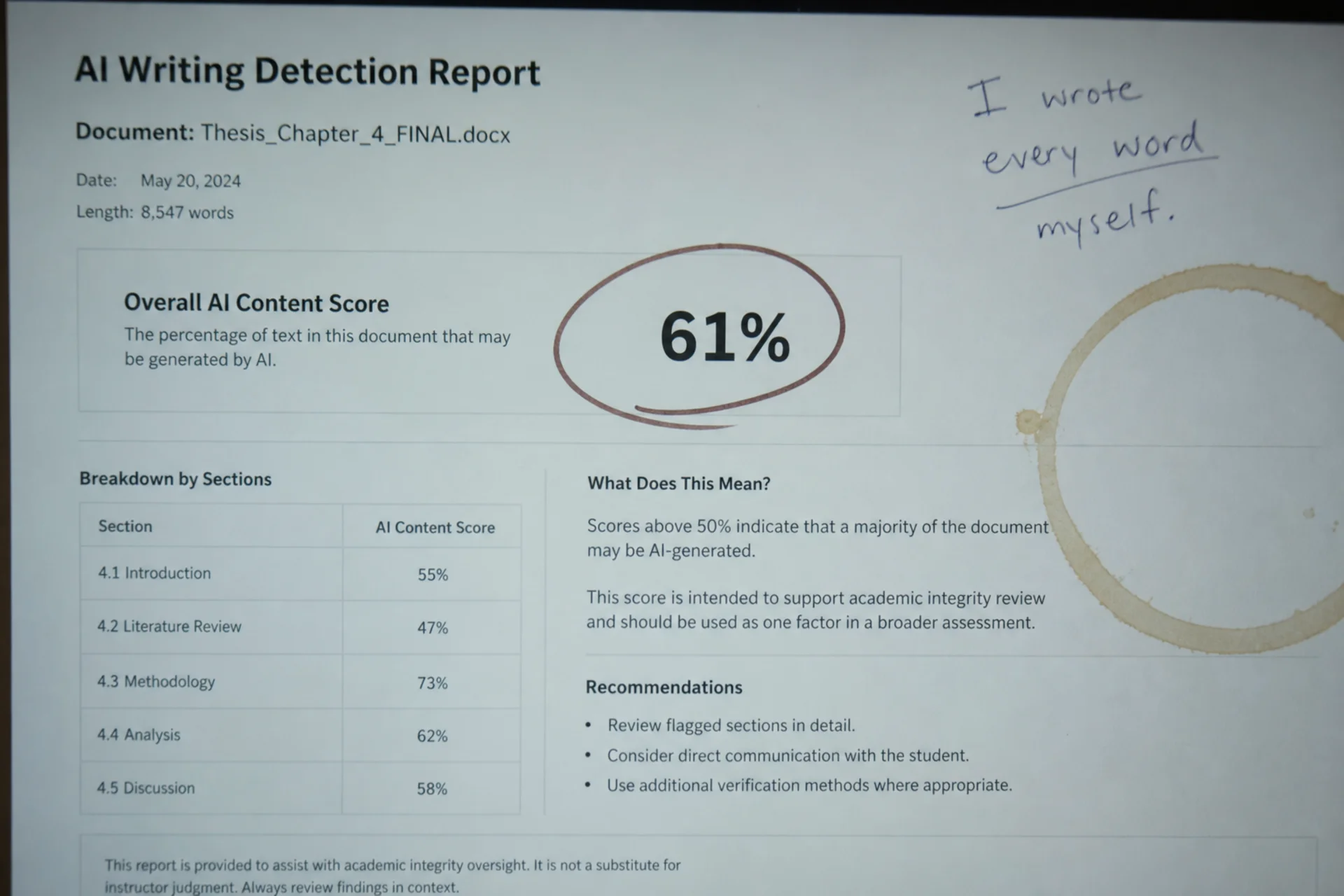
- turnitin says my paper is 61% ai and I wrote every word myself
- Why this is different for a doctoral candidate
- why do international students get flagged for ai more than everyone else
- I got flagged and I didn't use AI — what do I do right now?
- am I the only one this is happening to
- how do I find out what my university's AI policy actually is
- is there anyone who can actually help before my chair reports me
- Will my university find out?
- Test the detector on your own old writing
- Core References
Navigating AI Detection Paranoia
This page explains what the detectors actually measure, why clean scholarly writing can trigger a false flag, and exactly what to do if you're accused.
AI Detectors Do Not Detect AI
...turnitin says my paper is 61% AI and I wrote every word myself!
Where this stands, as of August 2026.
A growing number of universities have stopped using AI detection software, and several have disabled it outright. The University of Waterloo discontinued Turnitin's AI detection in September 2025 after internal testing flagged human-written work as 100% AI-generated. Yale's Poorvu Center does not endorse detection software and does not enable it in Canvas, citing a University of Chicago Booth study that found the tools "unsuitable for high-stakes applications." Inside Higher Ed reported in August 2026 that Yale, Vanderbilt, Johns Hopkins and Indiana bar or discourage treating detector output as sole evidence, and that at least a dozen institutions — Northwestern, Georgetown and New York University among them — have disabled Turnitin's AI detection entirely.
The reasons given are consistent: false-positive rates far higher than vendors claimed, and documented bias against writers whose first language is not English.
The most complete list is not ours. PLEASE maintains a running record of institutions that have disabled or declined AI detection, each entry linked to that university's own statement. If you need to show your program what other institutions have decided, start there.
What follows is what this means for a doctoral candidate specifically — which is a different question from what it means for an undergraduate essay, and one nobody else appears to be answering.
Why this is different for a doctoral candidate
Almost everything written about AI detection is written about undergraduate essays. A flagged term paper is a grade, a meeting, and at worst a semester.
A doctoral finding is not that.
It attaches to your name in a way that does not come off. It can follow you into your first academic post, into a tenure file, into a background check years later. And there is no retaking the module — a misconduct finding at dissertation stage can end the degree.
Which changes what you should do about a detector score. Not because the tools work better on doctoral writing — they do not — but because the cost of handling it badly is permanent.
It also changes who needs to know. Your Chair is not an examiner you can appeal past. They are the person who will either represent you to the committee or not.
AI detectors don't detect AI. They measure statistical patterns in your sentence structure — predictability, sentence-length variation, word choice — and estimate a probability that those patterns resemble machine output. A detection score is a probability estimate, not proof. Independent testing has found detector accuracy dropping sharply once a student edits their own text at all, with some platforms performing as low as 20 to 40 percent accurate under real-world conditions.
And there is a second thing, which detectors do not measure at all.
Reviewers, Chairs and committee members are increasingly reading for what we and others call automated cadence — prose that reads as machine-generated. Flat, evenly weighted, smooth in a way that human writing under pressure is not. No score is involved. A person simply notices.
These are different problems and they need different answers. A detector flag is a claim about statistics, and it is answered with process evidence — drafts, version history, a research log. A cadence objection is a claim about the prose itself, and it is answered by writing that carries your reasoning rather than a smooth average of everybody's.
The awkward part is that the two pull in opposite directions. Disciplined scholarly prose scores as machine-like to a detector — that is what clarity does to predictability. But it should never read as machine-like to a person.
One thing that follows from all this, and it points the other way. Detectors measure probability. Which means distinctive prose — particular, committed, in your own idiom — is exactly what a detector finds least suspicious. The hedged, evenly balanced, endlessly qualified writing that AI produces is the most probable text there is. We call it stodge, and it is worth learning to spot.
...why do international students get flagged for AI more than everyone else?
The most documented bias in AI detection tools is against non-native English writers. A 2023 Stanford study found that seven widely used GPT detectors misclassified over 61 percent of TOEFL essays written by non-native English speakers as AI-generated, while classifying essays from native English-speaking students with near-perfect accuracy (Liang et al., 2023). Formal, heavily edited academic prose — the exact style your Chair expects — tends to register as low in "perplexity" to a detector, the same statistical signature associated with machine writing.
...I got flagged and I didn't use AI — what do I do right now?
Welcome to the very, very large crowd! Stay calm and do not panic-rewrite your chapter. Gorichanaz (2023) studied what happens to students after the accusation, working from public accounts of real cases. The picture is consistent: significant distress, and a scramble to assemble digital evidence of their own innocence — draft histories, version logs, timestamps. Students accused on a detector score end up building a legal defense for work they wrote themselves.
That is the cost of a false positive, and it lands whether or not the accusation is eventually withdrawn. Do not treat any algorithm's score as a verdict. It is not evidence on its own. Gather proof of your own process: draft history, timestamps, cloud version history, notes. Ask, calmly and in writing, which tool flagged the work and at what threshold. If it escalates past an informal conversation, get help fast — not to argue louder, but to make sure due process is actually followed.
If you are accused, here is what the record shows
You are not the first, and the cases are now on the record.
A court annulled a finding built on a detector score
In February 2026 a New York court annulled an academic integrity finding, ordered the university to expunge the student's record, and held that the decision lacked a rational basis.
The student had submitted results from two other detectors indicating human authorship. The university declined to consider them.
The family reported six-figure legal costs.
Newby v. Adelphi University, 2026 NY Slip Op 26021.
And it is not only the courts
The UK's Office of the Independent Adjudicator has upheld student appeals on the same grounds.
The University of Waterloo — an institution with an international reputation in computer science — discontinued Turnitin's AI detection entirely in September 2025. Internal testing found the tool's advantages "inconclusive", and in more than one instance it flagged human-written text as 100% generated by AI. It has not been reinstated.
And Waterloo is not an outlier. It is early.
By August 2026, Inside Higher Ed reported that Yale, Vanderbilt, Johns Hopkins and Indiana had adopted policies barring or discouraging faculty from treating detector output as the sole evidence of cheating — and that at least a dozen institutions, Northwestern, Georgetown and New York University among them, had disabled Turnitin's AI detection outright, after it was found to have a far higher false-positive rate than the company had suggested.
Yale is more specific than most. Its Poorvu Center for Teaching and Learning does not endorse AI detection software and does not enable the feature in Canvas at all — citing a University of Chicago Booth study finding the tools "unsuitable for high-stakes applications."
And what Yale tells its faculty to do instead is what we tell Chairs to do. Talk to the student about the work — "a discussion focused more on standards and the writing process and less on accusations."
A supervisor reading that has Yale's own guidance behind them the next time somebody suggests a detector score settles anything.
Indiana's Kelley School of Business prohibits detector use in its faculty playbook, in terms a candidate should read twice: "Some tools claim to detect whether a student used AI, but these services are highly unreliable."
These are not institutions that have gone soft on misconduct. They are institutions that tested the tool and concluded it could not carry the weight being put on it.
MIT states plainly in its own guidance that detection tools should not be the sole basis for a misconduct charge.
Note who those two are. The institutions with the deepest technical expertise are the ones least willing to trust the technology.
And there is a second problem, less discussed than the first.
The detectors most programs actually run do not catch current machine writing — even when nobody is trying to hide it. Van Vlasselaer, Van Droogenbroeck and Spruyt (2026), in the International Journal for Educational Integrity, ran four tools on papers with known ground truth. Turnitin classified every fully AI-generated paper in that set as a false negative — scores in the 0–20% band, the range it treats as uncertain. GPTZero and Copyleaks failed on the same set (70% and 75% false negatives). A single prompt asking the model to make the AI passages sound more like a student dropped Turnitin's accuracy on mixed papers from 60% to 50%. Pangram did far better; the product sitting in most LMSs did not.
So consider what the tool actually does. On fully machine-written work from a current model, Turnitin returned nothing. A light rewrite made mixed work harder still.
That is not a tool with a margin of error. It is a tool pointed the wrong way.
But institutions do not always lose — and the reason matters to you
In Yang v. University of Minnesota, the Minnesota Court of Appeals upheld an expulsion in 2026.
Not because the detector was right. Because the institution followed its own process and rested its finding on more than a number.
So the pattern is not about detectors at all
Institutions lose when the score is the case — when somebody is found responsible on the strength of a number, offered no real hearing, and has contrary evidence set aside.
Institutions hold when the score merely started the inquiry and the finding rested on something else.
Which means the thing that decides your outcome is not the score. It is the process.
And that is the part you can do something about.
...am I the only one this is happening to?
No, you are not. You are part of a very large crowd, indeed! This is not a fringe concern. For example, the University of Pittsburgh's Center for Teaching and Learning has concluded that current AI detection software is not yet reliable enough to be deployed without a substantial risk of false positives. Universities across the country are reaching similar conclusions in real time, which is exactly why a documented, unpanicked response goes further than a defensive one.
...how do I find out what my university's AI policy actually is?
Ask a reasonable question and you would expect a single clear answer. In practice, most candidates discover their institution has said several things, in several places, at several different times — and that nobody has reconciled them.
Look in all four places, not one.
Your program's rules on AI are rarely in one document. Check every one of these, because they frequently disagree:
- The graduate or doctoral handbook. Usually the most formal statement, and often the most out of date.
- The academic integrity or academic honesty policy. This is the document that will actually be cited if you are ever accused, which makes it the one that matters most in a dispute — even when it is the vaguest of the four.
- Program or department guidance. Frequently more current than the handbook, sometimes contradicting it, and often circulated by email rather than published.
- Your syllabus, or your Chair's own stated expectations. The most current, the least formal, and the least likely to survive a change of Chair.
Where these conflict, the integrity policy generally governs in a formal proceeding — but the version your Chair believes is in force is what shapes your day-to-day work. You need to know both.
What you will usually find.
Institutional positions cluster into a few patterns, and it is worth knowing which one you are dealing with:
- Prohibition. No AI use in submitted work, sometimes extending to research and note-taking.
- Disclosure. Use permitted, provided it is declared — though what constitutes adequate declaration is frequently undefined.
- Task-limited permission. Some uses allowed, others not: proofreading yes, drafting no, or similar. These are the most workable policies and the least common.
- Silence. No stated policy at all, which is more widespread than most candidates assume.
Silence is not permission — and it is not prohibition either.
If your institution has said nothing, you are not free of the question; you have simply been left to answer it yourself, and to defend that answer later if asked. Decide your own standard, write it down, and keep the record. A candidate who can produce a dated note explaining what they used, for what, and why they considered it legitimate is in a very different position from one reconstructing intentions after an accusation.
How to ask, so that the answer is worth having.
Ask in writing. Email, not a corridor conversation. A written answer is a document you can produce later; a remembered conversation is not.
Ask specifically. "Is AI allowed?" invites an unhelpfully cautious answer. Ask about the actual thing you want to do: "I am using an AI tool to organize my research notes into thematic groups before drafting. I am not using it to generate any text that appears in my dissertation. Is that consistent with program expectations?" A specific question is far more likely to produce a specific, usable answer.
Ask which policy governs. It is entirely reasonable to ask which document your program treats as authoritative, and where to find it. If nobody can tell you, that is itself worth knowing — and worth noting down.
And expect enforcement to be uneven.
Even where policy is clear, application is not. The same use may pass unremarked with one Chair and trigger a formal process with another. Detection tools are deployed inconsistently, at different thresholds, with different levels of confidence in what they report. This is not a reason for paranoia. It is a reason to document your process as you go, so that whatever standard you are eventually held to, you can show what you actually did.
...is there anyone who can actually help before my chair reports me?
We can and we will. First, take a deep breath and read the tips beside these sections, if you have not already. Second, if you are too stressed to think? Jump to our Panic page — get a live person (and not an answering service either!), 24/7. Panic needs to be trodden on fast, before it results in unwise actions.
If it is urgent, we will assist you in retrieving old drafts — whole or partial — from whatever dark corners they have vanished into, if you do not have them. You would be surprised what can be retrieved in many cases. Second, we will explain how the so-called AI detection tools work, and what a flag does and does not show. Third, and where necessary, we will help you document your process — drafts, notes, version history — so that your authorship is traceable as yours, and we will go through your prose with you, showing where it could read more clearly and distinctively, so that you make the changes. We will do that from the first draft, with a documented process behind it. If you have a complete draft or even a full chapter facing unreasonable challenges — that is, facing a flag or a difficult conversation with your Chair — this crosses into genuine crisis territory, and it may be time to contact us ASAP. And, again, if you are at the point of panic? See our Panic page for immediate help, day or night.
Will my university find out?
Will your university find out? Probably not — and that is the wrong thing to be worrying about.
Detectors cannot reliably tell. That is the finding of every serious study, and it is why courts have annulled findings built on them. A detector score is not evidence, and institutions that have treated it as evidence have lost.
So if the question is "will I be caught," the honest answer is that detection is unreliable in both directions — it flags honest work constantly and misses machine-written work regularly.
But that is the wrong question, and here is why.
The risk is not detection. It is the defense.
Somebody will ask you to explain your own work. Walk me through how you arrived at this conclusion. Why this source rather than the obvious alternative? What did you leave out, and why?
Those questions are not designed to catch anyone. They are ordinary supervision, and they are asked of everybody. A candidate who did the thinking answers them in a sentence. A candidate who did not cannot answer them at all — and no detector was involved.
And the second risk is worse and slower.
Fabricated citations do not need a detector to surface. Somebody looks up your source and it does not exist. That can happen at review, at defense, or years after you graduate, and it is not a tool problem — it is research fraud, and it stays attached to your name.
Which is why the useful question is not "will they find out."
It is: can I explain and defend everything I submitted, and is every citation in it real? Answer yes to both and detection is irrelevant. Answer no to either and detection is the least of it.
See our Academic Honesty page for where we draw the line, and Purging Citation Contamination for verifying what you have.
And here is a point worth sitting with.
The same class of tool that scores your writing for authorship is the one that misread two precise methods sentences as a duplication in a documented case from August 2026.
A tool that cannot reliably tell two specifications apart is being used to tell your work from a machine's.
Test the detector on your own old writing
Run something you wrote before generative AI existed through the same detector.
An essay from 2019. A seminar paper from your master's. Anything with a date on it that predates the tools. If it comes back flagged — and it very often does — you have produced the most direct evidence available that the detector is measuring style rather than authorship.
It is also evidence of a kind nobody can wave away. It is your own prose, written years before the thing you are accused of using existed, tested on the same instrument that accused you. Keep the result. Screenshot it, note the date and the tool, and keep it with the rest of your file.
There is a record worth building, and it is worth building before you need it. Version history in your word processor. Drafts with dates. Notes and outlines. A search history from the weeks you were reading. None of this proves anything on its own; together it is a record of a process, and a process is what a fabricated document does not have.
S/he may not be allowed to. Where a formal process has begun, saying what s/he thinks about it can compromise both of you — and silence in that situation is procedural rather than personal.
Which tells you the dread is not about the work — it is about the verdict you expect to be attached to it. Revisions are a list; feedback feels like a judgment. They are the same document read two ways, and the way you are reading it is the one that costs you weeks.
Last reviewed 19 August 2026. Every institutional position and study cited on this page was verified live on that date.
This subject moves faster than anything else we write about. Three institutions changed position between this page first being written and its last review. If you are reading this months later, check the primary sources — they are all linked, and that is why.
Core References
Last verified 19 August 2026.
Gorichanaz, T. (2023). Accused: How students respond to allegations of using ChatGPT on assessments. Learning: Research and Practice, 9(2), 183–196. Link
Liang, W., Yuksekgonul, M., Mao, Y., Wu, E., & Zou, J. (2023). GPT detectors are biased against non-native English writers. Patterns, 4(7).
University of Chicago Booth School of Business. (2025). Do AI detectors work well enough to trust? Link
University of Waterloo. (2025). Discontinuing use of AI detection functionality in Turnitin. Office of the Associate Vice-President, Academic. Link
Yale University, Poorvu Center for Teaching and Learning. (2026). Academic Integrity and Detection. Link
University of Pittsburgh Center for Teaching and Learning. (2026). Encouraging Academic Integrity.
PLEASE. (2024). Schools that Banned AI Detectors. A sourced list of institutional positions. Last listed update 20 September 2024. Link
Van Vlasselaer, M., Van Droogenbroeck, F., & Spruyt, B. (2026). Who wrote this? Evaluating the reliability of AI detection tools in higher education. International Journal for Educational Integrity, 22, 16. Link
Inside Higher Ed. (2026, August 5). AI Detectors Are Out, New Assessments Are In. Link
One of nine pages on AI and academic honesty. Browse all 69.


There are three kinds of lies: lies, damned lies, and statistics.
Almost everybody attributes that to Mark Twain — our founder always did.
However, Samuel Clemens himself? He attributed it to Disraeli — and Disraeli never said it.
It appears nowhere in his works, and the earliest versions turn up years after his death. Earlier variants were credited to Balfour, to Charles Dilke, and to an unnamed "Wise Statesman."
The origin is unknown.
Thus, it may indeed be Samuel Clemens who first stated it — while thinking it was somebody else's thought. That may be the most important point here for academic writers.
We only caught this when checking every attribution on this site before publication. See Purging Citation Contamination — this is a worked example of exactly that.
Never assume, never guess — and the most famous quotations? Are mostly simplified misquotes.