Is this journal real?
Is this journal real?
How to check before you cite it. It takes minutes.
Deceptive journals are built to be indistinguishable from real ones at a glance, and they appear in ordinary search results alongside legitimate scholarship. Doubt is not naivety.
One of two pages on practical free tools. Browse all 69.
Related links
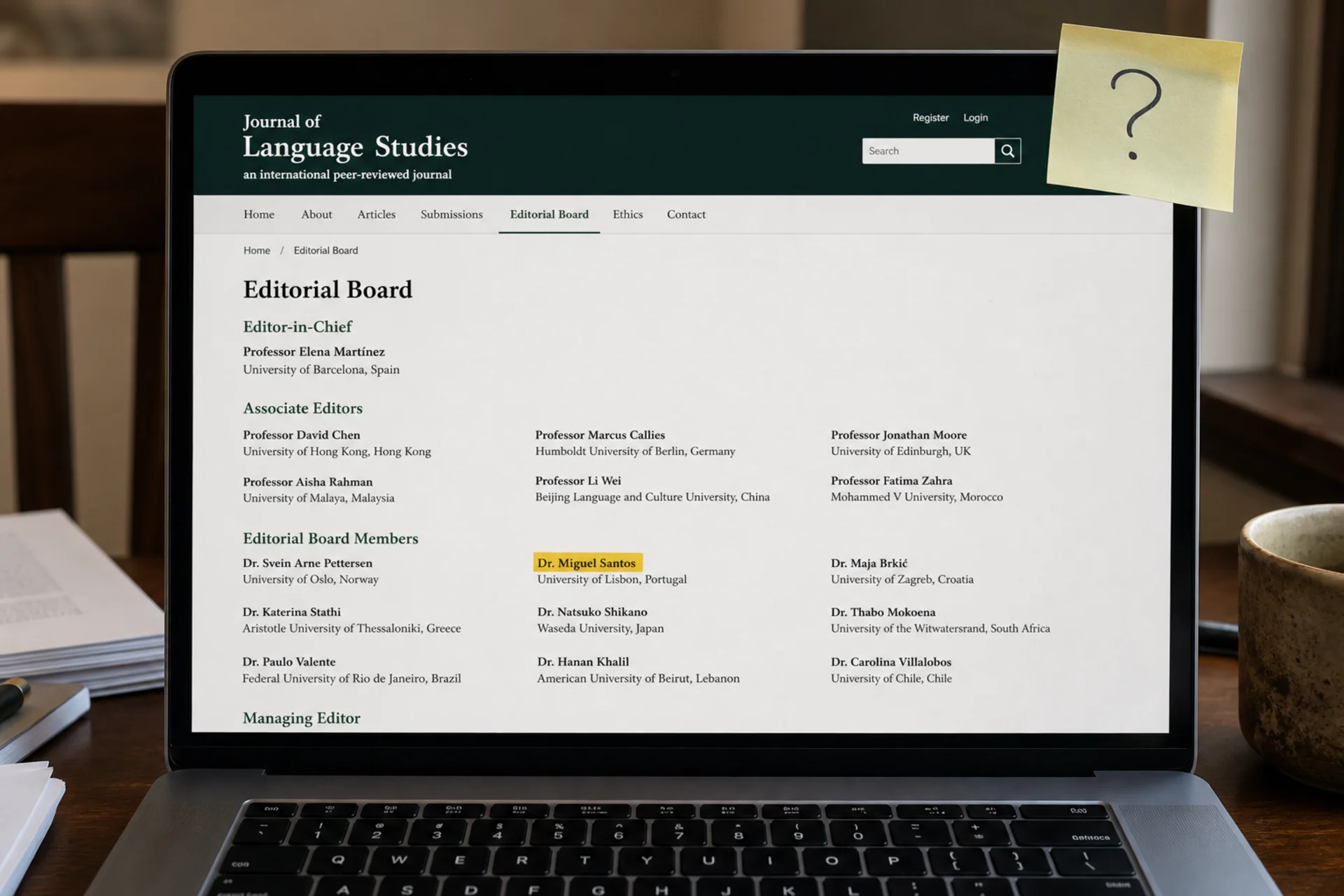
Deceptive journals rarely publish falsehoods.
They arrange true fragments so a reader supplies the rest — a name and a country, a catalogue number beside an impact factor, a footer that lists departments the company does not have.
Which means looking for false statements will not find them. You have to notice what is not being claimed.
A fabricated or predatory source found late costs months. If your committee catches one, the scrutiny reaches the rest of your bibliography.
Checking takes minutes. Do it before you write.
The audit this method came from: The Predatory Wolf in Sheep's Clothing.
The manual check
This is the whole method. It needs no software and no account.
1 · Look up the editorial board on their own pages
Academics are proud of genuine editorial appointments. They appear on university profiles, on personal CVs, and on ORCID records, because a real board seat is a line somebody put there deliberately.
- Pick two or three names from the board. Search each one with their university. Read their own page.
- If the journal is real and they serve on it, it will usually be listed.
- Watch the title character by character. The commonest trick is a near-identical name — a word added, a word dropped, Journal of against International Journal of. A professor listing one is not evidence for the other.
- Absence is not proof. Not every academic maintains a profile. But a whole board and not one of them mentioning the journal is a finding.
2 · Notice what the board listing does not say
A board given as names and countries only has claimed nothing. No institution, no title, no statement that anyone agreed to serve. Look a name up, find a real academic in that country, and you have supplied the affiliation yourself. The journal never said it. That is the point.
3 · Check the identifiers where they live
| Identifier | Where to check |
|---|---|
| ISSN | portal.issn.org |
| Impact factor | mjl.clarivate.com and jcr.clarivate.com |
| OCLC number | worldcat.org |
| Library of Congress number | catalog.loc.gov |
| Indexing in Scopus | the Scopus source list |
| The publisher itself | the state or national business registry |
An ISSN is a catalogue number, not a quality signal. So is an OCLC number. A journal that stacks them beside an impact factor is inviting you to read them as achievements.
4 · Read what is missing
Legitimate journals state these things. Ask whether yours does.
- Who the editors are, with institutions.
- How peer review works, and how long it takes.
- What it costs to publish, with an amount.
- What subjects it covers.
- A postal address and a telephone number.
- An archive you can browse, with more than one issue in it.
5 · Treat an unsolicited invitation as a warning
If a journal emails you out of the blue praising your work and inviting a submission with a tight deadline, that is a signal — not an honor. Legitimate journals do not recruit that way.
What to do with what you find
No single sign proves anything. A cluster of them should make you stop and verify before you cite.
And watch for what is arranged rather than stated. The better operations rarely publish falsehoods. They place true fragments so a reader draws a conclusion the page never makes — which means looking for false statements will not find them.
When in doubt, exclude the source and keep searching. Better to lose a citation than to defend one.
The faster route, if you use an AI tool
This does not replace the manual check. It collects what the journal says about itself so you can see the gaps quickly. It verifies nothing.
Fill in the two lines at the top, then paste the journal's own pages where the last line says to — About, Editorial Board, Author Guidelines, Contact, and the archive.
JOURNAL URL: [paste the journal's web address here]
JOURNAL NAME AS PRINTED: [paste the exact journal title here]

You are auditing a journal's own website copy for signals associated with
predatory or deceptive publishing. Work ONLY from the text I paste below.
The URL and title above are for the record; do not look either of them up
and do not use anything you may know about them.

STRICT CONSTRAINTS
- Answer every question using only the pasted text.
- Where the text does not answer a question, write exactly:
  NOT STATED IN SOURCE.
- Do not use outside knowledge about this journal, this publisher, or any
  person named in the text.
- Do not guess, infer, or fill gaps.
- For every finding, quote the exact words from the text that support it.
- Do not give an overall verdict on legitimacy.

A NOTE ON WHAT COUNTS AS A CLAIM
Deceptive journals rarely state falsehoods. They arrange true fragments so
a reader supplies the rest. Report what is ARRANGED as well as what is
STATED. Where the text invites an inference it has not made, say so
explicitly.

REPORT ON EACH OF THE FOLLOWING

1. EDITORIAL BOARD
   Are individual editors named? Quote every name exactly as printed.

   Then answer these separately:
   - Is each name given with an institution or department? Quote one
     example of the fullest listing.
   - Is each name given with an academic title or position?
   - If names appear with a country only, and no institution, department,
     or title, state that plainly and quote three examples. Report it as
     a pattern, not as missing data.
   - Does the text state anywhere that these people agreed to serve?
     Quote it, or write NOT STATED IN SOURCE.

2. PEER REVIEW
   Quote exactly what the text says about the review process. Report the
   stated turnaround time from submission to decision, in the journal's
   own words.

3. FEES
   Quote any stated article processing charge, submission fee, or other
   author-paid cost, with the amount and currency. If fees are mentioned
   without an amount, say so. If no fee is mentioned anywhere, say so.

4. INDEXING AND METRICS
   List every indexing service, database, identifier, or metric the text
   claims. Quote each claim exactly.

   Then separate them into:
   - Performance metrics (impact factors and similar)
   - Cataloguing identifiers (ISSN, OCLC, LCCN and similar)

   Report any metric whose name you do not recognize as a standard
   bibliometric measure, without asserting whether it is real.

   Report any identifier presented in a way that suggests it is a
   quality measure when it is not.

5. SCOPE
   Quote the stated subject scope. Report whether the scope covers more
   than one broad discipline, quoting the text. If no scope is stated
   anywhere, say so.

6. ARCHIVE AND HISTORY
   Report the number of issues, volumes, or articles visible in the
   pasted text. Quote the earliest and latest publication dates shown.
   If no archive is visible, say so.

7. CONTACT AND OWNERSHIP
   Quote the stated publisher name, postal address, and contact details.
   Report anything absent. Report whether the address is presented as an
   office, a suite, or a unit number.

8. LANGUAGE AND CONSTRUCTION
   Quote up to three passages containing grammatical errors, unusual
   formality, or promotional language about the journal itself.
   Report any sign of an unconfigured website template - default
   category names, placeholder text, or unlinked social media labels.

9. IMPLIED CLAIMS
   List every place where the text arranges information so a reader is
   likely to conclude something the text does not say. For each one,
   quote the text and state the inference a reader would draw.

THEN, IN A SEPARATE SECTION HEADED "TO VERIFY BY HAND"
List every claim above that a human must confirm independently, and say
where to confirm it. Do not confirm anything yourself.

For the editorial board, give the instruction ONCE and then list the
names beneath it. Do not repeat the same three steps for every person.

Include as a separate item: the journal name printed above should be
checked character by character against the name each listed academic
publishes under. Note that a near-identical title is a distinct signal
from an absent one.

TEXT TO AUDIT:
[paste the journal's About, Editorial Board, Author Guidelines, Contact,
and archive or issue-list pages here]
What to do with what it gives you
Read the NOT STATED IN SOURCE lines first. What a journal declines to say about itself is the finding. A legitimate journal names its editors, states its fees, and gives an address.
Then go back to the manual check. The tool has collected claims. It has checked none of them.
A word about the tool you are using
The prompt is written to stop an AI model doing what it does badly. Asked whether a journal is predatory, a model gives you a confident answer with nothing behind it. Asked to extract and quote from text you supply, it does something it can actually do.
Check its quotes against your pasted text. Two or three will tell you whether it is being accurate. If it gives a verdict despite being told not to, it is not following the instructions and you should not trust the rest.
What else these tools do to text — our documented list, and the cases behind it.
Take it with you
Is this journal real? — the printable version
Four pages. The manual method, the prompt, and where to verify each identifier.
Free to print and forward.
One of two pages on practical free tools. Browse all 69.

