Purging Citation Contamination
— when your AI gave you sources for your lit review and you're not sure any of them are real.
Assume none of them are, until you've checked. This isn't paranoia — it's the single most damaging mistake a doctoral candidate can make right now. Or a post-doc or researcher, either. Indeed, it is a specific example of the now ever-present hazard of "AI hallucinations." And? Yes, some are super-convincing. Never accept anything from an AI as 'true.' See what these tools actually do to text.' Always check it — and that goes triple for citations, which are supposed to be your foundational ground truth.
One of nine pages on AI and academic honesty. Browse all 69.
Related links
Skills Required
- Source verification
- Citation hygiene
- Link-checking discipline
- Hallucination skepticism
- Bibliography accountability
On this page
- how many ai citations in my paper are probably fake
- can I just look at my references and tell which ones are made up
- ok so how do I actually check if my sources are real
- will my committee reject my whole dissertation over one fake citation
- who can help me fix my bibliography before my defense
- Core References
Purging Citation Contamination
This page explains how widespread AI-hallucinated citations have become, why you won't catch them by eyeballing your reference list, and exactly how to verify every source before it goes in your dissertation.
Always have any AI-generated list of citations accompanied by a list of the weblinks, for ease of source inspection.
...how many AI citations in my paper are probably fake?
No one knows. However, fabricated citations in peer-reviewed biomedical research have increased more than twelvefold in the last two years, according to a peer-reviewed audit published in The Lancet. By early 2026, roughly one in 277 papers indexed in a major medical database contained at least one reference to a study that does not exist. One in 458 a year earlier. One in 2,828 three years ago (Topaz et al., 2026). This is not a fringe problem confined to obscure journals. In separate retracted papers, researchers have found reference lists where more than half the citations were entirely fabricated. If you have not been checking citations? Time to start yesterday.
...can I just look at my references and tell which ones are made up?
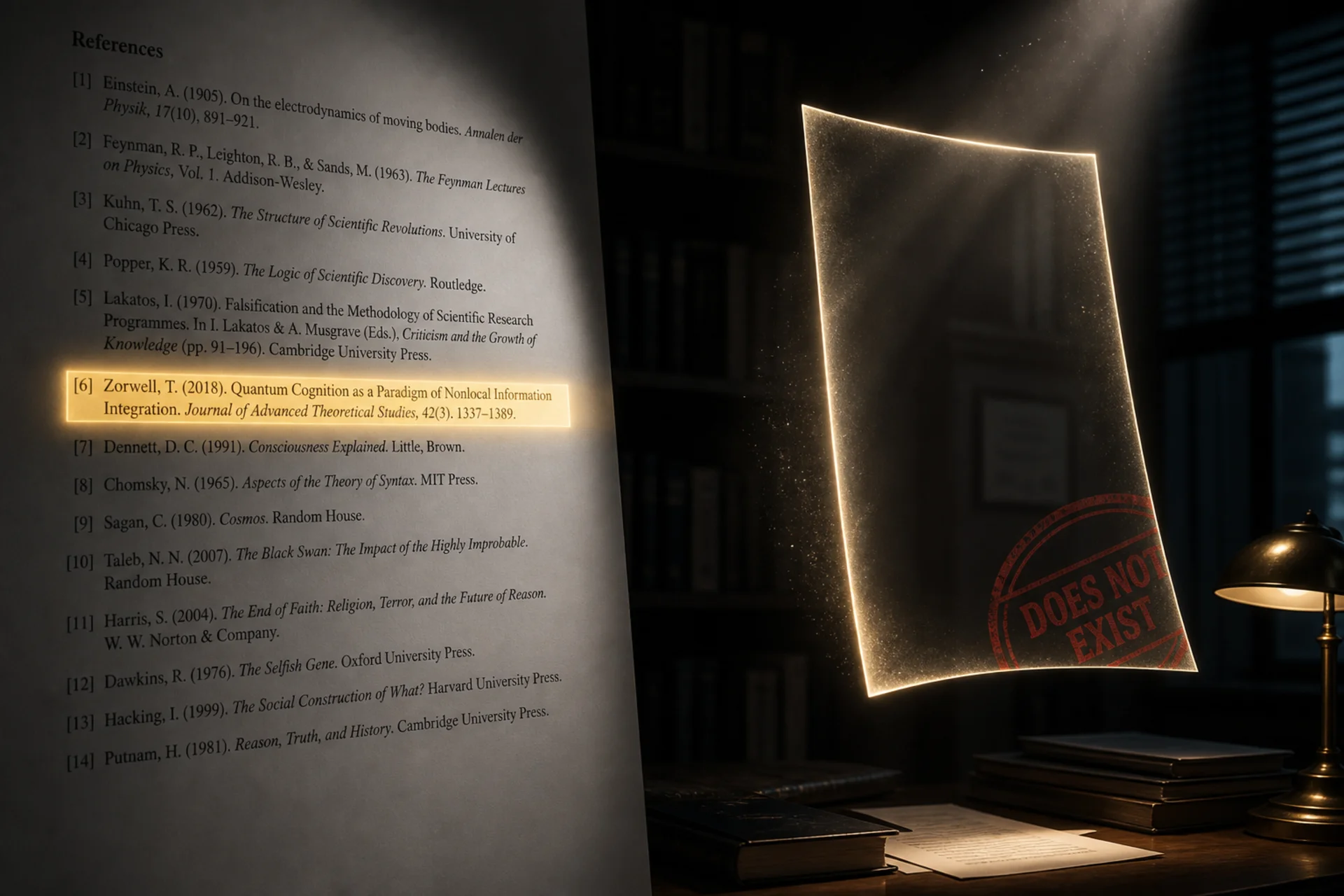
Fabricated references rarely announce themselves — and a literature review is where most of them enter. They typically carry a believable title, a real-sounding — frequently genuinely real — author name, a correctly structured format, and a plausible publication year and journal — yes, with a DOI as well. Formatting alone gives no warning sign.
And this is not particular to citations.
We keep a log of what these tools have done to real text in our own work — dated, with the model named and the passage before and after.
The Ghost in the Machine is our whole current list of AI models' common failures with text. Disconcerting, ugly and unhappy reading, alas.
Two of the twelve common failure cases we identify produce exactly what you are reading about here. A model deletes a real source and reports the deletion as a correction. A model reproduces its own earlier work from memory, so a citation that was right comes back wrong.
In both cases the output reads perfectly well. It always does. That is the whole problem.
Skimming your reference list for anything "off" will not catch this. Only checking each source against the actual paper will.
...ok so how do I actually check if my sources are real?
Don't trust any single signal — a link that opens, a citation that looks well-formatted. The only real verification is opening the actual source at the actual publisher or database and confirming three things by eye.
1. The title matches exactly.
2. The named authors are real and match.
3. The specific claim you're citing is genuinely stated on the page you think it is.
If any one of those three doesn't check out, the source doesn't go in your paper — no exceptions, no benefit of the doubt. Never let a source into your reference list until you've personally done this. If you inherited a reference list from AI-assisted note-taking sessions weeks or months ago, re-verify it now — don't assume past-you (or anyone else) already checked.
And a source can be real and still be worthless.
A 2025 PNAS study found paper mill output growing exponentially, with some publishers reporting up to one in seven submissions as probable paper-mill provenance. The study also identified editors at legitimate journals who repeatedly accepted work that was later retracted.
So a reference can survive every check on this page — real DOI, real journal, real authors, indexed — and still point at fabricated research.
What protects you is not the check. It is reading the source. A paper you have actually read cannot surprise you later.
Why a clean bibliography is not a safe one: Unlucky Seven.
...will my committee reject my whole dissertation over one fake citation?
This isn't a hypothetical risk you're being warned about early — enforcement is already here. Major research platforms have begun banning authors outright for submitting papers with AI-hallucinated references, and top academic venues are moving toward rejecting submissions for undisclosed AI use in citations. If you are already being asked about it, start here. If your committee or school reviewer catches even one fabricated source in your dissertation, it can trigger the exact kind of institutional scrutiny that stalls approval for months — the same structural crisis that verifying citation provenance and purging unverified entries before committee review is meant to prevent. If it is too late for that? It is even more important to call us and get help. Can't wait for business hours? Too stressed? Our Panic page exists to help you talk to someone knowledgeable — not an answering service — 24/7.
...who can help me fix my bibliography before my Chair sees it / Committee Review / School Review / Defense?
Checking format is something a good AI model does well, and we will set that up for you for free. What we charge for is the part it cannot do: we check every cite in your dissertation or thesis against your bibliography, and every reference against the published record. We verify that what you cite exists. Where a source does not appear to say what you cite it for, or does not seem to support your point, we flag it and ask — we do not decide for you, and we do not supply sources — the same standard of deep comprehension before revision we bring to every part of your manuscript, and the same line we will not cross.
Core References
Topaz, M., Roguin, N., Gupta, P., Zhang, Z., Peltonen, L.-M., et al. (2026). Fabricated citations: an audit across 2·5 million biomedical papers. The Lancet, 407.
Bauchner, H., et al. (2026). Fabricated references: a new threat to editorial integrity. The Lancet, 407.
Sadatmoosavi, A., Khasseh, A. A., & Tajedini, O. (2026). Link rot in LIS literature: A 20-year study of web citation decay, recovery and preservation challenges. Aslib Journal of Information Management.
One of nine pages on AI and academic honesty. Browse all 69.

