Chapter 2: Review of Literature
The literature review while fundamentally a formulaic chapter causes a great deal of grief for many doctoral candidates. Critical to ease of writing is ensuring that you have enough directly relevant high-quality sources. Critical to your concluding chapter is having as much possible preceding research that is directly relevant to your specific topic and research questions. Thus, this is a chapter where a very strong sense of linearity supported by never losing track of your own research focus as related to supporting research, is vital. If you view your dissertation as a master work, the review of literature provides the gold frame that will later be used to frame the canvas, represented by your results and the painting that will cover the canvas, that is your final synthesis and conclusions.
One of twelve pages on writing the dissertation. Browse all 69.
Related links

Skills Required for Review of the Literature Chapter:
- Thorough grasp of your topic
- Holistic grasp of research question in the context of the overall field
- Outlining skills
- Narrative writing skills (linearity and continuity)
- Scholarly writing that is clear and concise
On This Page
- What is Chapter 2 actually for?
- What is a review of literature?
- Standing on the shoulders of giants and advancing the art
- What constitutes scholarly literature?
- Current scholarship
- Finding a gap in the literature
- When one source is carrying too much
- Your review is a foundation, not a chapter you finish
What is Chapter 2 actually for?
We often call the review of literature chapter the 'black hole' as so many candidates vanish down this hole, sometimes for terms, sometimes for good. However, this chapter should not be the giant burden that it so often becomes. This chapter reports on a large quantity of prior scholarship, so an organized approach is critical. We will take a quick look at what this chapter should accomplish and then outline approaches to making writing the chapter much more accessible and less stressful.
How many sources does a literature review need?
There is no single answer, and any number offered without something behind it is a guess. Fields differ, programs differ, and a good many institutions decline to publish a figure at all.
Here is the number we use, and here is where we got it. Seventy-five directly relevant, high-quality sources — running to roughly twenty-five pages — is the rock-bottom floor for a doctoral literature review, and most need considerably more.
One exception worth naming. A genuinely narrow, highly technical topic may have a smaller literature than seventy-five sources — not because the work is thinner, but because fewer people have been there. Published ranges start as low as fifty for doctoral work, and some programs will accept that where the topic warrants it.
If you believe you are in that position, establish it before you write, not after. Ask your Chair directly, and be ready to show what your search actually returned.
We took that figure from Capella years ago, and it is still what their Chairs tell candidates when asked. Their Dissertation Chapter Guides say it plainly:
- Many dissertation literature reviews include seventy-five to two hundred sources.
- The literature review section should be a minimum of twenty-five pages, with chapter two running to roughly thirty-five in total, and the average in the mid-thirties.
- The review should be comprehensive and rigorous, and comprised mainly of primary sources.
And it has not moved. We have watched successive editions of that guide since, and the figures are unchanged. A number that survives a decade of revision by the institution that publishes it is telling you something — they have had every opportunity to lower it and have not.
What we can add is what has happened since. We have been reading doctoral literature reviews against that floor for many years, across a good many institutions — not only Capella. It has held up everywhere we have looked. Reviews below seventy-five relevant sources are, in our experience, reliably thin — and the ones that give trouble later are almost always at the bottom of that range rather than the top.
So: their number, our mileage. That is a more useful thing to have than either on its own, and considerably more useful than a figure somebody made up.
And their guidance on knowing when you are finished is the important part: read until you reach saturation. Not until you hit a number. The count is what a properly finished review happens to contain, never the thing you aim at. Tip: saturation is when new sources stop telling you anything new. You open the next paper and it cites the same studies, makes the same argument, and reaches the same conclusion as the last five. That is the signal to stop searching — not a page count, and not a source count.
It is also the honest answer to "how many is enough." A field with a small literature saturates early. A crowded one does not saturate at seventy-five.
One limit worth stating. That is Capella. Your institution may publish something different, and if it does, it governs. What almost nobody publishes is a source count at all — which is why this one is worth knowing.
The number resists being fixed because it is not really the thing being measured. A count is a symptom of coverage, not a substitute for it. Ninety sources that are merely adjacent to your topic make a weaker chapter than sixty that directly precede and support it, because only the second kind can be carried forward into your discussion in chapter 5. Volume is easy to produce and proves nothing on its own.
So the count is diagnostic in one direction only. Falling well short of seventy-five almost always means one of two things, and both are much, much less costly to discover now than in your final term: either the search has not yet been done properly, or the question sits in a space too sparsely researched to build a review on — which is a topic problem rather than a writing problem. Passing seventy-five, by itself, tells you nothing.
What to do instead of counting:
- Check whether your program publishes a written expectation. Some do. If yours does, that number governs, and ours is irrelevant to you.
- Ask your Chair what recent approved dissertations in the program have actually run to. This is a fairer question than 'how many do I need,' because it asks for observed practice rather than a ruling — and a Chair who is reasonably unwilling to invent a threshold can usually point you at examples.
- Search your topic across your institution's databases and Google Scholar within the date range your department accepts, and find out how much directly relevant scholarship exists before deciding what is achievable.
- Then test each source for relevance rather than counting it. If you cannot state a direct logical linkage between that research and your own — at most through intervening and cited work — it does not belong in the chapter, and it was never really part of the count.
Others decline to give a number at all, and reasonably. Sarah Elaine Eaton, whose post on this question has been read well over a hundred thousand times, answers "it depends" — on the topic, the project, and the level of scholarship. She is right, and it is why we tell you where our figure came from rather than presenting it as a rule.
Her more useful contribution is about kind rather than count. At least eighty percent of your sources should be books or peer-reviewed journals from reputable publishers. That is a test you can run on your own bibliography tonight — and a review that fails it will be thin however many sources it lists.
How long should chapter two be?
Two questions, and they get confused constantly.
The review of literature section — in our experience twenty-five pages is the floor and thirty-five closer to typical, and Capella's own chapter guides say the same, setting a twenty-five-page minimum with the average in the mid-thirties.
The whole of chapter two is longer, because the review is one section of it. Your theoretical or conceptual framework, your introduction, and your summary all sit alongside it.
And check whether your program requires a separate review of the methodological literature — how others have studied this, rather than what they found. Some do, and it changes the shape of the chapter considerably.
So what length should this chapter be?
The literature review section and the chapter as a whole have the same answer – as long as they need to be to provide sufficiently thorough answers per your institution's requirements. More specifically?
For the literature review that means it is as long as it takes to cover the scholarship that directly precedes your study — which is why we give a source floor rather than a page target. Cover the literature properly and the pages arrive on their own. Aim at the pages and you will pad.
For the chapter as a whole? The final length is whatever it takes to fully answer each section of the chapter your institution requires, within any page limits it sets.
Padding is visible. It reads as padding to anybody who assesses dissertations for a living, and it invites the one comment nobody wants: '...the chapter is long without being thorough.'
For the dissertation as a whole, there is no useful average. The published figures vary by discipline from around ninety pages to over three hundred — and in our experience dissertations at online universities commonly run 140 to 150 pages, while at a large research university a 300-page thesis is unremarkable. A number drawn from the wrong population will simply tell you that you are short when you are not.
So find your own program's number, it should not take long. A good AI may be able to find it for you (but check its results yourself). If there is a number it will likely be in any guides your university or program publishes. Finally? Your library holds your institution's completed dissertations, through ProQuest or the university's own repository. Find three from your program, in your field, approved recently, and look at their chapter twos. That is the only figure that has ever governed anything where you are — and unlike the numbers online, somebody's committee approved it.
What is a review of literature?
It is what it says it is...a review. That means you are doing the reviewing. You need to identify scholarship that is directly relevant to your chosen topic. Not just in the same field but directly relevant. We cannot emphasize this point enough! Also, this is not the place to express your own opinions nor to introduce your own research. Too many lit. reviews go wrong as much of the scholarship that is reviewed is in the same or similar academic fields but does not directly support your topic. This is a critical point as when you write your concluding chapter you have to be able to demonstrate in your discussion of previous research, how the reviewed research helped create the foundation for your current research. If you cannot perceive direct linkages (or, at most linkages via intervening and cited research) between a given paper's research and your own that research should not be in your literature review as it is not relevant to your work. There should be direct logical linkages between that research and your own. Note, seminal research, leads to later research, that leads to current research, that leads to your research...in a direct chain.
Tip: You need to identify scholarship that is directly relevant to your chosen topic. Not just in the same field but directly relevant.
Avoid predatory journals at all costs as they are not good sources of real scholarship.
Whatever the answer, grey literature must be treated circumspectly, and used only where there is no other choice.
Pro Tip: Run the verification pass in one sitting, per section. Ask your AI to output your bibliography as a plain list — title, authors, direct weblink, nothing else, in the order they appear in your chapter. Then work down it mechanically: click, confirm the title matches, confirm the authors match, tick it off, next.
Do this one chapter section at a time rather than attempting the whole bibliography in a single sitting. Verification fatigue is real, and the errors that slip through are disproportionately the ones checked last, when you have stopped reading carefully and started rubber-stamping.
Some of them are not. You cannot tell by looking, because fabricated references are correctly formatted and plausibly titled.
Standing on the Shoulders of Giants and Advancing the Art
Your research is going to fill a 'gap in the literature' – it will address a question that no prior published scholarship has answered. It will extend scholarly knowledge in the field of your topic. But your review of literature should identify all research that directly precedes and supports your research. Often such research will identify questions that arise from that research – questions you may be addressing.
What constitutes scholarly literature?
The gold standard is research reported in reputable peer-reviewed journals. Avoid predatory journals at all costs as they are not good sources of real scholarship. For some types of theses government reports and statistical sources may also constitute sources. If you are writing about a very fast-moving field (e.g., high technology and especially many IT related topics) you may find that you must rely on the 'grey literature,' that is to say consultants reports and industry research. Unfortunately, in high-tech often the private sector develops new technologies and only then do scholars study those technologies and their impacts. Finally, verify with your university's guidelines or your Chair if 'grey literature' is acceptable? How much of it? And, in what roles? Whatever the answer, grey literature must be treated circumspectly and it is best to minimize its use wherever possible.
Using AI on a literature review — where it helps, and where it ends candidacies
The literature review is the chapter where AI assistance is most tempting and most dangerous, and the two facts are directly related. You need seventy-five directly relevant sources at minimum — in our experience that is the floor, and most reviews need more — and a machine can hand you a list of eighty in under a minute. That list will look entirely credible.
Some of those sources will not exist.
This is not a rare malfunction. Fabricated references in published, peer-reviewed literature rose more than twelvefold in two years; by early 2026 roughly one paper in 277 in a major medical database contained at least one reference to a study that was never written. These are professional researchers with institutional support, publishing in reviewed venues. A doctoral candidate working alone at two in the morning is not better positioned to catch it.
What makes ghost citations dangerous is that they are not sloppy. They carry believable titles, real author names, plausible journals, plausible years, and frequently a DOI. Nothing about the formatting warns you. Only opening the actual source does.
Where AI genuinely helps here:
- Organizing sources you have already found and verified into thematic clusters
- Building a closed, queryable workspace from PDFs you have personally downloaded, so you can ask questions across your own vetted corpus rather than hunting through thirty browser tabs
- Producing a plain list of your bibliography — titles, authors, links only — so you can verify it mechanically and fast
- Reverse-outlining a draft section so you can see what each paragraph actually argues
Where it does not help:
- Finding sources. Use your institution's databases and Google Scholar, then verify. This is not 100% true. The exception is that if you cannot find enough sources, a high-end AI model may find some more. Handle those with extreme care and read each one personally. A good query will clarify for the AI precisely what you need and why.
- Telling you whether a source is directly relevant to your topic rather than merely adjacent to your field. That judgment is the entire skill this chapter tests.
- Summarizing a paper you have not read. You will cite the summary's distortions as though they were the paper's claims, and your discussion chapter will be built on them.
The rule is simple and admits no exceptions: no source enters your relevance document until you have opened it yourself. Full method on our Purging Citation Contamination page, and the broader framework on AI: Use & Abuse.
Current Scholarship
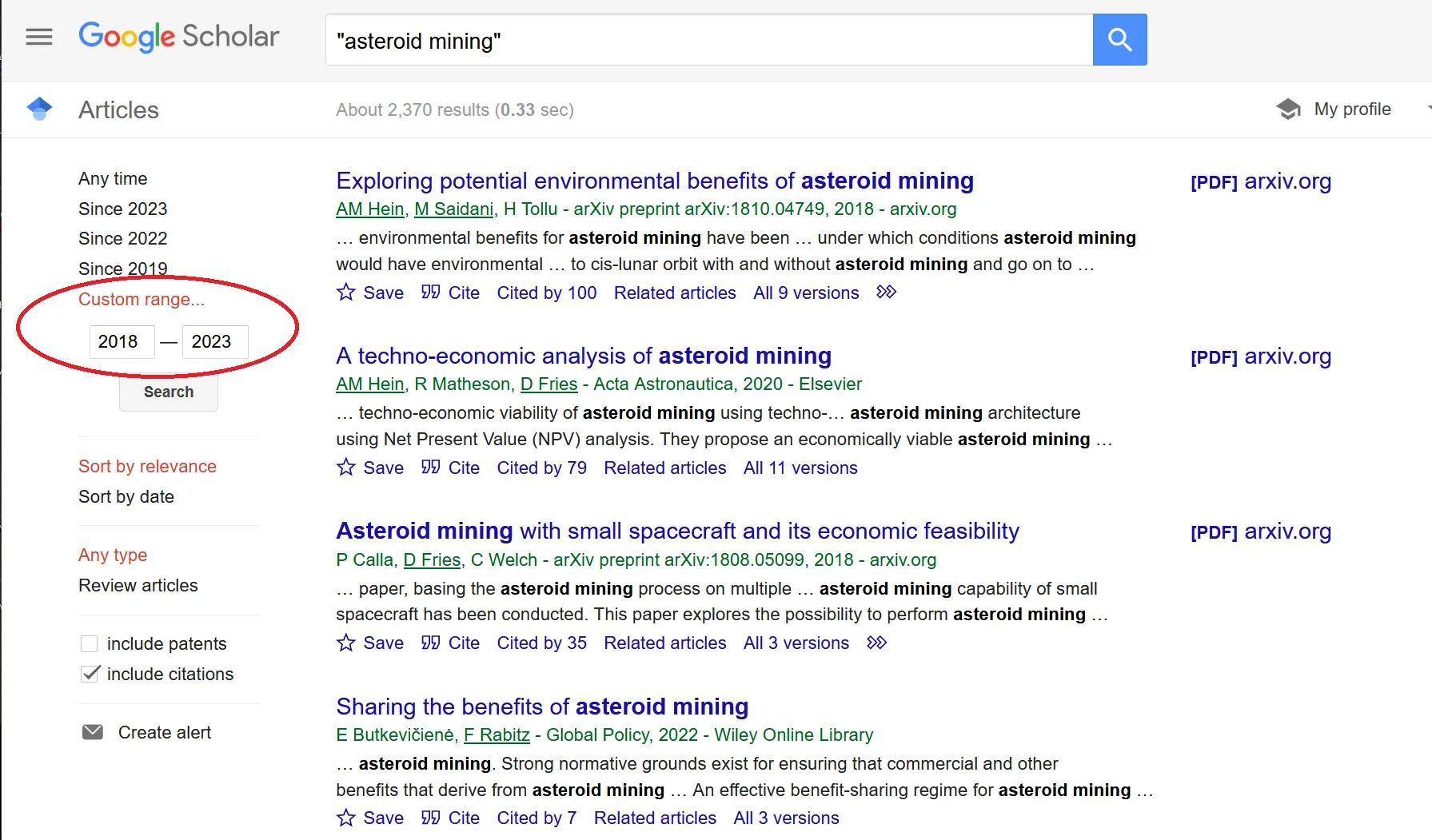
Generally, scholarship should be less than five years old to be considered current, especially in fast-moving fields. For some universities and some fields seven years is considered acceptable – History does not move as fast as, for example, AI research. Always check with your university before you start. The easiest way to find out how much literature fits this limitation is to use the date range feature in Google Scholar and have it search on all available scholarship in a date range. You can use some 'seminal research' – the research that is the original work that founded a field or discipline but this must be kept to a minimum and really should be seminal, i.e., the first research in the field that is foundational to all later research.
Finding a gap in the literature
Sometimes you know what field you are interested in, or need to write in, but are having trouble finding a gap in the literature. Worse, you need a 'goldilocks gap' — big enough to justify the research, small enough that you can actually do it. What to do?
- Approaches
- If you are struggling ask your Chair, they may have suggestions.
- Look up the top journal in your field and skim the last two years of issues. Do not read whole articles, only abstracts! If an article is interesting to you, at that point look at the article and especially their recommendations for future research.
- Talk to practitioners in a field.
- To find scholarly trends, magazines like The Economist (see the science section), Scientific American, Discover, Popular Science, and Wired can be very helpful. Wikipedia pages on the topic can be extremely helpful. However you search? Find the trend, then look up scholarship on Google Scholar.
- Keep the scale of research you can perform in mind at all times!
Bonus tip: put your topic/research questions a few lines below the title and hide them by narrowing the wordprocessor window to only show the title. You can always look at your questions by temporarily enlarging the window. This helps with topic drift when writing and also focus.
Avoid topics where there appears to be little or no scholarly research as it can greatly increase the difficulty of writing a literature review...or make it impossible.
As you do your research keep the 'direct linkage' rule in mind. If you cannot explain a direct logical linkage between a piece of previous research and your own topic that research is not 'on topic.'
N.B. Your topic was rejected, or has proved unworkable — and you do not want to lose the reading you have already done.
You do not have to, and there are two ways it keeps.
Mine it for the replacement. The reading you have already done is the fastest route to your next topic, because you now know the field. You have seen what has been studied, where the arguments are, and which questions keep being deferred to future research. A candidate starting from nothing has none of that. The topic changes; the ground you have covered does not.
And keep the rest for later. A topic your committee will not approve for a dissertation is still a topic, and the reading behind it can become a journal article, a conference paper, or post-doctoral work once the doctorate is finished. Nothing you have read stops being yours because a committee said no to the dissertation.
Keep the notes, keep the sources, and come back to it.
A separate note, on finding the replacement.
Look at the most recent scholarship in the field. Recent work is where the open questions are, and it is written by people who have just finished asking them. Their recommendations for future research are the shortest route to a workable topic there is.
And before you commit, count what is actually there. Clear the floor comfortably rather than exactly — if seventy-five is the minimum, you want to be able to see well beyond it before you start.
Tip: Keep looking for research as your thesis progresses!
Tip: Back up both your thesis and research to the cloud automatically and regularly
Tip: University departments can and do change their expectations for lit. review format so past theses may not serve as good models even if from the same institution and only a few years old.
When one source is carrying too much
A different fault from summarizing, and a candidate can commit one without the other. A review can be properly synthesized — organized by idea, several studies to a paragraph — and still rest almost entirely on one body of work.
Your reader will see it before you do. The tell is that the same name appears in every section, or that the sources cluster in one journal, one decade, or one methodological tradition.
And it makes the study fragile. If that one source is superseded, contested, or simply not what your committee reads, everything built on it moves at once.
There are four versions of this, and they are not the same problem.
One — many sources, one doing the work.
Forty sources in the bibliography, and every substantive claim traces back to one book or one author's body of work. The others establish context and then fall silent.
The check: take your three or four central claims and follow each to the source that supports it. If they all arrive at the same place, that is the fault.
Two — a framework taken whole, with the literature used to decorate it.
Common where a Chair suggested the framework. The candidate adopts it entire, then assembles a review around it rather than one that could have argued with it.
The tell: no source in your review disagrees with your framework, and none proposes an alternative to it.
This overlaps with "your framework doesn't fit." A framework nothing in your review argues with is a framework nobody has tested against your field.
Three — a review built outward from one source's citation list.
The candidate found a good review article, or a strong dissertation, and worked outward from its references. The result looks broad and is not.
You have inherited one author's selection, including what they chose to leave out and what they had not read. Their blind spots are now yours, and you cannot see them from inside their list.
The check: find two or three sources your central source does not cite, in the same area. If that is hard, you are inside somebody else's review.
Four — there is genuinely very little adjacent work, and the single source is a symptom rather than a fault.
Sometimes a candidate leans on one source because there is only one. The question is real, the source is sound, and the field has simply not been here.
This is not a reading failure and it cannot be fixed by reading more. It is a finding about the topic — and it is the one your Chair may actually have been pointing at.
It connects directly to whether you have a workable gap. A gap that supports a dissertation has to be reachable — enough closely related work to situate your study and interpret your findings against. If one source is carrying your whole review, that reachability is in doubt.
The repair is not more searching. It is the question.
If the directly relevant literature is not there, your question is in the wrong place. Widening what you count as relevant does not fix that — it produces a review of work that is not quite about your study, which is a different fault and one your committee will name.
Usually the question moves and the thesis survives. A different population, a different setting, a different outcome measure — the same underlying thesis, asked where the literature can support it.
Sometimes the thesis itself has to change. That is expensive and it is occasionally the honest answer. It is far less expensive now than at chapter five, which is why this belongs in the chapter where you are still choosing.
And that is a conversation to have early. A topic with insufficient foundational and directly supporting literature is survivable at proposal stage and very expensive at chapter five.
Which of the four you have decides what to do, and they need different repairs. Ask your Chair directly: is it that one source is doing all the work, that nothing in my review argues with my framework, that I have built from one author's citation list, or that there is genuinely not enough adjacent literature?
The first three are reading problems. The fourth is a topic problem, and only one of those is fixed by more searching.
Your review is a foundation, not a chapter you finish
Chapter two is not done when chapter two is written.
It is the foundation (the gold frame, if you prefer...) the rest of the dissertation is built on. Your findings mean something because of what the literature already established. Your conclusion contributes something because of what was already known. Both of those are chapter two, doing work in chapter five.
A review that never reappears was never a foundation. It was a background chapter — and that is the commonest reason a dissertation reads as thin while looking complete.
The check takes two minutes, and do it when your draft is finished.
Count how many sources from chapter two appear again in your discussion and your conclusion.
If the answer is very few, chapter two is doing less work than it should. Your review established a body of knowledge and then your findings arrived unconnected to it.
But the real consequence is earlier than that, and this is why it matters now.
Knowing this while you are still selecting sources changes what you select.
A candidate building a background chapter looks for work that establishes context. Reasonable, and it produces a review that reads well and dies at the end of chapter two.
A candidate building a foundation looks for work they will need to engage actively with. In human terms? To argue with. Studies that found the opposite. Studies in a comparable setting with a different result. The paper whose limitation your study addresses. Those are the sources that reappear in chapter five, because those are the ones your findings have something to say to.
The difference is not effort. It is what you are looking for while you read.
And this is the one version of the problem that cannot be fixed late.
A review built from context-establishing sources cannot be turned into a foundation at chapter five, because the sources needed for the argument were never selected. You would be going back to the literature at the worst possible moment, with the least time available.
Which is why we put this here, in the chapter where you are choosing, rather than in the chapter where you would discover it.
How to write a Review of Literature
We have told clients for many years that a solid, on topic, completed and approved Literature Review chapter represents the 65% completed mark for your thesis. It should be done in, at most, one ten or twelve week term or equivalent.
One check before you start writing from it.
Count the lines under each heading in your outline. If they are all about the same length, you have a list of topics rather than an argument — and a chapter written from it will read as a catalog, which is what "be more critical" and "this is descriptive" both mean.
The full check is on our outlining page.
- Create a folder in your browser for your thesis, if you have not already done so see how to write a thesis efficiently page for instructions if needed.
- When you get your first few articles up in tabs on your browser, bookmark these as a group called 'research' or something similar in your thesis folder on your browser. As you look up more research bookmark it directly to your new research folder in your browser. You will be able to open all of your research at once with an 'open all tabs' command, which is very handy.
- Search on your topic with a date range (usually five years, or up to seven) as specified by your institution or department.
- Do you have enough relevant research, related to your own topic?
- N.B. In our experience, seventy-five directly relevant high-quality sources is the floor. Most reviews need considerably more.
- Relevant research will also be a source of seminal research, as seminal research will regularly be mentioned. Look up the seminal research. Not sure what counts as seminal? A quick way to find out is often the wikipedia page on the topic, which usually notes which research is seminal.
- See our resources page for tools and tips, and our blog for longer pieces on doctoral work.
- As always, remember to back up your computer regularly!! Not sure how? See backing up my computer and its data
- Create a document and put in the title of each relevant piece of scholarship and write a paragraph as to why the scholarship is relevant to your topic. Call the document relevance.docx. Relevance is not relevance to your field but to your relevant topic. How does the research support or link to your own research topic? That is the key question.
- Before anything goes into relevance.docx, confirm you have opened the actual source and that its title, authors, and claims match what you are recording. If you did not open it, it does not go in the document. This step costs minutes now and may save your candidacy later.
- In the relevant research document in previous point, flag research by what type of theoretical framework it uses. The most important is research that uses your framework, second most important, is similar frameworks (e.g., you use the UTAUT, other technology acceptance theories, such as the TAM, UTAUT2 etc. are similar models and frameworks).
- Find out what type of reviewing your school is currently looking for. It could be that you report on a study, its methodology, etc. and highlight part of the study that relate to your topic and then do the next study and so forth, or your institution might want a narrative style where multiple pieces of scholarship are discussed in relation to each other.
- When you have enough relevant research follow any advice or guidelines your institution or Chair provide. Remember, the research you are reporting on is the research that directly precedes and supports your own research. Ensure that research using theoretical approaches the same as or similar to yours are well reviewed. Keep the research in chronological order. That gives an overview of how scholarly thinking in your field has evolved — automatically, as a by-product of the ordering. It also helps you to keep things straight in your own mind! Make sure to actually discuss that evolution and any critical turning points!
- Critiquing research. Critiquing research is just that – critiquing. It is not about your opinions of the research, nor is it about how it fits with your own research, nor is it a summary. A critique highlights issues with the research you reported on. Perhaps some scholarship is of limited generalizability (why?) or sample sizes are very small. Perhaps a given study is statistically inadequate, and so on... Critiquing can be a bit mysterious and we can certainly help if you need it.
If you have spent a term or more on your lit. review and it is not done? It is time to get help immediately. It is unnecessarily starting to cost you a great deal of money and delaying your dissertation. This chapter is long but formulaic. Know the formula? Write the chapter. Remember: a solid chapter two, with substantial research directly linked to your topic and research questions, puts you 65% of the way through the whole thesis process. That holds whether your thesis runs five chapters or seven.
One of twelve pages on writing the dissertation. Browse all 69.

