AI: Use & Abuse
— from digital tsunami to relentless academic clarity.
Discover how to responsibly leverage next-generation tools to accelerate your literature review, stress-test your arguments, and insulate your research from critical systemic hazards without compromising your scholarly integrity.
Back to Thesis writing process
One of nine pages on AI and academic honesty. Browse all 69.
Related links
AI: Use & Abuse
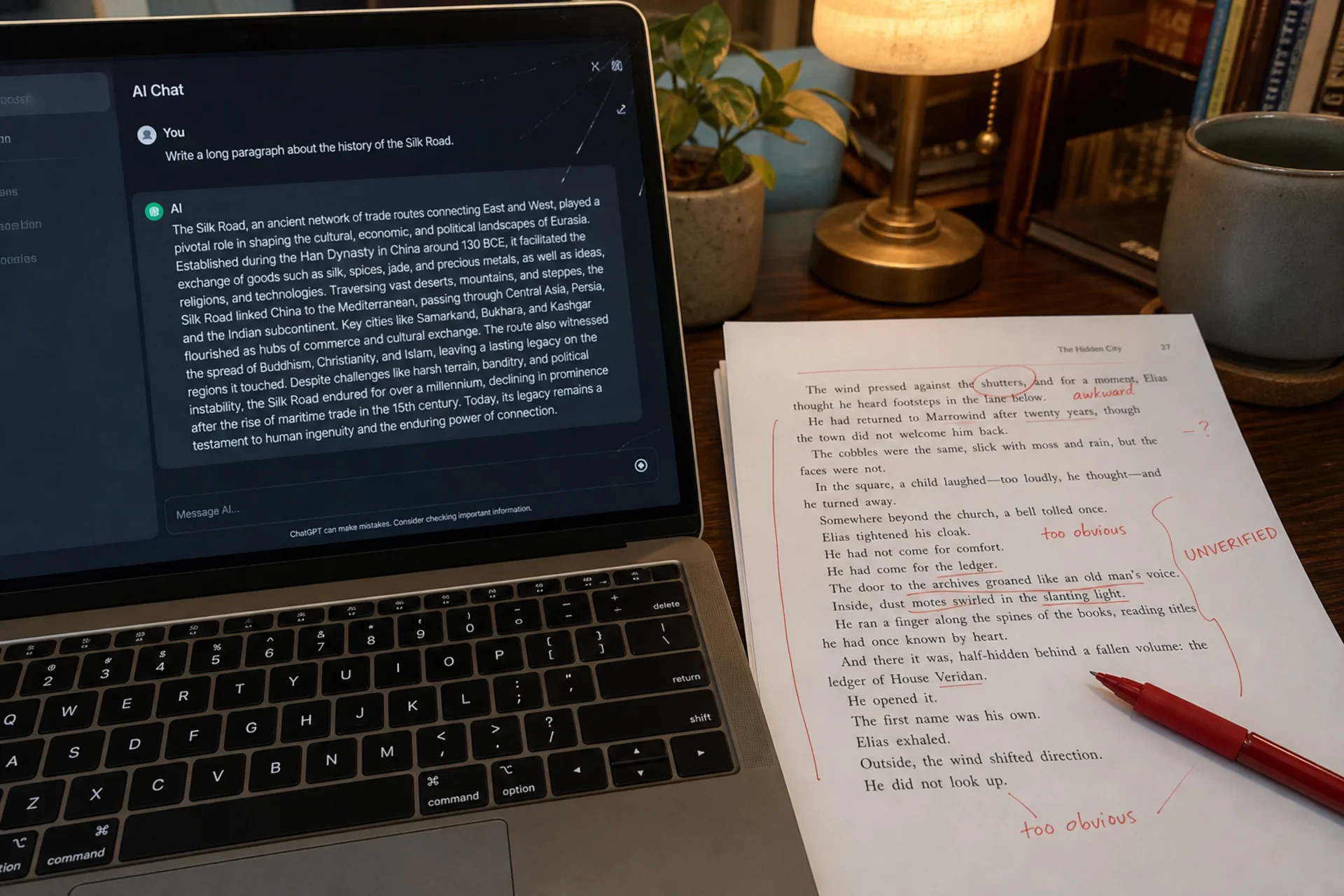
Artificial Intelligence is the most powerful operational assistant a doctoral or MBA candidate can use — if you know exactly where to draw the line. Most researchers get into trouble because they treat AI as a ghostwriter. They ask it to write paragraphs, which results in generic prose, fabricated citations, and instant red flags from university AI detection tools.
To protect your academic integrity and accelerate your timeline, you must treat AI as a bicycle for your mind, not a self-driving car. It is a tool for heavy-duty structural organization, conceptual clarity, and logic checking, never for final prose generation. Use AI for the scaffolding; use your own brain for the brickwork.
We will show you how to set the scaffolding up, and we do that for free — the model, the prompts, the closed research environment. What we charge for is the part no machine does. We read everything relevant, discern what the text currently argues, and work until we grok the whole — the dissertation's intent — before we query a single sentence. What that means in practice.
Advanced research sourcing and ingestion
When you are buried under mountains of source material, AI can serve as a highly customized, hyper-efficient research database. Instead of hunting through dozens of open tabs for where an author discussed a specific variable, you can build a centralized, queryable knowledge engine built exclusively on material you have already vetted.
The key advantages
- Eliminates Scattered Data: Consolidates loose notes, web links, and heavy PDF text blocks into a single, cohesive interactive workspace.
- Hyper-Targeted Semantic Querying: Allows you to ask conversational questions across hundreds of pages of text simultaneously, bypassing the limitations of standard keyword searches.
- Transforms Idle Time into Active Sourcing: Decouples research gathering from your desktop workstation. You can capture high-value intellectual material whenever a breakthrough or discovery occurs, keeping your momentum alive outside the office.
- Conquers "Blank Page" Panic: Provides a structured, interactive playground of your own gathered facts, giving you an immediate launching pad for your outlines.
What these tools do to text — and what to do about it
Everyone knows AI hallucinates. It does, regularly, and you should assume it.
Almost nobody knows about the rest — and the rest is worse, because hallucination announces itself. You go to find the hallucinated citation and it is not there. These do not announce anything at all.
Twelve failures follow. Each one is distinct, each one is common, and every one of them is documented in our own work — dated, and from a high-end frontier model.
- DELETION: It deletes true material and calls the deletion a correction. A real term, a real source, a real distinction — reported as invented, and removed.
- CONFLATION: It reads precision as redundancy. Two sentences specifying different things get merged into one. The prose improves. The meaning goes.
- VAGUIFICATION: It replaces a specific claim with a vague one. Fewer than forty becomes around forty. Nobody queries it, because nobody can.
- SILENT OMISSION: It drops insertions silently. Text you added does not come back, and nothing reports it. Replacements announce their own failure; insertions do not.
- AMNESIA: It forgets what it told you — and gives no signal of having forgotten. It reports a finding instead.
- MISREPORTING: It misreports what just happened, from a record still in front of it.
- MEANING DRIFT: It shifts the meaning while keeping the shape. Ask it to adapt a passage for a different reader and you get something that reads like the same argument and makes a different claim. Nothing looks wrong. It is simply about something else now.
- DEGRADED COPY: It reproduces its own work from memory, and the copy is worse. Ask for the same passage on a second page and you get a paraphrase — shorter, reworded, items missing — presented as the thing itself. This is the most frequent failure on this list by a wide margin.
- SYCOPHANCY: It agrees with you. Ask whether your argument holds and it will say yes. This one needs no case log — it is built into how these systems are trained, and you can reproduce it in seconds with your own work.
- LOST EMPHASIS: It keeps your words and drops your emphasis. Mark a single word italic and the word comes back unmarked. Nothing is deleted, nothing is reworded, and a word-for-word comparison passes — but a reason to look, never the finding is a distinction, and the same sentence unmarked is a slogan.
- FALSE EMPHASIS: It adds emphasis you did not ask for, in the wrong place. Bold arrives on the source rather than the finding, on six sentences in a row rather than one. When most of a passage is emphasized, none of it is — and the reader's eye lands where the machine chose, not where you did.
- REVERSION: It undoes the edits you just furnished to it. Send back a corrected document and the corrections it happened to notice survive; the rest silently reverts to the version before yours. Your file was open in front of it. It treated your work as suggestions and rebuilt from its own draft anyway.
What every item has in common: the output reads perfectly well.
There is no error message. No flag. No gap on the page. The prose closes over the loss and you read straight past it.
And none of this is fixed by using a better model. Every case we found involved current, paid, frontier-tier systems. It is inherent to how they work — probabilistic text-prediction engines, built to sound convincing rather than to be right.
The documented cases, with what happened to the text.
Why this matters more to you than to most people
A journalist who loses a sentence writes another one.
You are producing a document that will be read line by line by people whose job is to find what is wrong with it — and one deleted qualifier, one vagued-out figure, one citation that came back wrong, is enough to trigger a review of everything else.
The failures above are quiet. The consequences are not.
Four defenses. Use all of them.
1 · Close the loop. Never ask a general-purpose model open-ended questions about academic literature or history. Force it to work only within text you paste in or upload to a closed workspace — and tell it to say so when the answer is not there. The closed-loop prompt is below.
2 · Treat every AI-supplied citation as an unverified rumor. Nothing enters your outline or your bibliography until you have opened the primary source, checked the author's exact phrasing, and confirmed the page numbers with your own eyes. How to check a journal itself.
3 · Compare what came back against what you sent. In Word: Review → Compare. It shows you every deletion, including the ones nobody mentioned. This is the only defense against the silent failures, and it is the one almost nobody runs.
4 · Keep dated drafts. Every case above was recoverable, and every recovery came from the same two things — a previous version, or somebody who remembered. How, and why syncing is not backing up.
And the honest limit
A model checking its own work is a first line, not proof.
Two of the twelve failures above were a model reporting confidently on something it had itself got wrong. Asking it again produces another confident answer from the same tendency.
The check that works is comparison against the source. Not a second opinion from the same machine.
A worked example: MFN research in a closed environment
Consider a researcher tackling complex World Trade Organization (WTO) jurisprudence regarding the Most-Favored-Nation (MFN) principle. Trying to keep track of overlapping panel reports, historical exemptions, and academic critiques across dozens of separate documents is a massive cognitive burden.
How to do it. A tool like Google NotebookLM lets you create a private, closed-loop research environment. You create a notebook and upload your source materials — URLs, briefs, text files, PDFs. The tool maps the data and produces a localized expert that knows only what is inside those documents.
If you would rather not hand your sources to Google, Open Notebook is the nearest open-source equivalent. MIT licensed, self-hosted, and it runs local models through Ollama — so your unpublished research never leaves your machine. The trade is citation quality: Google's is more polished, and reviewers say so consistently. You can then ask it: "Compare how Author A and Author B interpret the public policy exceptions to MFN obligations." The tool synthesizes an answer — and gives you clickable citations that point at the exact paragraph in your own uploaded files.
Pro Tip: collect sources away from your desk.
You do not need to be chained to a workstation to do heavy research collection. On a walk or a commute, use your phone to review academic feeds, legal updates, or journal databases.
When you find something vital, clip the URL or the text into a structured mobile bookmarking system — Vivaldi and Raindrop.io both do this well.
Then batch-export the lot when you get back to your desk and feed it into your research workspace in one action.
Pro Tip: the closed-loop prompt.
To stop a model inventing things when it analyzes a block of text, bypass conversational language and give it rigid constraints.
Structure the prompt exactly like this:
"Analyze the text provided below. Answer the following question based exclusively on the attached text: [insert your question].
Strict constraints:
If the answer is not explicitly stated in the text, write 'Information not found in source.'
Do not extrapolate, infer, or bring in any external historical or academic knowledge.
Provide the exact quote from the text that supports your answer."
Stripping away the model's creative freedom forces it to act as a localized search index rather than a writer.
This is the technique the journal checking guide is built on.
One of nine pages on AI and academic honesty. Browse all 69.

