Predatory Journals
— when publication promises replace peer review.
Predatory journals mimic legitimate academic publishing but exist primarily to collect author fees, not to advance scholarship. They are not acceptable sources for a literature review, a thesis, or post-doctoral publication. Knowing how to spot them protects your reputation, your tuition investment, and the integrity of your research.
One of nine pages on AI and academic honesty. Browse all 69.
Related links
Skills Required
- Critical thinking
- Source evaluation skills
- Peer-review literacy
- Literature search discipline
- Healthy dose of skepticism of sources
Predatory Journals
The gold standard for doctoral scholarship remains research reported in reputable, peer-reviewed journals. Predatory publishers exploit pressure to publish by offering fast acceptance, impressive-sounding titles, and minimal — or fake — peer review. Including such material in Chapter 2 undermines your literature review and can trigger serious committee scrutiny. This page explains what predatory journals are, how to recognize them, and how to verify sources before you cite them.
The audit this method came from: The Predatory Wolf in Sheep's Clothing.
The Mechanics of Deceptive Publishing
Predatory journals are publications that charge authors fees while failing to provide legitimate editorial standards, genuine peer review, or meaningful quality control. They often use names that sound like established journals, spam researchers with flattering invitations, and promise unrealistically fast publication. They are not the same as low-quality but sincere journals, open-access outlets with real review, or newer journals still building a reputation. The defining issue is deception: the journal pretends to offer scholarly vetting it does not perform. For your dissertation, predatory material is worse than irrelevant — it can suggest you do not understand what counts as real scholarship. Avoid it at all costs.
Committee Scrutiny and Institutional Risk
Universities treat citations from predatory journals in PhD dissertations with strict scrutiny. Committee members and external examiners generally view them as a primary red flag that lowers the academic rigor of the entire project. Relying on unvetted sources can lead to extensive chapter rewrites, avoidable defense delays, or rejection of the dissertation entirely during the final defense phase.
- The Undermining of Academic Rigor: Because deceptive journals bypass legitimate, double-blind peer review, relying on them completely invalidates the baseline of your literature review. Institutional reviewers expect candidates to evaluate sources critically rather than treating all published claims as authoritative facts.
- The risk of comprehensive structural revisions. If your key findings, theoretical frameworks, or baseline methodologies rest on poor-quality, unverified sources, your committee may require you to strip those sections entirely, forcing a complete rewrite of affected chapters after your defense.
- The Citation Contamination Hazard: Citations serve as the foundational currency that sustains deceptive publishers. Including them in a major institutional document like a PhD dissertation lends an illusion of legitimacy to unverified data and can severely damage your long-term reputation as a rigorous scholar.
Red Flags
No single sign proves predatory status. Clusters of them should make you stop and verify.
And watch for what is arranged rather than stated. The better operations rarely publish falsehoods. They place true fragments so a reader draws a conclusion the page never makes — which means a check that looks for false statements will not find them.
- False or misleading metrics. Deceptive journals invent proprietary quality scores — Global Impact Factor, Universal Impact Factor — to mimic Clarivate's verified Journal Impact Factor or Elsevier's CiteScore.
- Aggressive, Mass Sourcing Tactics: Be highly suspicious of unsolicited, overly flattering emails inviting you to publish or join an editorial board for a journal completely outside your core area of expertise.
- Hidden Financial Frameworks: Legitimate open-access journals display Article Processing Charges (APCs) transparently on their main submission pages. Deceptive platforms often conceal these fees until after an article is "accepted" and copyright is signed over.
How to Verify a Journal
Before citing any journal article in your literature review, run this check.
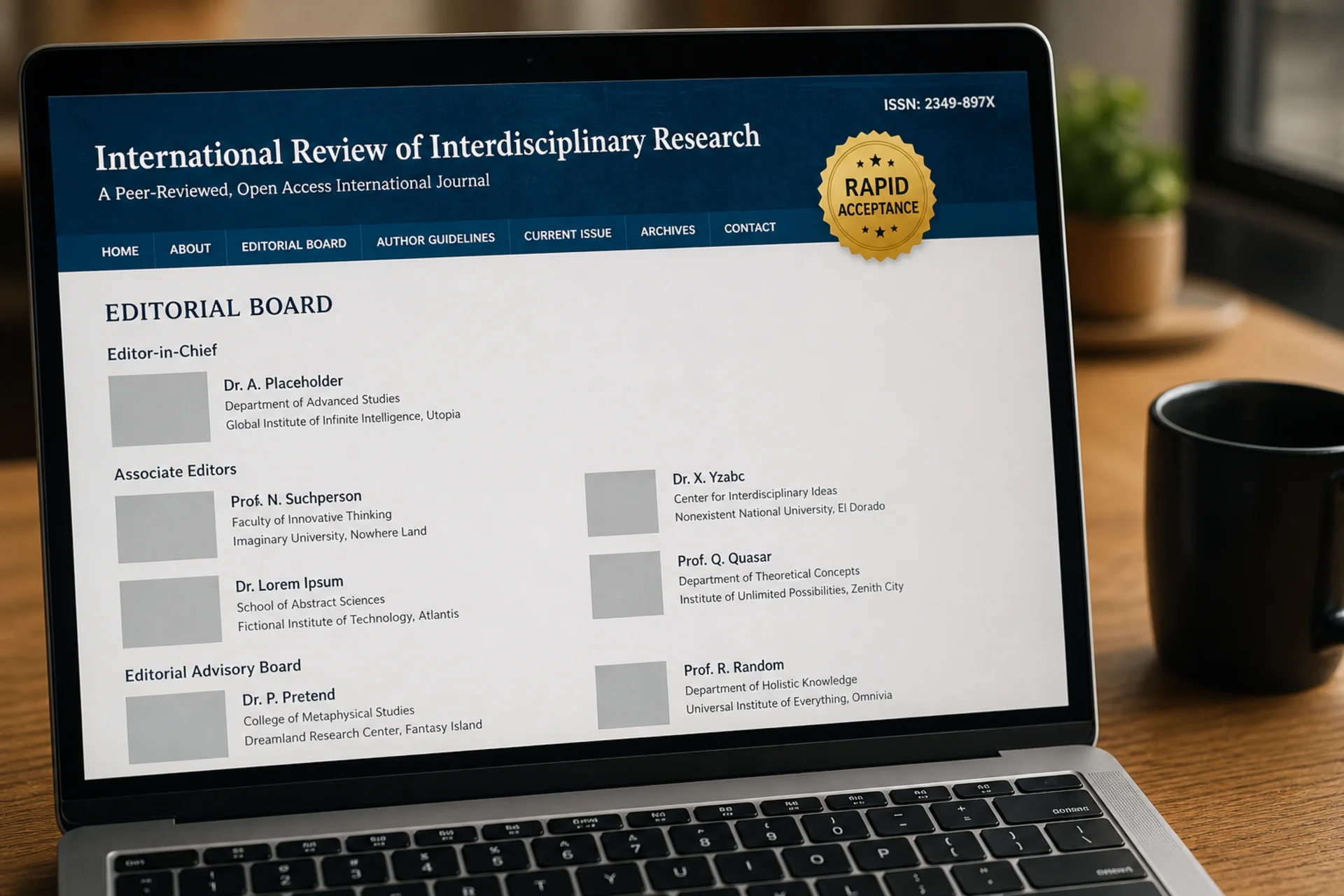
- Look the board up on their own pages. Academics are proud of genuine editorial appointments — they appear on university profiles, on CVs, on ORCID records, because a real board seat is a line somebody put there deliberately. Look up two or three of the names. If the journal is real and they serve on it, it will be listed.
- And watch the title character by character. The commonest trick is a near-identical name — a word added, a word dropped, Journal of against International Journal of. A professor listing one is not evidence for the other.
- Check what the board listing does not say. A board given as names and countries only — H. Jossberger (Germany) — has claimed nothing. No institution, no title, no statement that anyone agreed to serve. Look the name up, find a real academic in that country, and you have supplied the affiliation yourself. The journal never said it, and that is the point.
- Audit the Editorial Infrastructure: Deceptive platforms frequently invent fictional editorial boards or list prominent researchers without their knowledge or consent. Verify board members via their official institutional university profiles rather than trusting the journal's landing page.
- Cross-Check Impact Metrics: Verify that the journal's reported impact metrics match verified global data repositories like Clarivate Web of Science or Elsevier Scopus rather than proprietary imitation scores.
- Utilize Trusted Whitelists: The most reliable baseline check for any open-access journal is verifying its active status in the Directory of Open Access Journals (DOAJ). If an unfamiliar publication is missing from the DOAJ, Scopus, or the Web of Science index, exclude it from your bibliography.
Legitimate Exceptions for Deceptive Sourcing
The rare exception to the absolute exclusion rule occurs when the questionable source or the deceptive publisher itself is the explicit object of your inquiry. This includes qualitative or quantitative research tracking citation manipulation trends, analyzing academic hoaxes, or critiquing structural misconduct within a specific academic discipline. Outside of explicit bibliometric or research integrity studies, you should only cite a questionable platform if you have personally verified the raw datasets, primary methodology, and mathematical proofs as completely sound.
Summary
Predatory journals are not legitimate scholarship. They exist to collect fees while bypassing the peer-review standards your dissertation must meet. Learn the red flags, verify outlets before you cite them, and keep your literature review anchored in reputable peer-reviewed research. When in doubt, exclude the source and keep searching — or ask for help before you invest writing time on material your committee will reject.
Core References
Grudniewicz, A., Moher, D., Cobey, K. D., et al. (2019). Predatory journals: no definition, no defence. Nature, 576(7786), 210-212.
Moher, D., Shamseer, L., Cobey, K. D., et al. (2017). Assessing predatory journals: a survey of scholars and publishers. BMC Medicine, 15(1), 158.
Arenberg Doctoral School. (2026). Academic Publishing and Predatory Practices Guidelines. KU Leuven.
Tertiary Education Quality and Standards Agency. (2026). Academic Integrity and Deceptive Sourcing Frameworks. Australian Government.
One of nine pages on AI and academic honesty. Browse all 69.

