Scholarly Style
Scholarly style is now a little controversial. Formerly, everyone understood what it was. However, the traditional neutral, third-person, passive-voice style favored for scholarly writing is now being supplanted in some universities and institutions with a style more similar to business English. In this style the active voice is used and "I" and "we" can even appear in some writing.
Back to Thesis writing process
One of twelve pages on writing the dissertation. Browse all 69.
Related links
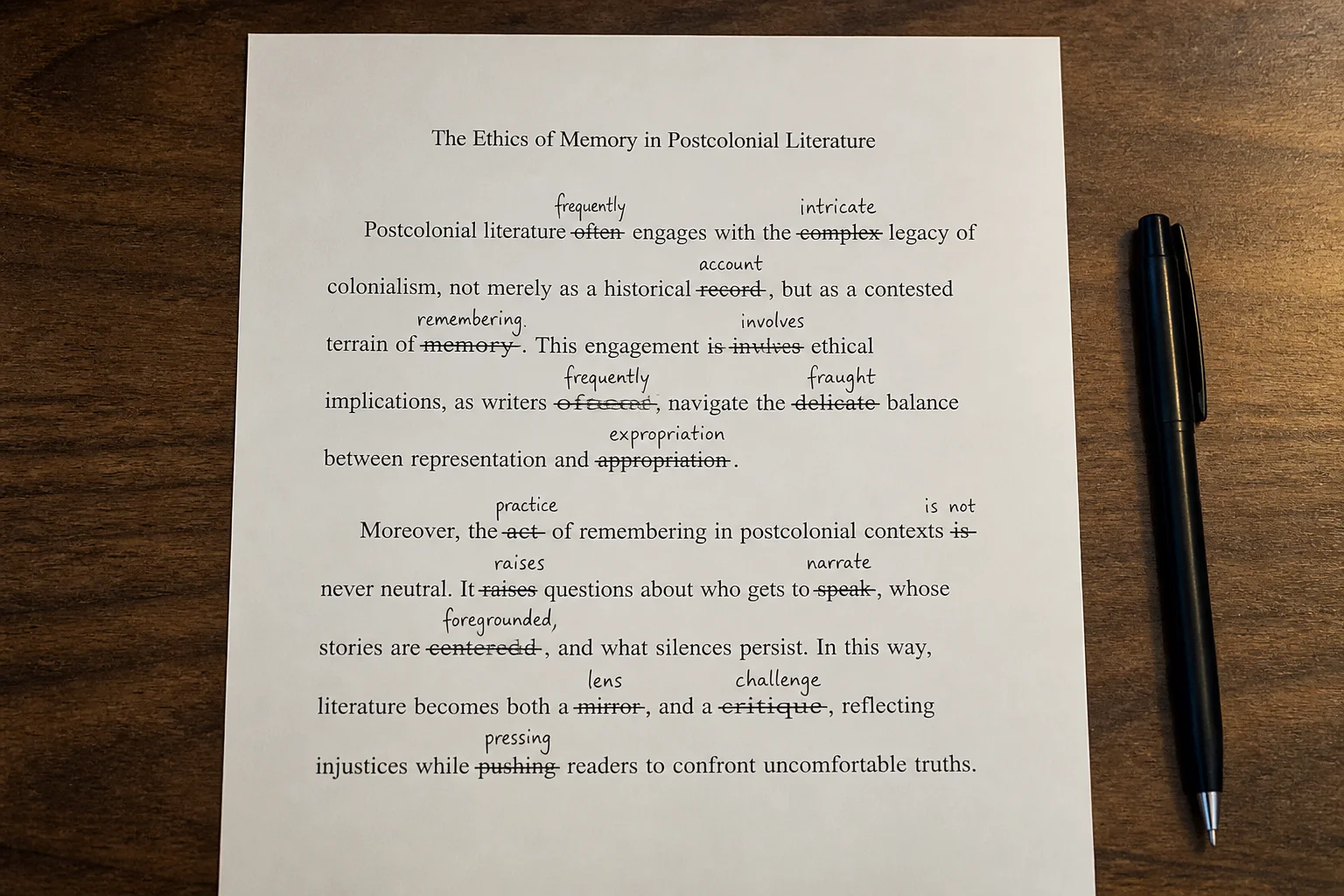
Scholarly style still requires clearly written, strongly narrative language and avoidance of anthropomorphisms and much use of the first person. However, it is often now written in an active voice. Whether you require the more traditional passive voice or active voice we can help.
Clarity in all writing is always critical. The purpose of writing is communication not obfuscation (…although the art of hiding your real meaning seems to be becoming more popular!) Furthermore, clarity is the key to both great writing … and to clear thinking.
"If you cannot clearly explain it in writing you do not clearly understand it…" – quote traditionally, and very rightly, heard from grumpy senior professors.
Clarity
- Acronyms: Limit use of acronyms. Acronyms should not be used unless the term is used extensively in your thesis … and at minimum three times.
- Jargon: use of industry or academic jargon makes text harder to read. A study of 21,486 papers found that citations dropped sharply once jargon exceeded 1% of the abstract — and that none of the most highly cited papers used any jargon at all in the title. One per cent of a 250-word abstract is two and a half words; three jargon terms put you over.
Martínez & Mammola (2021), Proceedings of the Royal Society B, 288(1948), 20202581. Avoid jargon!
Not every technical term is jargon. A methodology chapter cannot avoid heteroscedasticity or saturation, and should not try.
The finding is about unnecessary specialization — terms used where a plain word would do, and acronyms coined for a single paper. - Clarity is enhanced by use of short words and short sentences. The key virtue is brevity. - Avoid "run-on" sentences – these are sentences that go on, and on, and on. Break them up. Once a sentence gets to three lines of text you need to start to be on the alert. - Prolixity. The opposite of brevity. Prolixity is using too many words. Use as few words as possible to convey your meaning. Fewer words = clearer writing.
Prolixity now has an industrial source. Language models produce it by default — many words for a short phrase, a qualifier on every claim, nothing a reader could disagree with. We call it stodge, and it is worth knowing what it looks like before it arrives in your own draft. - Brevity. Keeping it short! Short sentences…and, yes, short words. - Slang – never use slang, or even colloquial usages, in your own academic writing. Keep to plain, standard English. - Focus. Lack of focus in writing, in other words, writing that is vague, wandering, and off the main point is a sign of clarity issues. - Linearity. Lack of linearity usually walks hand in hand with lack of focus and/or lack of clarity. Linearity means a paragraph or section starts at the beginning of a thought or topic and logically and clearly progresses through linked steps to the end of a thought or topic. (see the Linearity section below) - Clear writing is easy on your Chair, your committee, on School Review…and, indeed on you as you will often need to reread passages of your work as you work on later sections. - Lack of clarity wastes time and may retard progress due to misunderstandings about what you mean on the parts of your Chair or committee.
Linearity
Linearity means things flow in a linear fashion (i.e., like in a straight line). It means there is a logical flow to the material that is easy to follow, that avoids asides and digressions and leads to a well-supported conclusion.
- Lack of linearity is:
- Usually related, in part, to lack of clarity and lack of focus.
- Often a cause of prolixity (excess, not to point, verbiage).
- A sign that outline may not have been used to write text.
- Narrative text that is not clear because it does not start at A and go to Z in a direct line.
- Note: Every sentence should follow directly from previous sentence.
- Note: Every paragraph should express one thought. A paragraph about balls should discuss balls and not apples or boxes. In a longer section, usually paragraphs also lead to one another with one thought being expressed which, in turn, sets the stage for the next thought until the topic is concluded.
- Remember, many online universities (e.g., Capella) expect you to use an existing survey instrument. Your topic needs to fit with such an instrument.
- The good news is that an initial review of the literature to find a good topic will also yield supporting research that often uses instruments in alignment with your new topic extending previous knowledge.
- Many universities recommend using only one theoretical framework or theory in a dissertation. We also recommend this in nearly all cases.
Scholarly style
Traditionally scholars wrote in a rather flat, neutral, and formal style couched in the third person, (see example of highly cited paper in right column). Now, some universities including online schools are moving closer to the style favored in business reports based on the active voice (e.g., "We will examine…" versus "The present study will examine…"). However, such schools are still generally minimizing use of first person pronouns such as "I" and "we." Many schools discourage anthropomorphic references — "This paper will examine" — and the usual explanation is weak: a paper is not a person and cannot examine anything.
There is a better reason, and it cuts both ways.
Objectivity is difficult enough for any human and any scholar. The flat third-person style was not an aesthetic — it existed to hold the writer at a distance from the thing being studied, and distance is what keeps you from falling in love with your own hypothesis. This paper will examine is a distancing device. So is the passive. So is denying yourself the word I.
Which is the difficulty with banning it. This paper will examine does hide who did the examining, and a committee assessing your contribution needs to know. But the schools attacking it are attacking the machinery of the very distance their third-person rule existed to create, and most of them have not noticed.
And there is a practical cost to losing it. The first person makes it easy to assert without evidencing — I think, it seems to me, I believe — because a statement of what you think reads as a report rather than as a claim requiring support. The third person does not permit that. The data indicate has to be followed by data.
Follow whichever rule your Chair enforces. But understand what the tradition was for, because the fashion that replaced it has forgotten.
And the rule gets applied far too broadly. English is a rich language, and a great deal of perfectly correct usage is caught in the net. The table shows. The data suggest. The evidence points to. The study found. None of those is a fault, and all of them get flagged by a reviewer working from a rule rather than an ear.
More peculiarly, some online universities have lists of words which they do not want used. That would not be so bad except when it includes words such as "therefore" — and combined with a campaign against anthropomorphic usage it can cost real clarity, and real time, producing worse prose to satisfy a rule nobody can explain.
Maddeningly, these rules are enforced, enforced laxly, or not at all at different times. Be warned if you end up at universities struggling to change normal English usage!
Clear and precise are not the same thing.
A methods section can be perfectly clear and still lose the detail that makes a study reproducible. We have documented what that looks like — two sentences that a current model read as one, because they ended the same way.
When you tighten your own prose, the question is not does this read better. It is have I kept every distinction I had.
...my writing got flagged as AI because it is too clean
Here is an uncomfortable irony, and it is worth understanding before it happens to you.
Everything this page teaches — short words, short sentences, no jargon, minimal acronyms, relentless clarity, one thought per paragraph — produces prose that is statistically predictable. That is not an accident. Predictability is what clarity means at the level of a sentence: your reader knows where the sentence is going, so it is easy to follow.
AI detectors measure exactly that property. They call it perplexity. Low perplexity means highly predictable, and detectors treat low perplexity as a signature of machine writing, because language models also produce highly predictable text.
So the discipline that makes your dissertation clearer, more citable, and easier for your Chair to read is the same discipline that makes a detector more suspicious of it.
This is the detector's failure, not yours. The tools cannot distinguish "clear because the writer worked hard at clarity" from "clear because a machine averaged a million documents." They measure the surface property and infer the cause, and the inference is frequently wrong.
Do not write worse to avoid it. We want to be unambiguous, because candidates do attempt this: deliberately introducing convoluted sentences, unnecessary jargon, or erratic phrasing to raise your perplexity score is a bad trade. You will damage the actual quality of your work, your committee will notice the deterioration, your cite counts will suffer if the work is published, and you will still have no guarantee the detector is satisfied. You would be degrading a real thing to game a measurement.
Write well, and document that you did. Keep your drafts. Keep version history. Keep a dated research log. The defense against a false flag is not stylistic contortion — it is being able to show the work. Our Navigating AI Detection Paranoia page sets out exactly what to keep and what to do if you are accused.
...my dissertation reads like three different people wrote it
Because in a sense it was. Chapter 1 was written eighteen months ago by someone who did not yet understand every nuance of their own topic. Chapter 4 was written at speed under deadline pressure. Chapter 2 was revised four times by four different versions of you, in different moods, at different levels of exhaustion, possibly with different tools.
Voice drift is the most common structural flaw in a finished dissertation and the least often named, because readers feel it before they can articulate it. A committee member who says the work is "uneven" or "doesn't hang together" is frequently reacting to voice rather than logic.
Three things cause it, and all three are worse now than they used to be:
- Time. Chapters written months apart reflect who you were when you wrote them.
- Pressure. Prose written at 2am against a deadline does not sound like prose written when you are fresh, rested, and alert.
- Tool switching. Sections drafted or heavily revised with AI assistance carry a different cadence from sections you wrote unaided — smoother, flatter, more evenly weighted. Mixed through a document, this is conspicuous.
The fix is a deliberate pass over the whole manuscript, reading for voice alone, ignoring content entirely. Read it aloud. Better still, read it aloud to another person. You will hear the roughness instantly: the hesitations, the "ums," the little on-the-fly fixes you make as you go, catching yourself mid-sentence and rephrasing. That roughness is the diagnostic. It also names the actual cost of voice drift: every stumble is a small tax on your reader's attention, a moment spent reconciling something that should have been effortless, increasing reader cognitive load.
Real review is rarely one careful sitting. More often it is fragmented — spread over hours, days, or in many cases, even weeks, with notes taken piecemeal and sections skimmed between other obligations, closer attention paid to some chapters than others. That actually raises the stakes rather than lowering them. A skimming reader has no slack to absorb friction; smooth, consistent prose is what lets a document move quickly and survive a fast read. The moment voice drift creates a snag, a skimming reader does not stop to diagnose it — they just register that something is off, and that impression sticks precisely because they were not reading closely enough to explain it. You are listening for the places where the register shifts — where the sentences suddenly get longer or shorter, where the vocabulary changes level, where the writing stops sounding like a person thinking and starts sounding like a summary.
This is precisely what advanced editing catches, and precisely what sentence-level editing cannot, because every individual sentence may be perfectly correct. See our Editor, Advanced Editor, or Coach? page for where that boundary sits.
Summary of academic style in practice
- Clarity, supported by brevity and linearity are critical
- Run-on sentences, "absolute no-no!"
- Short words are better than long words that mean the same thing (e.g., 'using' versus 'utilizing')
- Avoid prolixity! Keep word counts down.
- Avoid jargon
- Avoid colloquial usages and slang
- Avoid acronyms, unless previously defined
- Acronym's only for more than 3 uses of a term in a paper. Reintroduce in new paper sections also.
Remember! Cite counts correlate with clarity, and clarity with jargon avoidance and concrete language
One of twelve pages on writing the dissertation. Browse all 69.

