What Your Chair's Comments Actually Mean
...the doctoral rosetta stone...
Three words in the margin, and you are supposed to already know what they mean.
You do not. And asking can feel like admitting you should have — which is why so many candidates nod in the meeting and then sit down to a comment they cannot act on.
Below are the longer versions of the phrases that come back most often: what they actually mean, and what to do about them. Have a cryptic comment? Decode it below...
Nothing here costs anything and nothing here requires contacting us.
Back to A Practical, Day-to-Day Reference for Chairs
One of twelve pages on writing the dissertation. Browse all 69.
Related links
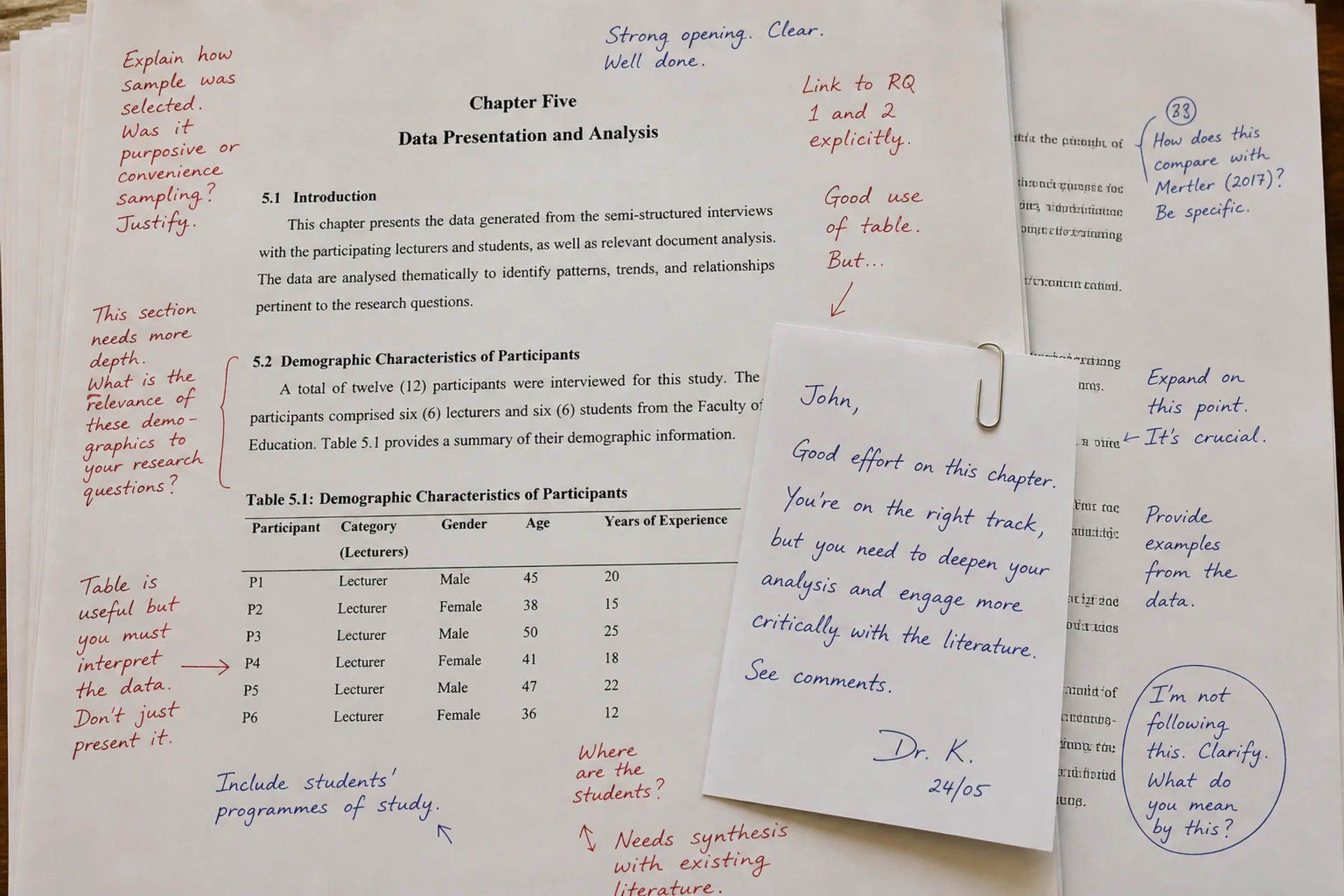
As for this page's image? It is our dream.
That is what we think we will get as feedback when starting our doctoral journey in all innocence — hands on, highly personal feedback.
The reality? Usually a few cryptic, we hope targeted, words.
Scope and framing
"Tighten your scope" / "Narrow your scope"
It does not mean write less. It means ask a less expansive question.
Almost every candidate hears this as an instruction to cut, and responds by deleting material. That is why the comment usually comes back a second time: the words went down, the question did not.
What your reader is actually seeing. A question your study cannot answer with the evidence you are able to collect. Not a bad question — an unanswerable one, by you, in the time you have, with the access to data you have.
It is nearly always one of three things, and each needs a different fix.
One — you want to draw a conclusion about a much larger group than you can study.
Your conclusion is about nurses in general. However, your data comes from just forty nurses at two hospitals.
Those forty are the real scope of your research. Everything your evidence can support is about them and only them.
Whatever your question poses, your conclusions can only be about those forty. Not nurses at those hospitals, not nurses in that state, and certainly not nurses in general. Your reader perceives the gap between the group you wish to address with your findings and the group your data can carry.
In methods language: your stated population is wider than your sample can support.
Two — the thing you are measuring is narrower than the thing you claim to be measuring.
Your study is about student engagement. However, your survey asks students how often they speak in class.
Speaking in class is participation. Participation is one part of engagement. It is not the whole of it.
Engagement can mean attendance. It can mean attention. It can mean effort, or interest, or persistence, or participation. These are six different things, and they do not always move together. A student can attend every class and pay no attention. A student can say nothing and think hard.
You measured one of the six. Your conclusion is written about all six.
Your reader has read your survey. They can see which part of 'engagement' you measured. They can also see that your conclusion is not just about that one part you actually measured, but makes unwarranted claims about components of engagement you did not measure at all.
The fix is not a better survey. The fix is to name what you actually measured and write your conclusion about that. A study of classroom participation is a real study. A study of engagement that measured only participation is a study with a hole in the middle of it.
In methods language: your construct — the abstract thing you set out to measure — has not been narrowed to something you actually measured.
Three — your conclusion claims more than your research design can establish.
You studied the advising program at one community college. However, your conclusion states that advising programs improve student retention.
One program. One college. One group of students. One point in time.
Your study can establish what happened at that college. It cannot establish what happens at colleges in general, because it did not look at colleges in general.
This is not a fault in your data. It is not a fault in your method. Your study may be entirely sound. The problem is the sentence at the end of it, which describes a body of evidence you did not gather.
Your reader is not doubting your findings. They are doubting the reach of the claim you attached to them.
The difference matters because the repair is different. A problem with your data means collecting more of it. A problem with your claim means rewriting a sentence — and sometimes rewriting the chapter that promised it.
Where this usually comes from. Chapter one stated an ambition. This study will contribute to our understanding of advising in higher education. By chapter five you have a finding about one college, and the two do not meet.
So check chapter one before you rewrite chapter five. If the promise at the start was larger than the study could ever have delivered, the conclusion is not where the problem began.
The fix is to state what you found and let the reader see its value. Students at this college who used advising were retained at a higher rate. That is a finding. It is defensible, it is yours, and it will survive questioning — which is more than can be said for a claim about higher education in general built on one campus.
In methods language: your claim has outrun your design.
— morethananeditor.com/feedback · 100% free resources for doctoral candidates
"Your research questions are too broad"
This is close to "tighten your scope" and it is not the same thing. Scope is about how much you are studying. This is about how precisely you have asked the question.
A question is too broad when it could be answered in several different ways, by several different studies, and you have not said which one you are doing.
What factors affect nurse retention? — Which factors? Affect it how? Measured how? In whom? Five different studies could answer that question and none of them would be wrong.
Here are three of them.
Does scheduling autonomy reduce intent to leave among night-shift nurses at two urban teaching hospitals? A survey, measuring one factor against one outcome in a defined group.
Which factors do nurses themselves identify as reasons for leaving? Interviews, open-ended, no pre-chosen factor at all.
Do retention rates differ between hospitals with formal mentoring programs and those without? Records analysis, one organizational factor, no individual nurses asked anything.
All three answer "what factors affect nurse retention." Not one of them resembles the others. Different data, different methods, different findings — and your reader cannot tell which one you are doing.
That is what too broad means. Not that the question is too large to answer, but that it does not say which answer you are going for.
A workable question specifies four things: what you are examining, in whom, in what setting, and what kind of relationship you are looking for.
What is the relationship between scheduling autonomy and intent to leave among registered nurses in critical-access hospitals?
The test: could two competent researchers read your question and design entirely different studies from it? If yes, it is not precise enough yet — and the ambiguity will surface again in Chapter 3, when you have to justify a method the question does not clearly call for.
Still unsure? Ask your Chair, in your own words. Either of these:
- Which part of my question is the part that actually matters?
- Which part is vague enough that it could mean several different studies?
— morethananeditor.com/feedback · 100% free resources for doctoral candidates
"This isn't really a gap"
Frustrating feedback, because you have probably checked and nobody has studied exactly your question. So why is it not a gap?
Because a gap is not simply an absence. Plenty of questions are unstudied because nobody needed the answer, or because the answer is obvious, or because the field settled it under different terminology thirty years ago.
A gap that supports a dissertation has three properties:
- It is unstudied — nobody has answered this specific question in this population.
- It matters — somebody's decisions or understanding would change if it were answered.
- It is reachable. Enough closely related research exists that you can situate your study and interpret your findings against something. A question nobody has been anywhere near cannot be written about, because there is nothing to build the twenty-five pages of literature review within chapter 2 that MTAE treats as a floor.
The most reliable place to find real gaps is in the concluding sections of recent papers, where authors state what future research is needed. They are telling you what the field considered both unstudied and worth studying when that study was published.
Still unsure? Ask your Chair, in your own words. Any of these:
- Has this already been studied, and I have missed it?
- Is it unstudied because it does not matter to anyone?
- Is there simply not enough directly relevant research for me to build on?
— morethananeditor.com/feedback · 100% free resources for doctoral candidates
"Your framework doesn't fit"
Before anything else: check which kind of framework you are supposed to have.
A theoretical framework rests on one existing theory. You take a theory somebody else established, and your study tests it, applies it, or extends it in a new setting.
A conceptual framework is one you build yourself, from several theories and concepts, when no single existing theory covers what you are studying.
These are not interchangeable, and most programs require one specific kind. Check your handbook, and check what your Chair actually wrote — because a candidate who has built a conceptual framework while the program expects a theoretical one has a fit problem that no amount of adjustment will solve.
And be careful here, because the terms are genuinely confused in the field. Some institutional guidance — including guidance from large online universities — uses them loosely or treats them as near-synonyms. Your committee may not — or may follow an idiosyncratic institutional definition of its own.
If your sources disagree, ask your Chair which they mean and get the answer in writing. That is not a difficult question and it is far cheaper than discovering the answer at review.
Now, assuming you have the right kind: what fit means.
It means something quite specific, and this feedback is costly if you misread it.
A framework defines what counts as an answer to your question. It names the things you are looking at, and it tells you which relationships between them are worth examining.
It fits when three things line up.
One. The things your framework names are the things your research questions ask about. Not similar things. Not related things. The same things.
Two. Your instrument actually measures those things. A validated instrument measuring something adjacent will produce clean statistics that answer a question you did not ask.
Three. The analysis your data supports can answer the questions you have posed.
Break any one and the other two stop working.
What to do.
Write your research questions on one side of a page. On the other, write the things your framework actually names — the constructs.
Draw lines between them. Anything left unconnected on either side is a misfit, and probably the one your Chair is pointing at.
And if nothing connects at all, the problem is not fit. It is that you have the wrong framework, or the wrong kind of framework — and that is worth establishing before you spend a month adjusting the one you have.
In methods language: your framework and your operational definitions are not aligned.
Still unsure? Ask your Chair, in your own words. Start with the first one:
- Do I have the wrong kind of framework — should this be theoretical rather than conceptual, or the other way round?
- Does my framework name different things from the ones my research questions ask about?
- Does my instrument measure something other than what my framework names?
- Can the analysis my data supports actually answer the questions I have asked?
— morethananeditor.com/feedback · 100% free resources for doctoral candidates
Evidence and analysis
"This needs more depth"
Almost always this does not mean add more sources. It usually means one of three things, and it is worth working out which.
One: you are describing rather than arguing. Your writing reports what each study found without saying what the pattern across them is, or why it matters for your question. Depth here means synthesis — see "Synthesize, don't summarize" below.
Two: you are stopping at the first level of explanation. You state that something is the case without going into why, what follows from it, or what disagrees with it. Depth means asking "so what?" of your own paragraphs until you reach something that would actually be disputed.
Three: you are not engaging with disagreement. Every field has arguments in it. Writing that presents only the settled parts reads as shallow, because scholarship is the argument.
What the difference looks like.
Description: Chen (2019) found that scheduling autonomy predicted retention. Patel (2021) found a similar effect in a larger sample. Rivera (2022) found no effect.
That is three sentences reporting three studies. A reader learns what was published and nothing else.
With depth: Chen and Patel both found scheduling autonomy predicting retention, in acute-care settings with formal shift systems. Rivera found no effect — in community clinics, where scheduling was already informal and largely self-determined. The disagreement is not really a disagreement: autonomy predicts retention where it is scarce, and predicts nothing where everybody already has it. That matters here, because the hospitals in this study run fixed rotations.
Same three studies. The second says what the pattern is, why the studies differ, and what it means for this dissertation.
Notice what was added: no new sources. What changed is that somebody thought about what the three findings, taken together, actually show.
The test: take any paragraph and ask what claim it makes that somebody could disagree with. If nothing, that paragraph is description, and description is what "lacks depth" very often means.
Still unsure? Ask your Chair, in your own words. Either of these:
- Is my review organized around sources rather than around ideas?
- Does too much of it rest on one book or one author?
Still unsure? Ask your Chair, in your own words. Any of these:
- Am I describing what studies found rather than saying what the pattern is?
- Am I stopping at the first explanation instead of going further?
- Am I avoiding the places where the field disagrees with itself?
— morethananeditor.com/feedback · 100% free resources for doctoral candidates
"Synthesize, don't summarize"
This is a real distinction and often not explained, so here it is plainly.
Summary is organized by source. Smith found X. Jones found Y. Patel found Z. Each paragraph is about one study, and the reader gets a list.
Synthesis is organized by idea. Three studies find X under conditions A, while two find the opposite under conditions B — and the difference appears to be the population studied. Each paragraph is about a finding or a disagreement, and several studies appear inside it.
There is a second form worth knowing about, and it is often the stronger one: tracing how the debate developed over time.
Not a chronological list of studies, which is still summary. An account of how the field's thinking changed and why — what was assumed early, what challenged it, what the field concluded, and what remains unsettled.
Early work treated X as fixed. That held until the mid-2010s, when better measurement showed it varied by context — which split the field into those explaining the variation and those questioning the measure. Neither camp has addressed Y, which is where this study begins.
That paragraph does something a thematic grouping cannot: it shows the reader where your study sits in a live argument, and it makes your gap follow naturally rather than being asserted at the end.
The practical test — count the sources in each paragraph.
If most of your paragraphs discuss exactly one source, you are summarizing. The structure is following your reading list rather than your argument.
Then check the other direction: does any single source appear in more than one paragraph, in different connections? In real synthesis it will — a study that bears on two ideas gets used twice, in two different places, for two different purposes.
This is a structural test rather than a stylistic one, and that matters. A paragraph can open with "Chen (2019) found X, while Patel (2021) found the opposite in a rural sample" and be doing perfectly good synthesis. What counts is whether the paragraph is organized around an idea or around a source.
How to convert: stop reading source by source and group your notes by what was found rather than who found it — or by when the thinking changed. The groups become your paragraphs.
In methods language: your review is source-organized rather than thematically organized.
And there is a different fault that produces similar feedback. A review can be properly synthesized and still rest almost entirely on one body of work — forty sources in the bibliography, and every substantive claim tracing back to one book.
Sometimes that is a reading problem — you built outward from one author's citation list, or adopted a framework whole and assembled a review around it. Sometimes it means there is genuinely very little adjacent work, which is a finding about your topic rather than a fault in your reading. All four versions are set out, with what to do about each, on the chapter two page here.
— morethananeditor.com/feedback · 100% free resources for doctoral candidates
"That's correlation, not causation"
Three words that sound like versions of one idea. They are three different claims, and each takes different evidence.
Correlation. Two things move together. When one is high, the other tends to be high — or tends to be low. Nurses who report more control over their schedules also report higher job satisfaction. That is the whole claim. It does not say which came first, or that one produced the other.
Covariance. How much they move together, and in which direction. Positive when both rise, negative when one rises as the other falls. You will report correlation instead, because correlation is standardized and comparable across studies while covariance is in whatever units you happened to measure.
Causation. One thing produces the other. This needs the cause to come before the effect, the two to be related, and every other plausible explanation ruled out. That last condition normally requires an experiment — people assigned at random, a control group, controlled conditions.
Which one you have depends on how you collected your data.
Nearly every doctoral study is cross-sectional: everything measured at one point in time — a survey, a set of interviews, a dataset, records that already exist. A cross-sectional study can show that two things go together. It cannot show that one changed the other, because you never watched anything change.
Tracking change requires a longitudinal study — the same people, organisms, or phenomena measured again and again over months or years. Almost no doctoral candidate can run one. They take years, usually massive funding, and subjects that stay reachable throughout.
This is a standard and expected limitation of doctoral research, not a fault in your work. Say so plainly in your limitations. This study is cross-sectional: all variables were measured at a single point in time, and it therefore cannot establish causality.
Then check your verbs, because this is where the claim gets in unnoticed.
Causal, though they do not sound it: increases, improves, leads to, results in, produces, drives, affects, develops over.
Safe for a cross-sectional study: is associated with, is related to, differs between, is higher among.
Candidates search their conclusions for the word cause and never find it — because they never wrote it. They wrote improves.
If your analysis uses a covariance matrix, or you want what to put in your methodology chapter rather than your conclusions, there is a fuller version on the chapter three page.
In methods language: your design supports an associational claim, not a causal one.
Still unsure? Ask your Chair, in your own words:
- Which of my conclusions is claiming more than my data can support?
— morethananeditor.com/feedback · 100% free resources for doctoral candidates
"Your findings don't support this"
You ran the analysis. The numbers are right there. So what is being questioned?
Usually not your arithmetic. Usually the gap between what you found and what you are claiming about it.
Three common versions:
- You found a relationship and claimed a cause. Your design shows two things moving together. It does not show one producing the other — the correlation-is-not-causation problem — and stating or implying that it does is the commonest overreach in doctoral work.
- You found something in your sample and claimed it about the population. Your findings describe the people you actually studied, under the conditions you studied them.
- You found something narrower than you hoped, and stretched the claim to cover the gap. This one is rarely deliberate. The results came in smaller than expected and the conclusion quietly grew to compensate.
- You found a difference between groups and claimed a change over time. Your data is a snapshot. Nurses with twenty years' experience report higher satisfaction than nurses with two — that is not the same as satisfaction increasing with experience. The twenty-year nurses are the ones who stayed; the dissatisfied ones left years ago and are not in your sample. A cross-sectional study shows what is true at one moment. It cannot show what happened to anybody.
The check: list every claim your final chapter makes, then list every finding your results chapter reports. Draw a line from each claim to the finding that supports it. Anything without a line is the overreach.
And read every claim for its verb. Increases, improves, leads to, results in, develops over — those are all claims about change or cause. If your study is cross-sectional or correlational, none of them is available to you. Associated with, differs between, is related to — those are.
In methods language: your claims exceed what your data can warrant.
Still unsure? Ask your Chair, in your own words. Any of these:
- Am I claiming a cause when I only found a relationship?
- Am I claiming something about everyone when I only studied my sample?
- Have I stretched a narrow finding to cover more than it can?
- Am I claiming something changed when I only measured once?
— morethananeditor.com/feedback · 100% free resources for doctoral candidates
"Be more critical"
This does not mean be negative, and it does not mean attack the literature. It means stop treating published work as settled fact.
Objectivity is difficult enough for any human and any scholar. The people whose work you are reading were subject to exactly the same difficulty — they had a hypothesis they wanted to be right, a deadline, and a limited sample. Reading critically is not doubting their competence. It is granting them the same conditions you are working under.
Uncritical writing reports what studies found. Critical writing asks how well they found it, and whether it applies to your case.
What that looks like in a sentence.
Uncritical: Chen (2019) demonstrated that scheduling autonomy improves nurse retention.
Critical: Chen (2019) found scheduling autonomy associated with retention in a single-site survey of 112 acute-care nurses. The association was modest and the design cannot establish direction — nurses who intend to stay may simply be given more control. The finding is a reasonable starting point for this study rather than an established effect.
Three things changed. Demonstrated became found. The study's size, setting and design are named, so a reader can weigh it. And the limitation is stated without dismissing the work.
You have not attacked Chen. You have shown you read the study rather than the abstract.
Five terms those questions use.
Population — the whole group your conclusion is about.
Sample — the people or cases you actually studied.
Statistically significant — unlikely to be chance. It says nothing about whether the result is large or important.
Effect size — how big the difference actually is, as opposed to how confident you are that it exists. A result can be statistically significant and far too small to matter.
Replicated — found again by somebody else, in a separate study. A finding that rests on one study is a starting point, not a fact.
The questions that produce it:
Who did they actually study, and does that population resemble yours?
How many, and is that enough to support what they concluded?
How strong is the evidence, actually? A statistically significant result is not automatically a large or meaningful one. What was the effect size? How much of the variation does the model actually explain? Was the finding replicated, or does it rest on a single study? A significant result from a small, unreplicated sample is a starting point, not a fact.
What did their design let them see, and what did it necessarily miss? A cross-sectional study cannot show change over time. A single-site study cannot tell you about other settings.
Who disagrees with this finding, and on what grounds?
And how old is it — has anything changed since?
You do not need to be right that a study is flawed. You need to show you have considered whether it is, and what that means for your use of it.
A practical marker: if you cannot find limitations worth mentioning in sources you cite, you are not reading critically. Every study has limitations — the authors usually list them.
In methods language: you are reporting the literature rather than appraising it.
Still unsure? Ask your Chair, in your own words. Either of these:
- Which studies am I taking at face value that I should be questioning?
- Is there a source you expected me to disagree with?
— morethananeditor.com/feedback · 100% free resources for doctoral candidates
"This is descriptive" / "needs more analysis"
Two phrasings of one comment.
Description says what happened. Analysis says what it means and why it matters.
Description: Twelve of the eighteen participants mentioned scheduling as a source of frustration.
Analysis: Scheduling dominated the frustration accounts, appearing in twelve of eighteen interviews — and notably, all twelve were night-shift staff. That pattern suggests the issue is not scheduling in general but the specific inflexibility of night rotations, which is consistent with Chen's finding and inconsistent with the assumption in the retention literature that pay is the primary driver.
Both are needed. The problem is a chapter that never gets past the first.
The three questions that convert one into the other:
- So what? Why does this finding matter — to your research questions, to the field, to anyone?
- Compared to what? How does it sit against what other studies found, or against what your framework predicted?
- Why might this be? What explains the pattern, and what alternative explanation would you have to rule out?
A useful marker. Analytical writing leaves a vocabulary trail. Scan a section for it:
Cause and explanation — because, therefore, thus, consequently, this suggests, this indicates, which explains, arises from, accounts for, gives rise to
Comparison and contrast — however, whereas, in contrast, conversely, unlike, by comparison, similarly, consistent with, at odds with, diverges from
Weighing evidence — notably, significantly, crucially, importantly, particularly, strikingly, surprisingly
Hedging and qualification — appears to, may reflect, tentatively, arguably, one interpretation is, this could indicate — hedging is a mark of analysis, not weakness. It shows you have considered that you might be wrong.
Position and argument — this study argues, I contend, the evidence suggests, taken together, on balance, extending this
Scan a section for all five groups. If it is thin across every one of them, it is describing.
And be careful of the opposite failure: sprinkling connectives into descriptive writing does not make it analytical. The words are a symptom of thinking, not a substitute for it. If you cannot say what the "therefore" is doing, it is decoration.
Still unsure? Ask your Chair, in your own words. Any of these:
- Which passages tell you what happened without saying what it means?
- Where should I be comparing my findings to something?
- Where should I be explaining why a result came out the way it did?
— morethananeditor.com/feedback · 100% free resources for doctoral candidates
Writing and structure
"Your writing is unclear"
Usually this is not about grammar, and correcting sentence by sentence will not fix it. There are several distinct causes, and they need different remedies.
- One paragraph, one thought. The most common and the easiest to fix. A paragraph carrying two or three ideas forces the reader to hold all of them at once and work out how they relate. Split it. If you cannot say in one short sentence what a paragraph is about, it is doing more than one job.
- Buried structure. The paragraph makes its point in the fourth sentence, after three of setup. Readers of scholarly work expect the claim first and the support after. Move the claim to the front and the paragraph often needs no other change.
- Undefined terms. You are using a word in a specific technical sense without having said so — or, worse, in two senses in the same chapter. Define it once, early, and stay with it.
- Overloaded sentences. Three subordinate clauses, two qualifications, and a parenthesis. Each part may be necessary; carrying them all at once is not. One sentence, one job.
- Undecided thinking. The hardest to see and the most important. A sentence is hard to follow when the writer has not settled what it is claiming, so it tries to hold several possibilities at once. The reader feels the strain and calls it unclear.
That last one is why smoother sentences often do not fix the problem. If the thinking is unresolved, rewriting produces a more elegant version of the same fog.
The test that separates them: read a paragraph, close it, and ask what point it made. Not what it was about — what it claimed. Something you could repeat tomorrow, that somebody could disagree with.
If a point comes back but the paragraph reads badly, it is structural — splitting, reordering, or a definition will fix it. If nothing comes back at all, the thinking is not finished, and no amount of rewording will help. Work out what you are claiming first. Not sure how? Best to visit the Clarity and Outlining pages for the mechanics of how.
Still unsure? Ask your Chair, in your own words. Any of these:
- Can you point me at one paragraph that gave you trouble?
- Are my paragraphs carrying more than one idea at a time?
- Am I burying the point after too much setup?
- Am I using a term without having defined it?
- Are my sentences trying to do too much at once?
— morethananeditor.com/feedback · 100% free resources for doctoral candidates
"This doesn't flow"
Different from "unclear." The sentences make sense individually. The problem is that the reader cannot see how each one connects to the last.
Three common causes:
- No signposting. Scholarly readers rely on words that signal how ideas relate — however, therefore, in contrast, building on this, despite. Writing with none of these reads as a list of true statements with no argument running through it.
- An order that made sense to you and not to a reader. You wrote it in the order you thought of things. The reader needs the order in which the argument builds — and those are rarely the same. This is frequently a sign of writing without an outline, or of straying a long way from one.
- Missing steps. You moved from A to C because B was obvious to you. It is not obvious to a reader who does not already know your study.
The diagnostic: read only the first and last sentence of each paragraph, in order, skipping everything between. That skeleton should still make an argument. If it reads as disconnected assertions, the flow problem is structural rather than a matter of transitions.
Still unsure? Ask your Chair, in your own words. Any of these:
- Is it the connecting words between my sentences?
- Is it the order I have put the sections in?
- Have I left out a step that seemed obvious to me?
— morethananeditor.com/feedback · 100% free resources for doctoral candidates
"This reads as uneven"
Or "it doesn't hang together," or "the voice shifts." This is a reaction a reader can feel but often cannot locate, which is why the feedback sounds vague.
It is usually one of three things.
Time. Chapters written months apart reflect who you were – and what you knew - when you wrote them. Your understanding, vocabulary and confidence may have changed significantly since.
Pressure. Prose written at 2am against a deadline does not sound like prose written when you are fresh and alert.
Tool switching. Sections drafted or heavily revised with AI assistance carry a different cadence from sections you wrote unaided — smoother, flatter, more evenly weighted. Using different AI models heightens this — and so does using the same one over a long project. The models change, exactly as you do. Text assisted in 2024 does not sound like text assisted now, for the same reason chapter one does not sound like chapter five. Mixed through a document, this is conspicuous.
What it sounds like.
Written early, unaided: The literature on nurse retention is extensive but the findings do not agree. Some studies point to pay, others to scheduling. It is not clear which matters more.
Written eighteen months later, with AI assistance: The extant literature on nurse retention presents a complex and multifaceted picture, with scholars identifying a range of contributing factors including compensation, scheduling flexibility, and organizational support, though the relative weight of these factors remains a subject of ongoing debate.
Both say roughly the same thing. The second is smoother, longer, more evenly weighted, and sounds like nobody in particular.
Neither is bad writing. Together in one chapter, they are conspicuous — and your reader hears the join before they can say what it is.
The diagnostic takes ten minutes. Copy the first paragraph of every chapter into one document, in order, and read them together with nothing else around them. Coherent work reads as one writer throughout. Where it does not, you will hear it immediately — and you will know which sections need a consistency pass.
Still unsure? Ask your Chair, in your own words. Any of these:
- Which sections sound different from the others to you?
- Is it the ones I wrote months apart?
- Is it the ones I wrote in a hurry?
- Is it the ones where I used AI assistance?
— morethananeditor.com/feedback · 100% free resources for doctoral candidates
Method and literature
"You need to justify your methodology"
This does not mean explain what your method is. It means explain why it was the right choice for your question, rather than the obvious alternatives.
A justification that only describes your approach reads as a manual. A justification that survives questioning does three things:
- Names the alternatives you considered — the other designs that could plausibly have answered your questions – if they existed.
- Says why each was rejected, in terms of your questions rather than your convenience. "Would not have captured the mechanism I am asking about" is a reason. "Would have been harder" is not.
- Cites studies that made the same choice in comparable circumstances, and says how it went for them.
The test is a routine defense question: why this method rather than the obvious alternative? If you cannot answer in two sentences, the justification is not yet in the chapter.
Still unsure? Ask your Chair, in your own words. Any of these:
- Which other design would you have expected me to consider?
- Have I said clearly why I rejected it?
- Should I be citing studies that made the same choice I did?
— morethananeditor.com/feedback · 100% free resources for doctoral candidates
"You need to engage with the literature more"
This rarely means read more. It usually means your writing treats the literature as background rather than as something you are holistically interacting with on a scholarly basis. In human terms '...in a searching and active conversation with.'
The distinction: background literature sits before your work, establishing context and then falling silent. Engaged literature runs through your work — supporting a claim here, contradicting one there, being extended or challenged by what you found.
Three markers of engagement:
- You disagree with something, somewhere. A review in which every source is treated as correct reads as uncritical. Fields contain arguments; a review that shows none has not found them.
- The literature reappears after Chapter 2. If sources are cited heavily in your review and barely afterwards, you have written a background chapter rather than a foundation. Your findings discussion should be dense with the work you reviewed — that is where you say what your results mean in relation to what was already known.
- You position yourself. Somewhere you say, in effect: this camp argues X, that camp argues Y, and my study sits here. Without that, a reader cannot tell what conversation you think you are joining.
The quickest check: how many sources from your literature review reappear in your results discussion and your concluding chapter?
Both matter, and they do different work. Your discussion is where each finding is set against what was already known — this is consistent with Chen, and contradicts the assumption in the retention literature. Your concluding chapter is where you say what the study as a whole contributes to that body of work.
If your sources appear heavily in Chapter 2 and thin out afterwards, that is what the feedback is about. You have written a background chapter rather than a foundation.
Still unsure? Ask your Chair, in your own words. Any of these:
- Do I ever disagree with anything I have cited?
- Do my sources disappear after chapter two?
- Have I said where my own study sits among the arguments in the field?
— morethananeditor.com/feedback · 100% free resources for doctoral candidates
Who to ask — and how to ask an AI so it tells you something true
Before you ask anyone: most of these you can answer yourself.
Open your draft and look. Do my sources disappear after chapter two? You can count. Do I ever disagree with anything I cited? You can search. Am I claiming a cause when I only found a relationship? You can read your own conclusion.
The question was the thing you were missing, not the answer. You could not act on "be more critical" because nobody told you what to look for. Now somebody has, and your draft is in front of you.
Ask your Chair the ones only they can settle.
What your program expects. Which alternative design they had in mind. Whether the gap is real. Whether the framework is the right kind. Those depend on your institution, your field, and their judgment — and nothing else can supply them.
And be realistic. Your Chair may take a week, and the AI is in the next tab.
Some of these it answers usefully. Several it will answer confidently and wrongly. The difference is worth knowing, and so is how to ask.
What it does well: finding things in text you give it.
List every causal verb in this conclusion. Find every paragraph carrying more than one idea. Find every term I use without defining. Which sources appear only once in this chapter?
Those are searches over text you supply, and you can check the answer by looking.
What it does badly: anything about the world outside the text you gave it.
Has this been studied? Is there enough directly relevant research? It cannot reliably search the literature and it will produce citations that do not exist.
What does my committee expect? It does not have your handbook.
Is this good enough? It will say yes.
How to ask so the answer means something.
One — give it the text. Never ask about work it cannot see. "Is my literature review critical enough?" produces a paragraph of plausible advice about literature reviews in general. Paste the section and ask what it actually finds.
Two — ask it to find, not to judge. "Find every claim in this passage that goes further than the evidence I have quoted" gets you a list you can check. "Is this well argued?" gets you a compliment.
Three — tell it what you have, in one line. "This is a cross-sectional survey of forty nurses at two hospitals." Without that it will assume whatever makes your writing look best.
Four — ask for the case against. "Give me the three strongest objections a committee could raise to this paragraph." Asking for problems works. Asking whether there are problems does not.
Five — make it point at the text. "Quote the sentence you are referring to." If it cannot quote it, it invented it — and you have just caught it.
Six — ask the same thing twice, in different words. If the answers contradict each other, neither one is knowledge.
The one thing to hold on to.
An AI will agree with you. Ask whether your framework fits, and it will find a way to say broadly yes. Ask whether your conclusion holds, and it will say yes with a suggestion attached.
Your Chair said it does not fit. The AI will tell you it does.
One of them has read your dissertation and has to defend passing it.
What to do when the answer is still vague
Every entry above ends with a specific question. That is deliberate, and it does two things at once.
If you ask it and get a specific answer, you know what to repair. "The population — you cannot generalize past your sample." You now have work you can do.
If you ask it and get a broader version of the same comment, that is also information — and it is not a failure on your part.
A reader's sense that something is wrong very often arrives before the words for it do. That is not a criticism of your Chair. It is how reading works, for all of us. Your supervisor may be registering something real that they have not yet articulated, and lacks depth is what a genuine reaction sounds like before it has been examined.
Two things follow, and both matter.
Do not dismiss it. An unarticulated reaction is still a reaction, and it is usually pointing at something. Readers are rarely wrong that a problem exists. They are frequently wrong about where it is.
And keep the question specific. "Which section were you reading when you felt that?" is easier to answer than "what do you mean?" — and the answer locates the problem even when your Chair cannot name it.
A specific question is a kindness as well as a tactic. It gives your supervisor something to answer rather than something to defend.
One of twelve pages on writing the dissertation. Browse all 69.

