Professional Degree Capstones and Theses
A capstone is not a 'small dissertation'. The formats vary enormously — a consulting report, a program evaluation, an applied project, a thesis proper — and what your program requires may look nothing like what another requires.
What does not vary is that they run into trouble. That is where we come in. Nothing on this page costs anything, and nothing here requires contacting us.
One of seven pages on getting started. Browse all 69.
Related links
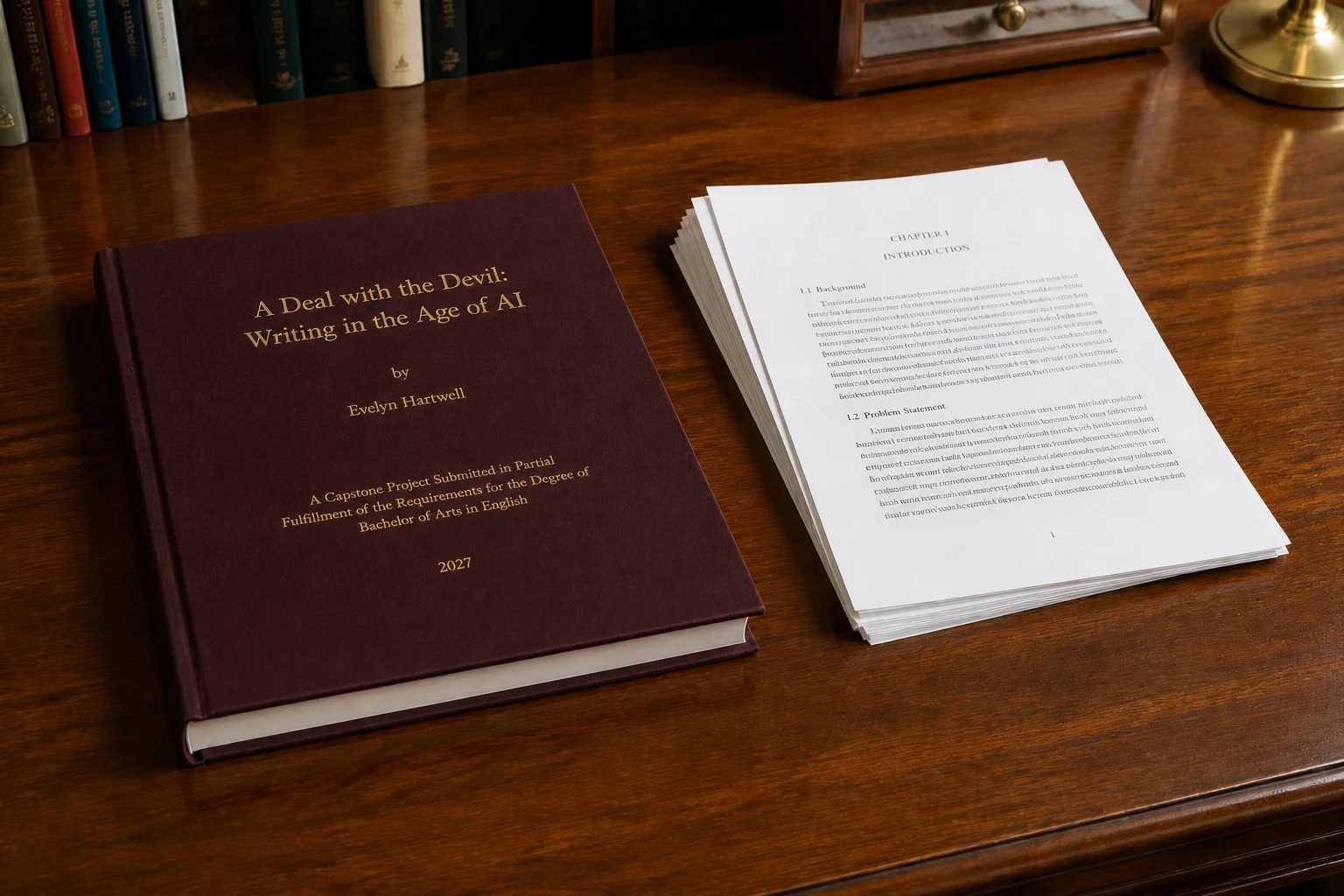
Most of our master's-level work has been professional degrees, for a reason: a professional degree is a career investment with a deadline attached. A delay is measured in promotions and salary bands, not semesters.
The failures, however, are the same failures. The question and the method not matching. An argument with a step missing. Evidence that does not support the conclusion drawn from it. The same faults at every scale and in every format — which is why the rest of this site applies to you without adaptation.
Which degrees
These are examples, not a list of specialties. The work is broadly the same across professional degrees, and our competence covers essentially all of them.
Business — MBA, MSOD (MS in Organization Development), MS in Business, MS in Global Business, MS in Applied Finance, MS in Business Analytics, MS in Real Estate, MS in Human Resources, MS in Management and Leadership.
Beyond business — MPA, MSW, MSN, MHA, MPH, MEd, and their equivalents.
If your degree is not listed, it means little. Professional master's programs multiply and rename constantly. What matters is whether you are writing a substantial piece of assessed work under supervision. If you are, this applies to you.
What is different from a doctorate
Chiefly, that a capstone is applied. It solves a problem rather than filling a gap in the literature. The question is usually what should this organization do rather than what is not yet known. That changes what the evidence has to do, and it changes what counts as a conclusion.
Beyond that, generalizations are unsafe. Length, timeline, supervision and format vary so widely between programs that anything we told you would be wrong for somebody. Your program handbook is the authority, and it is worth reading twice.
What is exactly the same
Everything about how it goes wrong.
The question and the method not matching. An argument that skips a step. Findings that do not support the conclusion drawn from them. A literature section that summarizes rather than synthesizes. Prose that reads well and says nothing.
Which is why the rest of this site applies to you, in full and without adaptation:
- Clarity — the seven tenets, and the tests
- What your supervisor's comments actually mean — the same phrases, the same confusion
- Outlining and scholarly style
- Chapter three and chapter four — methodology and results, at any scale
- When it has stalled and when it has been returned
Where knowing the field matters
Most academic help is subject-agnostic — structure, argument, evidence, whether the conclusion follows. That is most of what any capstone needs, and most of what we do.
Business capstones are sometimes the exception. A case analysis stands out when it sees further than the case: what the sector does next, which comparable failed and why, where the forward risk actually sits. That is not editing. It is knowing the field.
And sometimes the question is a test. A good advisor poses one the candidate cannot easily answer — that is what a seminar question is for, and it is usually good teaching. Answering it with real insight, rather than adequately, is what separates a pass from work somebody remembers.
Our founder has been writing on technology and business since the early nineties — thirty-five years, and the record is public. He learned to program in 1973 — Fortran IV, on an IBM 360.
This is the only place on this site where we suggest working with our founder directly.
Everywhere else, that would be a waste of your money. A sherpa is the right person for a capstone, a chapter, a stalled draft, a rejection. We say so on every other page and we mean it.
But if your analysis needs world-class technology and business insight — quite possibly with the policy implications attached — the price is small against what it changes. For any other candidate? It is not worth it, and we will tell you so.
It remains coaching. We ask the questions and supply the context. The analysis and the words stay yours.
AI, and what it does to a professional thesis
Professional candidates use these tools more than doctoral candidates do, for a reason that has nothing to do with integrity: you have a job, a deadline, and less time than anybody.
Your program's rules are probably vaguer than a doctoral program's. Professional programs are newer, they rename and multiply, and their integrity policies have often not caught up. Find out in writing what yours permits, at the start — how to ask, and how to get a usable answer.
You will be told these tools hallucinate. They do, regularly. What nobody mentions is what else they do to text.
- They delete true material and call the deletion a correction. A real term, a real source, a real distinction — reported as invented, and removed.
- They read precision as redundancy. Two sentences specifying different things get merged into one. The prose improves. The meaning goes.
- They replace a specific claim with a vague one. Fewer than forty becomes around forty. Nobody queries it, because nobody can.
- They drop insertions silently. Text you added does not come back, and nothing reports it. Replacements announce their own failure; insertions do not.
- They forget what they told you — and give no signal of having forgotten. They report a finding instead.
- They misreport what just happened, from a record still in front of them.
- They reproduce their own work from memory, and the copy is worse. Ask for the same passage on a second page and you get a paraphrase — shorter, reworded, items missing — presented as the thing itself. This is the most frequent failure on this list by a wide margin.
- And they agree with you. Ask whether your argument holds and the answer is yes. You can reproduce that one in seconds with your own work.
Every one of those leaves prose that reads perfectly well. No error message, no gap on the page.
On a capstone this is worse than on a dissertation. You are writing about an organization you know and a reader does not. A doctoral committee reading a methods chapter has the field to check you against. Nobody is going to notice that the figure in your recommendations no longer matches the figure in your findings.
What these tools actually did to real text — dated examples, with what happened to the passage.
One thing to do tonight. Before you accept anything back from a model, compare it against what you sent — in Word, Review → Compare. Ten seconds, and it shows you every deletion nobody mentioned.
Before you write: get the list
Doctoral programs have decades of convention behind them. A professional program that renamed itself two years ago may have a template, a rubric and a handbook that disagree — and nobody will tell you which the reader is actually using.
We diagnose and coach. We do not write.
This needs saying here more than on any other page.
A professional candidate often has money and no time — the combination that makes ghostwriting tempting, and the combination the mills target. We will not do it, not for a capstone, not for a thesis, not at any price.
We diagnose and coach. We read what you wrote, tell you what is wrong with it, and work with you to address it.
We always keep you safe. The words stay yours.
And if you need a proofread and nothing more, we will say so — see what help you actually need, where the honest answer is often none.
One of seven pages on getting started. Browse all 69.

