University Abstract Word Limits and Rejections
...can't squeeze your abstract down?
If you are staring at a draft that was just rejected because it is over the word limit or fails to meet specific content requirements, your dissertation approval is on hold. Whether you are at a traditional brick-and-mortar university or an online institution like Capella, Walden, Grand Canyon University, Liberty, or the University of Phoenix, rigid word count and content requirements turn abstract writing into a stressful roadblock right when the end is in sight.
One of twelve pages on writing the dissertation. Browse all 69.
Related links
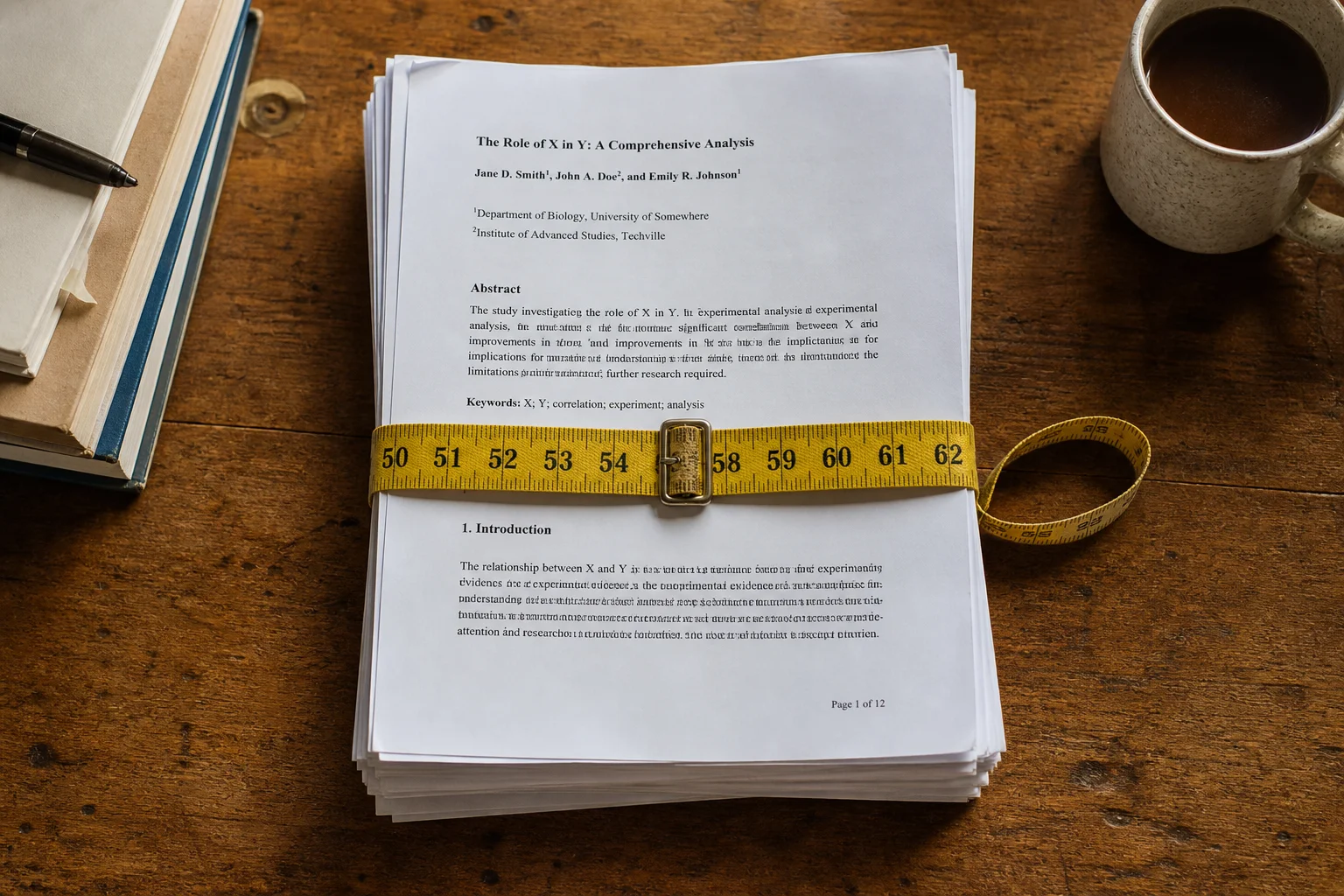
Most schools enforce a hard cap on your abstract length — usually 250 words. They also demand specific content requirements. The institutional submission systems, including the ProQuest ETD Administrator system, are completely mechanical. If the limit is 250 words and your text is over the line or missing a required section, the system rejects the file automatically.
All too often you are forced into a revision cycle with no real guidance:
- Chairs are frequently overloaded with work. Any revision or query you send regarding your abstract will tend to go into the work queue. All the while the clock is ticking on your term.
- Vague directions to queries for help are the norm. Actionable advice is the exception. In truth? You will need to figure out the actual content and editing mechanics on your own. That is why you are on this page.
- Guessing in a fog: Without a clear blueprint, you are forced to guess what to change. Every time you guess wrong and miss the word count or leave out a required content element, your Chair must reject your dissertation/thesis again.
Why Hitting Strict Content and Length Targets Feels Impossible
- Writing Paralysis: Candidates so intimidated they do not know where to start, leading to complete writing paralysis.
- The Kitchen Sink Trap: Fitting a quart into a pint pot. After spending years living with their research, the candidate loses perspective on what is critical and what is minor background context. They feel that if they do not include every key research parameter the abstract is somehow dishonest or incomplete. They are trying to fit a quart into the pint pot of 250 words.
- Methodological Over-Writing: Candidates who use complex statistical frameworks, mixed-methods, or multi-case study designs are often challenged as they do not know how to summarize their process cleanly.
- Listing Every Single Finding: When it comes to the results section, the candidate often attempts to cram in every finding instead of stating the single primary contribution of the study.
- The Weight of Academic Passive Voice: Academic prose is naturally bloated. Candidates are conditioned to write sentences like: “An investigation was structurally undertaken by this researcher for the explicit purpose of discerning whether or not…” That is twenty words to say “This study analyzed…” Your draft sits fifty or a hundred words over the limit simply because the sentence structures carry linguistic dead weight.
Why using ChatGPT [or any other!] to shrink or fix your abstract will break your data
If you dump your draft into a public AI tool and tell it to “shorten this to exactly 250 words” or “make it meet academic requirements,” it backfires.
These models cannot count. They do not see words — they see tokens, which are fragments of words, and they generate one at a time by predicting the next most probable one. Nothing anywhere keeps a running total.
So 250 is a target the model estimates by the machine equivalent of feel. You get a frustrating loop: text that misses the target, a correction, text that misses it differently — while your timeline slips away.
Worse, generic AI does not understand the required content elements a committee looks for. To hit a lower length, it treats your text as disposable copy. It will routinely chop out your specific sample size, your geographic boundaries, or your primary statistical tests, while leaving in sentences of meaningless introductory background because it thinks the prose sounds elegant. It flattens your hard-earned empirical findings into vague, generalized fluff that fails the university's highly specific content requirements completely.
Jargon: the bad bargain
The studies on jargon and citations measure journal abstracts, where the author chooses the length within a limit. A dissertation abstract is capped — frequently 350 words — and you have no such choice.
Jargon costs citations. Length does not — but that finding is about journal abstracts, where you choose how long to be.
Your dissertation abstract is capped. The only variable you control is clarity — which makes the jargon finding the one that matters to you.
And when you cut to fit a cap, cut words, not clarity. The usual failure is compressing by substituting a technical term for an explanation — which meets the cap and costs you the reader.
For clarity and scholarly style in the dissertation itself, see the main abstract page.
Grok first. Write second.
Trimming an abstract, or fixing its content, is not about hacking sentences apart until the text box stops flashing an error. It is about structural alignment.
First, double-check the exact content your university requires. Second, hold the grok of your whole thesis in mind — its entirety. Its essence.
Then map your draft against the 8-sentence formula detailed on the main abstract page. Instead of guessing what to keep and what to throw away, that sentence-by-sentence blueprint forces you to isolate your primary contribution, protect your methodology, satisfy every content mandate, and strip out the linguistic fat automatically.
At the end of the exercise your abstract should reflect your research's intent, methodology and resolution.
WARNING: Do not try to sneak an over-limit draft past the system. Any violation of strict institutional guidelines will send your abstract straight back to the bottom of an overloaded Chair's work queue, burning up weeks of your term.
“In truth? You will need to figure out the actual content and editing mechanics on your own. That is why you are on this page.”
PRO-TIP: Meet the active voice mandate without letting your writing slide into an informal business memo. Many institutions now strictly insist on active voice to eliminate passive bloat like: “An investigation was structurally undertaken...” Whether your university handbook requires first-person (“I analyzed”) or active third-person (“This study analyzed”), switching to a direct, active verb instantly kills 16 words of dead weight in a single sentence while satisfying your committee's formatting rules.
Beware of using public AI models. They don't count words — they guess based on tokens. When you force them to compress academic text, they delete your vital methodology and data just to make the paragraph sound smooth, missing both length and content targets.
Grok — to understand something so thoroughly that you hold the whole of it in mind, with the relationship of every part to every other part clear. Robert A. Heinlein coined it. Full treatment on our glossary and our clarity page.
TIP: Stop guessing in a fog. Realign your text using the 8-sentence blueprint found on the main abstract page to protect your findings and satisfy your university's mandates automatically. If the 8-sentence blueprint does not fix your issues, it is time to call us.
One of twelve pages on writing the dissertation. Browse all 69.

